Life Worth Living: On Becoming a ‘Sustainable Stoic’

Artist Michael Gresalfi introduces the personal value to him of adopting the ancient philosophy of Stoicism and its principles in his quest to “live a life worth living”, and to do so in a more environmentally sensitive manner.


1,480 words: estimated reading time = 6 minutes


Hello fellow Climate Cultures members and readers.

As our editor, Mark Goldthorpe, has explained in the introductory section of our network’s website: “…we haven’t got very far agreeing what ‘climate change’ means, what the priorities are, what they need from us, what we can actually do.”

Yes indeed, we face a complex set of environmental, social and economic problems that seem insurmountable and frankly, very worrisome. Again, as Mark states: “…the ‘problem’ is not merely a technical one, or a political or an economic one, or a social one — or even a simple mix of these. It seems somehow bigger and more fundamental: a predicament of the imagination.”

Perhaps, like me, you, my fellow ‘creatives’, are also busy activating your imagination through the arts. I suspect, like me, that many of you are also open to exploring new ideas and new ways of thinking about how to personally respond to these human-induced climate change interdependencies that portend an unsettling future.

We are facing multiple existential crises, from the damage and disruption of life-supporting atmosphere, water and land resources and associated seasonal cycles, to the interwoven balances of the natural world, and increasing social inequality. These crises are driven by an unsustainable form of market-based economy that promotes excessive material consumption by the few, at the expense of the many.

For me, exploring classical philosophies has been an element of my personal journey. I have found reading books by ancient, medieval and contemporary philosophers to be an excellent method for activating my imagination, particularly with respect to living a more environmentally sustainable life.

Perhaps you are familiar with the following inscription from around 700 BCE that was displayed at the entrance to the Temple of Apollo at Delphi, the site of the Greek oracle: “Gnothi Seauton” (Know Thyself).

Showing the Temple of Apollo at Delphi
The Temple of Apollo at Delphi Skyring, CC BY-SA 4.0, via Wikimedia Commons

A number of well-known and competing philosophies have assisted my personal growth over the past decades. They have helped me to understand myself better, and to reveal, or at least reconfirm, my own character strengths and weaknesses. My goal remains to correct, or at least minimize, my assorted character deficiencies and become both a better person and a better steward of planet Earth.

A life worth living, not simply one to be endured

One philosophy in particular has been of great assistance to me, with respect to my attempt to live in a more minimalist and eco-sustainable manner. Stoicism has helped me to know myself better, and has provided me with constructive methods to practice behaviors that are better aligned with my personal quest to “live a life worth living” – and to do so in a more environmentally sensitive manner.

A short historical review of stoicism reveals that it is a philosophy of Hellenic era origin. It was established by a Phoenician named Zeno of Citium around 300 BCE. Zeno and other like-minded philosophers of antiquity were clearly influenced by the teaching of Socrates and Plato. In the centuries to follow, this maturing philosophy was refined through the texts of various Roman citizens, to include Seneca, Epictetus and Marcus Aurelius. Contemporary authors and present-day philosophers of stoicism include Massimo Pigliucci, Christopher Gill, Nancy Sherman and Ryan Holiday, to name but a few.

Unfortunately, in our present times, the word stoicism (and its derivatives) has been poorly defined as “the endurance of pain or hardship without the display of feelings and without complaint.” This is not at all an accurate definition of the philosophy, which is centered on providing its practitioners with a moral-based path toward becoming a more ethical and ‘virtuous’ person.

To the ancient Greeks, becoming more virtuous embodied a range of character improvements, that through earnest practice, led to a more ethically-based “authentic human life.” Through the practice of stoicism, the ultimate goal is to truly live a life worth living, to the benefit of all.

Striving to become virtuous, Stoics contend, is essential to living a meaningful and deeply satisfying life. While stoicism is based on improving both individual ethical behavior and personal decision-making, it also requires its practitioners to ensure their efforts are supportive of their respective society’s increasing virtue as well.
It is my belief that the Stoic’s philosophical emphasis on becoming more virtuous through the principles of practical wisdom, temperance, moral courage and justice, is intrinsically linked to becoming both a more sustainable individual, and over time, a more sustainable world — in all its forms and dimensions.

“The chief task in life is simply this: to identify and separate matters so that I can say clearly to myself which are externals not under my control, and which have to do with the choices I actually control. Where then do I look for good and evil? Not to uncontrollable externals, but within myself to the choices that are my own …”
Epictetus, Discourses 2.5.4–5

Reading and practicing the principles of stoicism has helped me and countless others to become more fully aware of what is within our span of personal control and what is outside of our personal control, and how to more successfully navigate our journey towards a less stressful and more content life.

Life worth living: showing the philosopher Epictetus and his philosophical principle.

Stoicism — an active life

Stoicism is a philosophy that is focused on living a meaningful and virtuous life, in accordance with our human nature; which includes applying our inherent capacity for reason (practical wisdom) for the improvement of ourselves, our society, and the world at large. It encourages us all to participate as active members of society, and to do so with a moral obligation to both express virtue towards other peoples, and to care for all creation.

With respect to sustainable development, the four above-noted principles of virtue, while excellent individual goals, also, if practiced by enough members of a society, over time, may well demonstrate that humanity does not require limitless growth to flourish, and that we can live in harmony with our fellow life forms, in a more complementary manner.

In conclusion; from my personal journey as a practicing Stoic, I believe the following:

That through the practice of the four noted principles of virtue, we can make more environmentally sustainable, and less material-consuming decisions.

That we can improve both ourselves and our communities, as well as the world at large.

That we can become more responsible stewards of the natural environments that all forms of life rely upon.

That humanity does not require limitless growth to flourish.


Find more

You can explore the history of Stoicism and its development from ancient into modern thought in its Wikipedia entry, which explains that the name itself “derives from the Stoa Poikile (Ancient Greek: ἡ ποικίλη στοά), or ‘painted porch’, a colonnade decorated with mythic and historical battle scenes on the north side of the Agora in Athens where Zeno of Citium and his followers gathered to discuss their ideas, near the end of the 4th century BC. Unlike the Epicureans, Zeno chose to teach his philosophy in a public space. Stoicism was originally known as Zenonism. However, this name was soon dropped, likely because the Stoics did not consider their founders to be perfectly wise and to avoid the risk of the philosophy becoming a cult of personality.”

The Stoic Fellowship — a worldwide network with a mission to help build, foster, and connect communities of Stoics around the world — has a collection of resources on both ancient and modern Stoicism.

In his first post for the ClimateCultures blog, “Where Have All The Birds Gone?”, Michael shares an artwork that uses repurposed materials dating from before our mass communications ‘information age’ to witness the extensive decline of bird species and populations in his local area and the loss of natural spectacle.

You can see three of Michael’s other environment-themed artworks in our Creative Showcase, including “What Man Has Wrought”, a seven-panel installation that offers an opportunity for self-reflection, making creative use of styrofoam with melted wax, acrylics and a heat gun to reflect humanity’s darker side and visions of a world we risk if we fail to make restoring our Earth our shared priority. Our Changing Planet, a video presentation of his artworks with his own narration, offers educators and advocates one example of personally communicating the science of climate change through a creative medium. And most recently, in Mother’s Lament — his painting of past, present and possible future states of our coral ecosystems, the ‘rainforests of the seas’ –- he finds inspiration in the “elegant tit-for-tat” coral-algae relationship of shelter, food and, photosynthesis: “the algae also paint their coral hosts with their famous colors — the riotous colors of a reef are actually a symbol of one of the world’s oldest alliances.”

Michael Gresalfi
Michael Gresalfi
An artist who seeks to incorporate art with climate change data, and whose work in encaustic medium, glass paint, oils and acrylics includes 'Our Changing Planet'.

Modernism in the Anthropocene

Researcher Peter Adkins explores how radical early 20th-century literary shifts reimagined the human within broader planetary processes, a ‘Modernist Anthropocene’ expanding understandings of our geological agency long before global environmental predicaments became the widespread crises of our times.


2,000 words: estimated reading time = 8 minutes


1922 is often considered a golden year when it comes to literature. James Joyce published his epic modernist novel Ulysses, a work that was almost immediately banned in Britain and America on account of its transgressive content. T. S. Eliot’s The Waste Land arrived as a fiery example of how verse might respond to the upheavals of post-World War One life. And Virginia Woolf’s experimental narrative of a young man who doesn’t return from the front, Jacob’s Room, established her as one of the foremost novelists of her generation.

Literature was reinventing itself, pushing at the boundaries of what could and couldn’t be said. Along with similar revolutions in the visual arts, music, and architecture, rapid transformations were sweeping cultural forms, breaking down the old ways of experiencing the world and offering new ways of conceptualising lived experience.

Less well-known is the degree to which 1922 was something of a threshold year in attempts to conceptualise what we now refer to as the Anthropocene. The Cambridge geographer, R. L. Sherlock published a book entitled Man as a Geological Agent, in which he argued that we have to think of the human species as both a biological and geological actor — predating Dipesh Chakrabarty’s influential argument about the human as a geological agent in the Anthropocene by almost 90 years. And perhaps even more remarkably, the Russian geologist Aleksey Pavlov actually used the word ‘Anthropocene’ in a 1922 paper, arriving at it as a term that might recognise the longstanding influence of human activity on the planet. 

Human in the nonhuman world

When I began the research on what would become my book, The Modernist Anthropocene, I wanted to know if there were any links between these two spheres of activity: one revising how we understand literature and the other revising how we understand planetary life.

Certainly, it was the case that modernist writers were interested in how humans interact with and imagine the nonhuman world. In one of the moments of Jacob’s Room that moved me when I first read it during my PhD, Jacob Flanders is described as overcome with the urge to press himself against the ground and “feel the earth spin; to have–positively–a rush of friendship for stones and grasses”. Woolf’s writing is so often attuned to geology and ecology. The middle portion of her novel To the Lighthouse (1927), entitled ‘Time Passes’, is largely devoid of human characters and instead imagines the decay of a house on the Isle of Skye, left abandoned during World War One and slowly succumbing to the sea air. It is a vision of life after humans, of the world we might leave behind us. While in Orlando (1928), whose narrative covers over four hundred years, Woolf charts the vicissitudes of the English climate seeming, at moments, to appear to intuit the concept of anthropogenic climate change (possibly, as I discovered during my research, influenced by her reading of the early climatologist John Tyndall).

Modernist Anthropocene: Showing the cover for the first edition of Virginia Woolf's 'To the Lighthouse' (1927) featuring a jacket design by Vanessa Bell
Cover for first edition of Virginia Woolf’s ‘To the Lighthouse’ (1927) featuring a jacket design by Vanessa Bell

This cosmological orientation towards the earth and the air is shared by Joyce, albeit in starkly different ways. Leopold Bloom, one of the principal characters in Joyce’s Ulysses, frequently turns in his thoughts towards nonhuman life, from other animals to celestial bodies. Towards the end of Ulysses, the reader finds Bloom reflecting on the puniness of the human when placed within a planetary frame that runs from macroscopic to micro. In a tour de force sentence, Joyce presents Bloom meditating on:

the eons of geological periods recorded in the stratifications of the earth: of the myriad minute entomological organic existences concealed in cavities of the earth, beneath removable stones, in hives and mounds, of microbes, germs, bacteria, bacilli, spermatozoa: of the incalculable trillions of billions of millions of imperceptible molecules contained by cohesion of molecular affinity in a single pinhead: of the universe of human serum constellated with red and white bodies, themselves universes of void space constellated with other bodies, each, in continuity, its universe of divisible component bodies of which each was again divisible in divisions of redivisible component bodies, dividends and divisors ever diminishing without actual division till, if the progress were carried far enough, nought nowhere was never reached.

For Bloom, whose interest in science provides a worldview in which the human is itself a constellation of otherworldly processes, there is a clear continuity between the geological and the biological. As we find throughout Joyce’s writing, the human is divisible into flows and processes that firmly situates it within broader planetary processes. The human is, in an important sense, resolutely inhuman.

Modernist Anthropocene: Showing the first edition of James Joyce's 'Ulysses' (1922), banned in Britain and USA.
First edition of James Joyce’s ‘Ulysses’ (1922), banned in Britain and the USA.

Tipping points in the Modernist Anthropocene

As I wrote The Modernist Anthropocene, I discovered that there were clear points of confluence between the modernist writers shaking up the literary world and those in the sciences, both in terms of direct points of connection and indirect areas of resonance and overlap. The French philosopher, Henri Bergson, provided one such connection. Eliot had attended Bergson’s lectures while in Paris and his writing on evolution both inspired Joyce (who owned a copy of Creative Evolution while writing Ulysses) and Vladimir Vernadsky, whose work Geochemistry helped pave the way for the field of climatology. Indeed, Joyce and Vernadsky lived in Paris at the same time in the 1920s. Although I am yet to find any evidence of their having met, I like to think that they might have drank at the same cafés or attended the same operas, unaware that they were in the company of a fellow intellectual revolutionary.

Another question which presented itself as I wrote my book was: why then? Why was it during the 1910s, 20s and 30s that these developments took place in literature and science?

Part of the reason was that they were looking to dislodge ideas from the previous century that now appeared lacking in certain respects. In literature, modernist writers were looking to challenge (although not necessarily wholesale reject) Victorian literary conventions. For novelists, this meant utilising narrative techniques such as free indirect discourse and interior monologue to break with what they saw as the artificiality of the realist novel and get closer to the subjective experience of life itself. A similar rationale could be found among figures such as Bergson and Vernadsky, who saw nineteenth-century ideas in evolutionary biology and physics as being too mechanistic, unable to account for what Bergson famously termed ‘élan vital’ – the vital spark which powers life onward.

Yet this was only half the story, as I discovered. The early twentieth century was also a period of environmental tipping points and thresholds. The period saw the development and use of liquid fuels, the nascence of motor and air travel, the invention of human-made nitrate fertiliser, as well as continued rapid growth in industrialism, urbanisation, fossil fuel extraction, and intensive agriculture, all of which were responding to, and fuelled by, ever-expanding population levels.

And although the figures I look at in my book cannot be said to be ‘environmental writers’ in the sense of writing with the explicit aim of ecological consciousness-raising, they were nonetheless alert to the poisoning of the world around them. In Joyce’s Ulysses, for instance, we find repeated descriptions of Dublin’s polluted status. In one particularly memorable description, the River Poddle is described as a “tongue of liquid sewage” emptying out into the Liffey. Later in the book we discover that Bloom knows a family who, reliant on collecting mussels for food, have been poisoned by the sewage. In his attention to the unequally distributed consequences of pollution, Joyce might be seen as intuiting the notion of slow violence, or the way in which many of the effects of the Anthropocene materialise not through cataclysmic instances but gradual processes that unfold so slowly as to become near invisible to all those but most directly impacted.

Showing a postcard image of the River Liffey, Dublin, in 1900. The Liffey, and the tributaries that fed into it, were heavily polluted by the end of the nineteenth century.
Postcard image of the River Liffey, Dublin, in 1900. The Liffey, and the tributaries that fed into it, were heavily polluted by the end of the nineteenth century.

The concept of the ‘Modernist Anthropocene’ emerged as a synthesis of these observations and insights. The term, as I use it, denotes both a historical period, in which significant environmental change and scientific developments occurred that profoundly altered our relationship to the planet, and an identifiable set of aesthetic responses to that historical moment, represented in the works of innovative writers who were highly aware of the way in which humans were influencing nonhuman processes.

The finished book explores this idea by looking in detail at three modernist writers: James Joyce, Virginia Woolf and Djuna Barnes. T. S. Eliot, E. M. Forster, D. H. Lawrence, Gertrude Stein, Franz Kafka, Vita Sackville-West and others also make appearances at various points. As I write, I’ve just finished a follow-up book, an edited collection entitled Virginia Woolf and the Anthropocene. Woolf, for me, might be the modernist writer who was most sensitive to developments in the physical world and the edited collection, which brings together essays from ten leading scholars, explores various facets of her writing as they relate to the Anthropocene. My own contribution to the volume is a chapter on Woolf, petroleum and colonial extractivism and reflects what, I hope, will be the subject of my next book: modernism, energy transition and oil.

Literary works are, as critics are increasingly recognising, uniquely poised to open up new ways of thinking about emergent planetary conditions. As Tobias Menely and Jesse Oak Taylor frame it in the introduction to their edited collection, Anthropocene Reading: Literary History in Geologic Times (2017), literature might be approached as offering a kind of stratigraphic record, providing us with snapshots of specific points in planetary history and thereby helping us understand how we have historically imagined the world. Yet this stratigraphic approach also insists that texts are not just historical artefacts but lively and vibrant materials which can enter into dialogue with the present and help us make sense of ongoing crises and challenges.
Reading and writing are, as the modernists showed us, activities that can help us see the world afresh and foster new ways of understanding what it means to live on a damaged planet. 

Showing 'The Modernist Anthropocene' by Peter Adkins


Peter Adkins

Peter Adkins

A researcher and writer exploring how literature helps us imagine, understand and rethink environmental history, planetary change, resource use, and relationships between humans and other animals.

The Modernist Anthropocene: Nonhuman Life and Planetary Change in James Joyce, Virginia Woolf and Djuna Barnes by Peter Adkins (Edinburgh University Press, 2024) is published in a paperback edition and is also available for free as an open access e-book. 

Virginia Woolf and the Anthropocene is forthcoming with Edinburgh University Press, due for publication in June 2024. 

Peter mentions how the writings of key modernist authors such as Joyce prefigure or intuit ideas that have become established in 21st-century accounts of the Anthropocene. Among these are the works of historian Dipesh Chakrabarty and literary scholar Rob Nixon. 

In 2009, Dipesh Chakrabarty published The Climate of History: Four Theses (Critical Inquiry, Volume 35, Number 2) in which he suggested that: anthropogenic explanations of climate change spell the collapse of the age-old humanist distinction between natural history and human history; the idea of the Anthropocene, the new geological epoch when humans exist as a geological force, severely qualifies humanist histories of modernity/globalisation; the geological hypothesis regarding the Anthropocene requires us to put global histories of capital in conversation with the species history of humans; and the cross-hatching of species history and the history of capital is a process of probing the limits of historical understanding.

In 2013, Rob Nixon published Slow Violence and the Environmentalism of the Poor (Harvard University Press), discussing how the violence wrought by climate change, deforestation, oil spills, and the environmental aftermath of war takes place gradually and often invisibly: a “slow violence, because it is so readily ignored by a hard-charging capitalism, exacerbates the vulnerability of ecosystems and of people who are poor, disempowered, and often involuntarily displaced, while fueling social conflicts that arise from desperation as life-sustaining conditions erode.”

We Saw It All Happen

Poet Julian Bishop uses his collection We Saw It All Happen to witness signs of the climate crisis with the immediacy of news coverage of war and conflict, and to find hope in nature’s ability to hang on.


1,880 words: estimated reading time = 7.5 minutes


Back in the days when I was a cub reporter on the South Wales Echo I thought words could change the world. And to an extent they did. I’d write a piece about a family with a damp flat and as if by magic the landlord would quickly fix it, shamed by a Page Five lead.

Later I was made the BBC’s first environment reporter in Wales, at a time when climate change was barely on the news agenda. I seem to remember the position was prompted by a series of terrible floods in North and West Wales. And because they were “great pictures”, I often had the top story in bulletins. When the weather was ok, I used to cover any rural issue. Once I reported on a new pesto factory opening in Powys.

Ambition took me to ITN’s News At Ten in London where I switched to more of a production role, eventually being in charge of deciding the running order of news stories. I frequently elevated environmental stories only to have them knocked down to the bottom of the list. Those were the days of ‘climate change’ rather than ‘climate crisis’ but, even so, I’ve noticed that most TV news programmes only lead on it when there are “great pictures” — the recent US wildfires come to mind.

And here’s the problem — war and famine are huge human catastrophes with an immediacy that the climate crisis doesn’t have, except when it manifests itself (increasingly) in fire or flood.

Showing the cover of Julian Bishop's poetry collection, We Saw It All Happen (Fly on the Wall Press, 2023)

Visualising five degrees

Which is where my idea for We Saw It All Happen came in. Is it enough to bear witness to such events and move on or do we have a greater responsibility than that? Is the media necessarily underplaying climate change because of huge unfolding disasters like the conflict in Gaza? There’s a separate blog to be written about the climate factor in this conflict, although probably for another day.

For me, the attack on our natural world is also a form of warfare but one that isn’t on our TV screens daily, if you discount Sir David Attenborough’s increasingly outspoken Planet series. Don’t forget such programmes fall under the general tag of ‘entertainment’ at the BBC.

That said, I wanted to create something engaging to read but that also made a forceful point. For inspiration, I reached back to some of the now hugely out-of-fashion Augustan poets of the 18th Century, for example Alexander Pope and Jonathan Swift. Generally thought of as satirists, they were also masters of poetic form, another approach I was keen to adopt. So my book contains many sonnets, a specular, sestina, Golden Shovel and riffs on other forms. It’s also very political. I learnt about many of these forms during a year-long poetry course at City Lit in London, an adult education centre just off Covent Garden.

I wrote the ‘anchor poem’ for the book, Five Degrees, after reading a report from scientists at Stanford University which looked at the impact of each extra degree of warming on the planet. I remember I was on the Eurostar going to Brussels for some media event and it made me wonder whether dull-sounding data might somehow be translated into poetry, especially given that many poetic forms depend on various numbers of lines or syllables. ‘Five’ immediately suggested a villanelle, a tricky form with five three-line stanzas and a final quatrain, with the first and third lines of the first stanza repeating alternately in the following stanzas. I knew instantly that the refrain had to be: “too late”. And then with not a little poetic licence I began to fill in the detail, tethering each degree to one of the scientific findings in the Stanford paper.

This is what it looked like:

Five Degrees

Take one – another atoll gone, droughts, faster rate
of ice melt. Sweltering taxis. A few mortuaries fail 
to cope in The Pyrenees. Chin up, it’s not too late. 

Two degrees - forget the Med. Instead, investigate
Aberystwyth for a tan. Gozo is a no-go. You can sail
across London in a skiff! Maybe Donald’s heart-rate

skips a beat. Three degrees. Now the floodgates
open. Holland (and the coral) gone. A large-scale
exodus from Africa. Geo-engineers arrive too late.

Work hard for a degree at Oxford-by-the-Sea, wait 
for a Balliol boat. Bail out - Cambridge is a folktale.
At four, methane leaks from the sea floor, the rate

accelerates. Mangrove swamps, sapodillas recreate
the tropics in Paris. Bananas on a boulevard; so shale
had an upside after all! Take the fifth – way too late

to keep the lid on oceanic gas explosions so great 
Hiroshima is but a flicker. Then the final coffin nail:
supercharged fireballs banging into cities at a rate 
of knots. The lid lowers by degrees. Sorry: too late.

Five Degrees was eventually printed by Magma Poetry magazine in their Schools issue — after Trump lost the election, so “Donald” was changed to “the Earth” which was an extremely satisfying edit! Sadly the poem is proving horribly prophetic…

I say it was an anchor poem because I wanted a central section of the book to deal with current affairs, seen through a poetic eye. I divided the poems into Starters, Mains and Afters, not least because after trying to order the poems I noticed food was a pervasive presence (weird, because I’m skinny, although I do love cooking).

We Saw It All Happen – hope and trauma

My plan was to try and release the strongest poems in a pamphlet and then focus later on a full collection. I sent off a selection to a pamphlet competition run by a small press in Manchester called Fly On The Wall, who caught my eye as one of the few publishers to claim everything they do is with the environment in mind and actually mean it. To my shock, Isabelle Kenyon, who runs the press, asked if I’d like to go ahead with a full collection straight away. Of course the answer was yes!

Then began the terrible process of sifting through several years of poems to work out which ones fitted my chosen framework. I soon realised they were quite a gloomy bunch — and who wants to read a book of poems about the climate emergency without a few notes of hope?

This led to some research on efforts being made to save endangered species from extinction and the birth of poems such as Little Whirlpool Ramshorn Snail, one of a sequence of poems inspired by the Back From The Brink project, a collaboration between several different UK wildlife agencies to save some 20 species from extinction. The poem was also published in an issue of Magma Poetry:

Little Whirlpool Ramshorn Snail

A name twenty times its length, curled
on a page indexing threatened species -
smaller even than a waterboatman's oar
pushed out to the fringes of extinction.

These water specks, scaled-down ammonites, 
translucent on the edge of a British ditch,
crawl among the marginals, dodging carp
to clamp onto reeds they still call home.

Despite the incursion, the plucky Ramshorns
cling on, skim ditches for scraps of algae, 
flattened whorls spiralling ever further down 
through the ferny fringes of a marshy nook.

Small coils that spin in a run-down clock,
man's hands have been moving against them,
conchologists wading in to their rescue,
trying to wind the miniature cogs back.

And I needed a title poem for the book. I eventually decided to re-work a draft of a poem I’d called ‘That Scene With The Walruses’ which was about watching an episode of David Attenborough’s Netflix documentary series Our Planet where walruses appeared to be climbing cliffs in search of food only to throw themselves off. It now appears they may have been fleeing from polar bears but whatever the reason, I found the film extremely traumatic and wrote the poem straight after watching the programme.

So it seemed most fitting to re-title the poem We Saw It All Happen, given that an important function of the book was to examine the role of the media — for better or worse — in how we formulate perceptions about the climate emergency.

Rather gratifyingly, some poems have taken on a life beyond the book. One called Lobster was runner-up in the international Ginkgo Prize, a major international award for ecopoetry, in 2018, where the prize was a week’s residency at a retreat near Ballinskelligs in southern Ireland. I used the time to put together a first draft for the book and the residency inspired a few new poems as well. But the poem was picked up by several other publications, most recently an anthology of poetry and short stories from Guts Publishing called The Transformative Power Of Tattoo. In case you’re wondering what the connection is, here’s the poem:

'Lobster', one of Julian Bishop's poems in his 2-23 collection, We Saw It All Happen

Relating to the natural world

We Saw It All Happen has been out nearly a year now and I’ve been concentrating on promoting it. Most bizarrely, I was asked to give a talk to a group of City types with offices near The Gherkin in London. They’re a firm of environmental consultants and I tried to convince them that maybe there’s a place for poetry in corporate boardrooms or at least as part of a distinctive pitch. I’m not sure how the message landed but I managed to sell quite a few books.

Julian Bishop reading at a Magma launch, London 2023

And of course I’m planning a possible follow-up, this time with more of a focus on plants and trees and how humans relate to them. I’ve been greatly inspired by Canadian scientist Suzanne Simard and her book Finding the Mother Tree: Uncovering the Wisdom and Intelligence of the Forest, (Penguin, 2022). Her work explores the symbiosis between fungi and trees and how trees use fungi to communicate with one another.

Another mini project has been what I’m calling Shakespeare Shovels – using lines about the natural world from Shakespeare plays as the basis for climate-related poems. I’m convinced that if Shakespeare were alive today, he’d be a climate protester!

To finish with, here’s a sneak preview based on a quote from Macbeth Act II, Scene 3 (“some say the Earth was fev’rous and did shake”):

Poems © Julian Bishop 2023


Find out more

We Saw It All Happen is available from Fly on the Wall Press (2023).

The Ginkgo Prize is a major international award for ecopoetry, funded by the Edward Goldsmith Foundation and organised by the Poetry School. You can download each year’s anthology of winners and runners up — including the 2018 anthology featuring Julian’s poem, Lobster. 

Suzanne Simard’s book Finding the Mother Tree: Uncovering the Wisdom and Intelligence of the Forest is published by Penguin (2022).

Julian Bishop
Julian Bishop
A former journalist, environment reporter and tv news editor who writes poetry about eco issues and was runner-up in the 2018 Ginkgo Poetry Prize.

Living (and Composing) in the Anthropocene

Composer Stanley Grill shares his Music for the Earth project and how his feelings about climate change have a way of turning into music evoking connections with the natural world and our obligation to be caretakers, not destroyers.


1,880 words: estimated reading time = 7.5 minutes 


By nature, I’m a loner and a contemplative – not an activist. By practice, I’m a composer – and music has, since childhood, been a source of solace and a world more real to me than the world of people and all of their strange beliefs that strike me, by and large, as entirely unhinged from reality. I am not a religious person, but inclined to believe that most of the stories people tell themselves to explain the world are fantastical illusions.

The view of mankind as a unique species somehow granted dominion over the Earth, a view held by many of the world’s dominant religions, seems evidently false – an example of humanity’s limitless hubris and nothing more. It seems to me that for the entirety of our existence on Earth, we have told ourselves such stories in order to silence the sheer terror that comes with an awareness of our insignificance. Perhaps Rainer Maria Rilke said it best and most poignantly when he wrote, in the opening lines of the first of his Duino Elegies, “Who, if I cried out, would hear me among the Angels’ Orders? And even if one of them pressed me suddenly to his heart: I’d be consumed in his more potent being. For beauty is nothing but the beginning of terror, which we can still barely endure, and while we stand in wonder it coolly disdains to destroy us. Every Angel is terrifying.”

Music for the Anthropocene
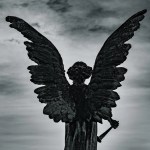
Angel, Cemetery Marseille, Provence, France
(www.flickr.com/photos/x1klima/28040991569 CC BY-ND 2.0)

Dating back to the very beginnings of human civilizations, our primary driver seems to have been the desire to subdue the terrors of that great Angel, the Earth, with its (incomprehensible in their vastness) forests, deserts, mountains, oceans, storms, earthquakes, volcanoes, and wild beasts. As our skills with technology grew, we walled ourselves in, we paved over the ground, we burned or hacked away at forest and jungle, we wantonly destroyed creatures we feared, and worst of all, abandoned our elemental connection to the Earth and its bounties, perceiving ourselves as somehow separate and apart from (and superior to) the myriad living creatures with whom we share the planet.

Our exact trajectory along that path is largely unrecorded and lost. What role did we play in the destruction of many long-extinct species as our species spread across the globe? How many once flourishing habitats did we transform into barren desert? Wreaking environmental havoc is not something new for us – it is a very ancient habit. Our relatively recent recognition of our role in climate change – and the fact that we’ve coined a new name for it – doesn’t change our past. We’ve always done this, even if the full extent of our impact on the planet is far from understood, remaining, perhaps forever, unknowably lost to time. The Anthropocene started a very long time ago.

The connectedness of everything

While our need to tinker with the world without comprehending the consequences and ripple effects of our actions has been in our DNA from the start, the speed of those ripples has grown exponentially in the past century, exacerbated by vast increases in our numbers and our technological capabilities. It was only recently that I learned about the disappearance of the Aral Sea, one of all too many examples of overly confident people setting out, perhaps with good intent, to change one thing, without having a clue as to the consequences. The connectedness of everything was understood, to some extent, by at least a minority of people since the beginning of time, but lost time and again. And occasionally rediscovered.

While his books may now collect dust in libraries, Alexander von Humboldt discovered it for himself in the late 18th century, writing that “in this great chain of causes and effects, no single fact can be considered in isolation,” becoming perhaps the first explorer with a modern scientific outlook to acknowledge and document human-induced climate change. Those who tinkered with the Aral Sea would, one wants to hope, have thought better of their plans if they had read some of Humboldt’s books describing the impacts of deforestation he witnessed during his journey through South America. But, perhaps not, especially if profit is the driving motivation.

As I write this, struggling to frame out my thoughts, trying to piece together into a coherent whole the bits and pieces I’ve picked up without any organized study over the years, I always wind up face to face with the reality that, as bleak as our prospects may look from today’s vantage point, I am entirely powerless to do anything about it. For sure, all of this was beyond my ken as I was growing up. The inventions of our age all seemed so exciting and the future so filled with promise. Looking back, the repercussions of our actions seem evident, but then, we are all far more ignorant and stupid than we ever think we are. But, one fact stands out – the planet and the life on it is all one interconnected web and we tug and pull or tear any strand of it at our peril.

“Endangered World: Life Wall” by Xavier Cortada (CC BY 2.0)

Music for the Earth

Which brings me around to where I started. Whatever my feelings and thoughts are about this subject don’t really matter much. I can do little or nothing about it. But I am a composer – and while notes and ideas have little intrinsic connection, my feelings about climate change and the bleak future we’re careening towards at an ever more rapid pace do have a way of turning into music. We humans have always told ourselves stories to explain what we don’t understand or can’t control – and, guilty as charged, I tell myself stories for the same reasons.

I started a Music for the Earth series a few years ago, with the idea that perhaps, through music, I could have some small influence on any who heard it. Putting small black dots on paper that transform into vibrations in the air might serve to evoke in others a feeling of connection with the natural world and of our obligation to be caretakers, rather than destroyers, of the life that everywhere surrounds us. A story I tell myself…

Over the past several years, the series has grown – and more recently, I’ve started to get the music recorded. And I’ve created videos, either on my own or in collaboration with others, with music from Music for the Earth. These include Canciones de la Tierra, settings for mezzo soprano and viola of seven bucolic poems by Federico Garcia Lorca about the Andalusian landscapes that so inspired him. I find myself repeatedly drawn to Lorca’s poetry in connection with my thoughts about climate change and, more particularly, with my conviction that a corollary to our disconnectedness from the natural world is the ease with which we accept environmental catastrophe and human-caused mass extinctions without feeling a deep sense of shame and loss.

Lorca’s poetic and passionate essay The Theory and Play of Duende often comes to my mind when composing music. “The duende … Where is the duende? Through the empty archway a wind of the spirit enters, blowing insistently over the heads of the dead, in search of new landscapes and unknown accents: a wind with the odour of a child’s saliva, crushed grass, and medusa’s veil, announcing the endless baptism of freshly created things.”

We cannot really feel unless we are elementally connected to the life of the Earth. And, the corollary to this is that we will be unable to change our relationship with the Earth and all of the life on it unless we understand and feel duende. For Lorca, the spirit of duende was to be found in the Andalusian countryside, and so I turned to his poems of Andalusia for Canciones de la Tierra.

“Remember, you are this universe…”

Remember is a video collaboration with dancer/choreographer Mariko Endo (previously showcased on ClimateCultures) with music for viola and piano, intermezzi with themes inspired by poems of the Earth. The music in this video comes from the fifth and final intermezzo in my composition Remember – which is based on a song from my The Whirr of Wings composition – to a poem of the same title by poet laureate Joy Harjo: “Remember, you are this universe and this universe is you.”

Sea & Sky, for two violas, is a collaboration with violist Brett Deubner, the music inspired by and composed on walks along Cape Cod bay.

And, for the future, time and resource availability permitting, will be recordings of Gaia’s Lament for violin & orchestra, Gaia’s Song for piano and orchestra, Ode to Thea and Sulla Natura for string quartet, The Whirr of Wings for chorus, flute, viola and cello, and A Single Thorn for soprano, French horns and string orchestra, setting poems by Canadian poet Meg Freer.

Best wishes for a greener planet. 

And for any reading this, musicians or not, if curious about the Music for the Earth project, do browse through my website and, even better, if any others active in ClimateCultures want to collaborate on a project, please reach out. We can tell that story together.


Find out more

You can explore more of Stanley’s Music for the Earth and other projects at his site and his YouTube channel, and two of his works have featured in the ClimateCultures Creative Showcase: Remember, mentioned above, and Ahimsa.

You can find out more about Prussian naturalist, explorer, and geographer Alexander von Humboldt (1769–1859) in this piece by Maria Popova at The Marginalian, Alexander von Humboldt and the Invention of Nature: How One of the Last True Polymaths Pioneered the Cosmos of Connections – a review of the book The Invention of Nature by Andrea Wulf.

And you can read about the disappearance of the Aral Sea in this 2021 piece on The Meaning of Water site, The Aral Sea — More Than a Lake Is Disappearing…

To explore the poems that Stanley has quoted from and which have inspired his work, visit:

The image “Endangered World: Life Wall” shows the work created by artist Xavier Cortada. “Cortada created “Endangered World: Life Wall” using 360 red bricks along with stones deposited in the Netherlands by glacial forces during the last ice age. The work is a 2.1m x 8.5m wall created near the nation’s largest neolithic gravesite at the Hunebed Center in Borger. The 360 bricks represent 360 animals struggling for survival across 360 degrees. On each brick, Cortada painted the longitude where each animal lives. When a species dies out, the number is painted black. The animals are part of an interconnected web that includes humans. How many bricks can be removed before the wall of life comes tumbling down?” You can explore Cortada’s work at cortada.com.

Stanley Grill

Stanley Grill

A composer of music that attempts to translate something about the nature of the physical world or promote world peace, sparking positive thoughts and inspiring change.

Deconstructing our Dominion Stories in a Time of Unravelling

Photographer and writer Joan Sullivan reviews a pair of books – non-fiction, fiction – that embrace the unknown, helping us navigate our collective uncertainty and explore what it means to be human in a time of Anthropocene unravelling.


2,460 words: estimated reading time = 10 minutes


And so, on a most inauspicious date — 24th June 2022 — the day when millions of women lost control of their own bodies, I sit down to write my first book review ever. I stare blankly at the screen; come back tomorrow, it tells me. But the numbness would continue for several more days, as the US “supreme” court went on a week-long rampage, bludgeoning Indigenous sovereignty and our fundamental rights to a livable planet.

I am thinking of Ursula Le Guin. Four years before her death in 2018, she said “I think hard times are coming, when we will be wanting the voices of writers who can see alternatives to how we live now and can see through our fear-stricken society… We will need writers who can remember freedom. Poets, visionaries – the realists of a larger reality.”

Unravelling: showing one of Joan Sullivan's photos in the series "Becoming River", 2021
Joan Sullivan: Untitled, from the series ‘Becoming River’ © 2021
“An abstract photo from the ongoing series ‘Becoming River’ that explores, in a phenomenological way, my eco-anxiety about the rapidly disappearing ice on the Saint Lawrence River in eastern Quebec, Canada.”

This is a review of two very different books by two very different writers, both of whom are currently co-directors of the Dark Mountain Project. Charlotte Du Cann has pulled together some of her finest essays into one volume; Nick Hunt presents his début collection of short fiction. A daunting challenge for my first attempt at writing a book review. But nothing as daunting as learning how to embrace the humility of the unknown, which for me is the luminous thread that connects these two important works.

Both writers explore the existential question of what it means to be human in a time of unravelling. Both writers propose transformative journeys in time and space that, if we remain open, have the potential to radically shift our perception of this living, breathing planet and — most essentially — our shared space within it.

Finding transformation in the underworld

“I am not sure I can take you there with words,” writes Du Cann towards the end of her book. “I can show you the stones. I can dance. Everything else you walk yourself.”

In After Ithaca: Journeys in Deep Time, Du Cann peels back the layers – in characteristically non-chronological order — of her decades-long descent to re-entangle herself with a sentient Earth. She reveals the doubts, the joys, the humility, the rapture, the patience, and the dogged discipline required to un-civilize oneself in our fossil-fueled, frequent-flyer, fast-fashion societies. It is “a grinding process in which you lose or die to your tough conditioned husk and discover the germ within.”

‘After Ithaca’ – cover art: ‘On the Edge of This Immensity’, Meryl McMaster © 2022 merylmcmaster.com/

The faint of heart need not apply. “The rebirth we seek does not happen without our descent… Venus, the embodiment of love, beauty and a fair fight, steps into the arena to bring new life. She doesn’t do that by chanting a new mantra or changing her shopping habits, she does that by grabbing you by the throat and pulling you towards everything you have so far refused to see or hear.”

Boom! This is Du Cann at her very best, a moment of dazzling clarity: she hands us the mirror, asking the hard questions, shaking us out of our collective sleepwalk. To guide those of us who have not yet begun the “hard, hard task” of relinquishing the “self-obsessed material life we grasp and cling to,” Du Cann shares examples from her own non-linear passage of transformation through the prism of Psyche’s four initiation tasks – assigned by the goddess Venus, the jealous mother of Psyche’s divine lover, Eros. To earn back the love of the “winged boy she has lost”, the mortal Psyche must undergo radical change by embarking upon a perilous journey to the Underworld, without a script or roadmap or even a guarantee that she will ever find her way back. But she does, in spades, thanks to the unexpected help she receives from — and this is key — the most unassuming of allies: an army of ants, some river reeds, an eagle. As Du Cann explains, pivotal transformation can only take place in the Underworld “because change needs to happen at a deep inner level to make any kind of effective change on the outside.”

One of my many ‘Aha!’ moments reading Du Cann’s After Ithaca came from this passage: “Change is not something you tell governments or other people to do; you have to undergo change [yourself] to make space for the world to enter.” She expounds:

We wield great terms above our heads like axes – social justice, transformation, shift of consciousness, power of community – ready to split enemy heads apart with their force… but we are still asleep, reacting, neglecting… we lament deforestation whilst sitting on teak chairs…

As a species we appear to be as stupid, cruel and greedy as ever. Our technology has evolved but we are less vigorous, less alive, more timid, more pursued by ghosts and the trauma of history through generations, at a standstill where we feel responsible for everything and nothing at all;

Nothing transforms if we are the same people inside… if we haven’t found a way to dismantle the belief systems that keep us trapped in the cycles of history. If we haven’t dealt with our insatiable desire for power and attention…

We need a rigorous practice that will break us open. A shock that will push us in another direction.

Rebirth.

After Ithaca humbly suggests a path forward. This brutally honest book is all about transformation and resurrection: undergoing collective change; “reforging ourselves” in alchemical spaces of conversation and gathering; making ourselves more vulnerable by honouring the great mystery. It’s time to deconstruct the dominion stories we’ve inherited — and embraced — throughout the millennia about the self-anointed privileges of one species among many. The arrogance of naming itself ‘wise’! It’s time to question the bright shiny lie that sapiens alone can bend nature to its will without consequences.

Unravelling: showing one of Joan Sullivan's photos in the series "Becoming River", 2022
Joan Sullivan: Untitled, from the series ‘Becoming River’ © 2022
“Temperature anomaly: an historically hot month of May followed by an historically cold month of June caused havoc for farmers in this rural region of Quebec along the banks of the Saint Lawrence River.”

We are standing at the threshold between what was and what’s next, between despair and hope. Deep in our bones, we acknowledge that we’ve painted ourselves into a corner, and there is only one way out: transform, or die. Our task: to develop a collective consciousness to enmesh ourselves, once again, with our more-than-human kin.

Facing the unravelling

Nick Hunt’s collection of short fiction, Loss Soup and Other Stories, explores the same themes of time, despair and collective uncertainty as Du Cann’s After Ithaca. But while Du Cann employs a more-or-less traditional narrative arc as we follow her real-life transformational journey, Hunt creates disorienting storyscapes with nebulous beginnings and unfinished endings. We feel seasick, suspended in time somewhere between 16th century Mexico and a dystopic future that appears, disconcertingly, to have already arrived.

Loss Soup – cover art: ‘Herd (not seen)’, detail. Daro Montag © 2022

Each of the 14 stories in this slender volume explores what it means to bear witness to collapse. Hunt’s characters are fragile, vulnerable, unsure of which way to turn or whom to believe. There is very little dialogue between them, a reflection of social unravelling.

Loss Soup is not just about loss, but unimaginable loss: of memory, of words, of identity, of places saturated with meaning. Of species, both real and mythic. One nameless character chooses to lose himself in the middle of a vast ocean, drifting aimlessly in a plastic vortex: “He came here to go nowhere.” In the not-too-distant future, both he and his yacht will be subsumed by the great Pacific garbage patch, “a convenient vanishing zone for lost, unwanted things.” His well-stocked coffers of wine, crisps and Cadbury will not last forever.

Welcome to the Anthropocene. Nick Hunt’s fiction brings us as close as we can possibly get — viscerally, phenomenologically — to grasping the ambiguity of this liminal moment, in ways that non-fiction never could. “I try to think of what I’ve forgotten, but there’s no way to catch hold of it. Just a feeling of unease, somewhere between guilt and loss, that contracts and expands when I breathe, pushing up against me.”

Several of these stories left me feeling squeamish. I squirmed in my chair, looking around for an easy way out. But Hunt holds us skillfully in these uncomfortable landscapes, coaxing us to linger a bit longer with the ambivalence. Our instinct is to flee, to return to the soma of our Instagram-perfect world. But something deep inside has already shifted: we choose to stay, to face the unravelling. Such is the power of fiction, to reveal the cracks in the veneer, the hidden spaces with multiple layers of meaning. This is the well from which we must draw.

Finding paths through collective uncertainty 

Loss Soup reminds us that there have always been and will always be periods of radical uncertainty and impermanence. “Time does not flow in a straight line but turns inside repeating wheels, so that everything that has happened is still happening. Nothing has ever stopped. It never will.” If sapiens are as wise as we think we are, we will turn to the past for clues about navigating crisis, dysfunction, collapse. When seen through the lens of liminality, these recurring cataclysmic periods can be interpreted, in retrospect, as transformative: everything that gets swept up in the chaos will be transported and changed. Sometimes for the better, sometimes not.

The dawn of the Anthropocene is yet another liminal moment, a bridge between two possible worlds, two ways of being. Destination unknown. While the outcome indeed looks bleak, it has yet to be written. “We will be wanting the voices of writers,” prophesized Le Guin, “who can see alternatives to how we live now and can see through our fear-stricken society.” The voices of writers Nick Hunt and Charlotte Du Cann bring much-needed clarity and insight to this existential moment.

If sapiens manages to save itself – along with millions of other species with whom we share this blue planet – it will be because of a profound shift in collective consciousness, not scientific facts or statistics. We could start by shifting our thinking about the Anthropocene as an opportunity to expand our ideas of what is possible, to embody it as an unquenchable thirst to break free from the chains of fossilized ways of thinking.

Unravelling: showing one of Joan Sullivan's photos in the series "Becoming River", 2022
Joan Sullivan: Untitled, from the series “Becoming River” © 2021
“An abstract photo from the ongoing series ‘Becoming River’ that explores, in a phenomenological way, my eco-anxiety about the rapidly disappearing ice on the Saint Lawrence River in eastern Quebec, Canada.”

Throughout After Ithaca, Du Cann refers frequently to her favorite metaphor: the metamorphosis of the butterfly, which emerges only after the caterpillar has dissolved. Life begins anew out of death and darkness, as it always has and always will. Navigating the apocalypse may feel like the end of the world. But the dark is where everything is born.


Find more

After Ithaca: Journeys in Deep Time, by Charlotte Du Cann (2022) and Loss Soup and Other Stories, by Nick Hunt (2022) are both published by Greenbank Books, an imprint of Sumeru, and are available from the Dark Mountain shop.

The Dark Mountain Project is many things and has taken many forms, including the original manifesto written amidst the global financial catastrophe of 2008 and the ongoing ecological crisis. “Faced with this unravelling, the manifesto calls us to question the stories our societies like to tell about the world and our place within it: the myth of progress, the myth of human separation from nature, the myth of civilisation. And it claims a particular role for storytellers and culturemakers in a time when the stories we live by have become untenable.”

Charlotte Du Cann and Nick Hunt are co-directors of the Dark Mountain Project. After working as a journalist, Charlotte spent a decade travelling, mostly in the Americas, before settling in Suffolk to write a series of books about mythos and reconnecting with the Earth, starting with 52 Flowers That Shook My World. Nick’s books include Walking the Woods and the Water, Where the Wild Winds Are, The Parakeeting of London: An Adventure in Gonzo Ornithology, and Outlandish. You can see Charlotte and Nick discuss the role of writing in times of unravelling and loss in this May 2022 Earth Talk event (in it, Nick describes the process that artist Daro Montag used to make the sculptures shown in the cover of Loss Soup). You can read excerpts from Where the Wild Winds Are in a series of Nick’s posts here at ClimateCultures.

The three photographs of Joan’s we’ve used in this post are from her series ‘Becoming River’. Joan explains that “all images in this series were created ‘in-camera’ using ICM (Intentional Camera Movement), with minor adjustments to contrast and clarity in Lightroom. No images were manipulated in Photoshop.” Of the middle photograph, on temperature anomaly, Joan adds: “I use ICM to express my eco-anxiety about our collective indifference to the climate crisis.”

You can learn about Joan’s life and work in photography on the climate crisis and energy transition in The liminal space between what was and what’s next (January 2022), episode 96 in the Conscient podcast series from Claude Schryer. And she writes regular posts for the Artists & Climate Change blog.

Watch Ursula Le Guin’s short acceptance speech when she received the National Book Foundation’s Medal for Distinguished Contribution to American Letters at the 65th National Book Awards on November 19, 2014.

Read Australian climate scientist Joëlle Gergis on ecological loss from climate breakdown in The great unravelling: ‘I never thought I’d live to see the horror of planetary collapse’. In this wide-ranging article for The Guardian (14/1//20), she says: “As we live through this growing instability, it’s becoming harder to maintain a sense of professional detachment from the work that I do. Given that humanity is facing an existential threat of planetary proportions, surely it is rational to react with despair, anger, grief and frustration. To fail to emotionally respond to a level of destruction that will be felt throughout the ages feels like sociopathic disregard for all life on Earth. … Perhaps part of the answer lies in TS Eliot’s observation that ‘humankind cannot bear very much reality’. To shy away from difficult emotions is a very natural part of the human condition. We are afraid to have the tough conversations that connect us with the darker shades of human emotion.”

Joan Sullivan

Joan Sullivan

A photographer, writer and farmer who focuses on climate change and whose abstract, phenomenological approach to photography expresses her ecoanxiety and gives voice to the nonhuman.