Cockroach Cabaret — Learning to Make Friends With Arthropods

Composer and performer Camilla Cancantata considers the nonhuman voice in Cockroach Cabaret. Scrutinising human actions, her alter ego questions the role of humanity on planet Earth, asking if we can pull ourselves back from the brink of apocalypse.


1,570 words: estimated reading time = 6 minutes


The Cockroach is an alter ego that I developed years ago, after writing a song called the Complaint of the Cockroach as part of my Songs for Interesting Times collection.

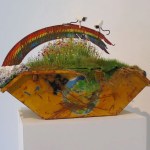
Cockroach Cabaret. Showing a photograph of Camilla Cancantata © 2006
Cockroach Cabaret. Photograph: Camilla Cancantata © 2006

The Cockroach is uncertain about the role of humanity on planet Earth, and frankly astonished by our behaviour. Why are we so hell-bent on our own and other species’ destruction? Why do we despise, torture and eat some animals and keep others as pets, the eating of whom is generally considered shocking? Why do we seemingly consider ourselves superior, despite our very recent arrival on Earth?

It seemed to me that a creature that emerged in the Carboniferous era,  survived several ice ages and outlived the dinosaurs, that is still thriving and diversifying, should be treated with respect. The Cockroach points out the relatively recent arrival of vertebrates, and even more recent arrival of primates, and how modern humans have essentially been here for the blink of an eye.

Alas, our jumped-up species totally fails to view creatures from a more ancient lineage than ours with any kind of evolutionary perspective. 90% of animals on Earth are arthropods — animals (including all insects) that manage perfectly well without an internal skeleton. They also form half of the biomass of all animals on Earth — whereas humans have the smallest biomass — 0.01% — even less than viruses! And a tragic statistic that the Cockroach thinks all humans should know: only 4% of mammals now on Earth are truly wild, and less than 6,000 tigers live in the wild.

Cockroach cabaret — solidarity with the more-than-human

Most cockroaches live in woods and forests in warm climates. Only a few can live around humans — and be hated for it. They are deemed pests — they upset our routine, eat our left-over food, some of them carry diseases. But they got on quite happily with life before we turned up. Cockroaches, like certain flies — also often hated by humans — compost and recycle, keeping the planet free of waste.

Showing BatCave Cockroach, photograph by Ltshears
BatCave Cockroach. Photograph: Ltshears (2005), shared under the Creative Commons Attribution-Share Alike 3.0 Unported license. https://commons.wikimedia.org/wiki/File:BatCave_Cockroach_0123.jpg

So did humans, for a while — and most indigenous tribal peoples still do, living gracefully, taking only what they need to survive, and co-operating with the non-human world. The Baka people of Africa, for example,  build beautiful housing out of leaves and branches, which will merge back into the landscape when they move on.

In the ‘developed’ world — whatever that means — colonialism and industrialisation have created vast amounts of increasingly toxic waste that, in the 21st century, has now become virtually impossible to break down. We gaze in confusion at coloured plastic boxes and wonder if that old toothbrush can be recycled?

To restore some balance and perspective, I founded the Arthropod Friendship Association, only partly in jest. You are invited to join, the requirements being that you agree with and try to adhere to, or at least respect, the constitution:

The Arthropod Friendship Association

Constitution

Aims and objectives

To break down the barriers to understanding between arthropods and vertebrates and create new relationships. This includes examining and reducing both irrational and justifiable vertebrate fears of e.g. being poisoned, infected with life-threatening diseases or losing food supplies.

Explore differences between approaching the world with an exoskeleton or internal bone skeletal structure.

Educate in order to reduce current inequalities, where a few powerful vertebrates control the lives of millions of arthropods.

Acknowledge that most arthropods have been on the earth for many millions of years longer than vertebrates. They deserve respect.

But respect is in short supply for cockroaches. Google ‘cockroaches’ and you will be taken to endless sites of extermination. And that terrible question — “What are cockroaches/wasps/spiders etc for??”

To which the only sensible retort is “What are humans for??”

Once I started on the path of cockroach solidarity, I discovered others had been there before me — Don Marquis, the author of archy and mehitabel, and Marion Copeland, who wrote Cockroach, a poetic and thoughtful book that made me decide I too am an eco-feminist. There are many others, some of whom feature in Copeland’s book.

Archy and Mehitabel — cross-species comrades

In archy and mehitabel, Archy lives in a newspaper office, back in the early 20th century, and comes out at night to use the typewriter, calling himself a ‘vers libre poet’ trapped in a cockroach body. The human daytime workers make sure there is always a fresh sheet of paper for him to write his stream of consciousness poetry: he needs all his weight to put down a key, and so cannot use capitals or punctuation. Mehitabel is a disreputable and wonderful female alley cat who is a reincarnation of Cleopatra, or believes she is. The two creatures of the night have a slightly uneasy relationship but are comrades in adversity.

“Damned be this transmigration,” writes Archy — “I with the brain of a milton fell into the mincemeat at christmas and was damned near baked in a pie”…

Mehitabel, after hanging out with suburban middle-class cats — “fat slick tabbies” — says — “none of that for me give me the alley archy me for the mews and the roofs of the city and the occasional fish head and liberty is all I ask freedom and the garbage can”…

Cockroach (Animal) by Marion Copeland (2003) – cover.

Marion Copeland’s book explores both entomology and history, and also takes a look at the culture surrounding cockroaches, including a plethora of poetry, stories and children’s stories, all sticking up for the humble and despised creatures of the world. She notes how small children are generally fans of cockroaches and other so-called bugs, and only later learn — presumably from adults —  to hate them. She quotes Janelle Cannon, author of a children’s book, Crickwing, about a golden rainforest cockroach, who says: “considering how long these well-designed bugs have survived…it is easy to see that we humans invaded the cockroaches’ pantry long before the cockroach entered ours!”

Absolutely. We humans invaded everyone’s pantry, not only invaded, but laid waste to it. Our endless wars devastate lands and landscapes and their non-human inhabitants, animal and plant. We even destroy the means of our own sustenance: irreplaceable seed banks in Palestine, Sudan, Ukraine and Afghanistan have been destroyed by war and wanton looting. Corporations and industrialised agriculture kill off entire ecosystems, poisoning land and water. The heating of the Earth caused by our reckless use of fossil fuels is having impacts that will reach far into the future.

The Cockroach is clear: too many humans are taking up too much space with too much stuff. Yet we do not even look after our own kind. We tolerate inequality with ease and cannot control the violence and wanton destructiveness of our own species: we need to respect and learn from the ancient heroes of evolution who have survived so much. With the help of their wisdom, we may still be able to pull ourselves back from the brink of apocalypse.

You despise us, criticise us, try to paralyse us
Call us vermin, want to wipe us out
You say there’s too many of us but we’d like to know
Which one of us will be the first to go?


Camilla adds that, “although health issues meant that the Cockroach Cabaret couldn’t go on tour this year, next year looks hopeful. Expect music, songs and spoken word, in a thought-provoking performance with plenty of humour and some salient facts. No live cockroaches are exploited for this show. Contact me on camilla@littleweed-music.org if you’re interested in the Cockroach Cabaret — and find out more at The Cockroach 2026, looking for friendly spaces.

You can listen to Camilla’s song ‘Complaint of the Cockroach’ and her Songs for Interesting Times album on Bandcamp.

archy and mehitabel, by Don Marquis, was first published in 1927 and is published by Penguin (1987).

Cockroach (Animal), by Marion Copeland, is published by Reaktion Books (2003).

***

From 2026, ClimateCultures is inviting members to say something about how they use AI in their work and in their posts for us. We will be exploring this in future posts here and at our ClimateCultures & more Substack.

Camilla – “In my favourite line of work/play — which is live performance — I find no use for AI. I got taken to Gifford’s circus this year — a family outing on a very hot day. It’s commercial theatre that relies on ticket sales, and not cheap, but it was great to see circus again and experience the high energy of it all (I have run away to the circus a few times).  Acrobatics and balancing acts, live music, cues — all rely on trust. As does theatre, even without acrobatics. I don’t think I could ever trust AI. I have used it occasionally as an editing tool but am not interested in its creative possibilities. I’m not in the film industry or a commercial field of music threatened by AI — that I  leave to others. The military aspects of AI are of course terrifying, but until we humans have taken the Cockroach’s advice, it looks as if we’re going to carry on with war and violence. All we as artists can do is use our creativity to try to move things in a different direction with whatever tools we feel comfortable using.”

Camilla Cancantata
Camilla Cancantata
A composer, improviser and performer, currently working on Dancing Dark Matter and Food! a family-friendly musical on the growing resistance to the corporate takeover of food.

Dark in Nature – Out of Sight, Out of Mind?

Eco-artist and designer Ife Abhulimen‘s sculpture, Dark in Nature, explores persistence by holding an object in place long enough to be noticed. Emerging from the space between appearance and disappearance, it questions our notions of ‘waste’ and ‘away’.


960 words: estimated reading time = approximately 4 minutes


Often times, the moment something becomes ‘waste,’ it also becomes easy to forget.

And then, once it leaves our hands, we move on. We carry on with our day as usual and rarely stop to wonder where it ends up.

Every year, we discard hundreds of millions of tons of plastic. Most of it slips quietly out of view into landfills, oceans, into places we don’t have to look at. And once it’s gone from sight, it becomes easier to believe it’s gone altogether.

Out of sight, out of mind.

But some things don’t often follow that saying.

What we choose not to see

Most of what we throw away is designed to leave us quickly. A bottle is used for minutes. Packaging is torn open and discarded without a second thought. These objects pass through our hands so briefly; it almost feels like they were never really there to begin with.

And yet, they remain, just not where we can see them. That absence creates a kind of comfort. If it’s no longer in front of us, it no longer belongs to us. It becomes someone else’s problem. Somewhere else’s reality.

But that distance is thin. Almost imaginary.

It didn’t start as art

Dark in Nature, one of the pieces from my recent solo exhibition, Delicate Resilience, began in that space between presence and disappearance. It is made from reclaimed plastic bottles, wire, textile scraps. Materials that were once held, used, and then set aside. Things that had already reached what we might call their end but in my mind still had potential to become a conversation piece. At the centre, a darkened organic-looking structure holds fragments within it, bits of colour and texture held in another bottle that feel like remnants of something that hasn’t fully let go. Around it, the forms extend outward. Bottles bend and stretch, no longer functioning as they once did, but not erased either.

They linger, outliving us by generations.

Dark Nature: Showing: 'Dark in Nature', by Ife Abhulimen, 2026: Plastic bottles, garden wire, textile scraps.
‘Dark in Nature’ (Ife Abhulimen, 2026). Plastic bottles, garden wire, textile scraps. Photograph: Ife Abhulimen

Something is still happening

There’s a sense of movement in this piece of work. The wire reaches outward, almost searching, almost restless. The forms resist stillness. They push past the boundaries that try to contain them.

And then, unexpectedly, there are the yellow elements. They resemble flowers; small, delicate, almost hopeful. For a moment, they suggest something familiar. Something natural. Something alive.

But they are not what they seem.

They are constructed, like everything else in this piece. Placed there, not grown there. These ‘flowers’ hint at nature’s persistence, its quiet way of pushing against human interference, always trying to find a way to thrive.

The illusion of growth

That’s where the tension sits. Dark in Nature holds that contradiction quietly. It looks like growth, but it isn’t the kind we understand. These materials do not return to the earth. They do not follow the cycles we associate with life.

They stay, they break, they shift, they scatter but they remain part of the world, whether we see them or not.

So what we are looking at isn’t growth in the traditional sense. It’s persistence taking on the shape of something we recognise.

Showing 'Dark in Nature' (Ife Abhulimen, 2026). Plastic bottles, garden wire, textile scraps. Photograph: Ife Abhulimen
‘Dark in Nature’ (Ife Abhulimen, 2026). Plastic bottles, garden wire, textile scraps. Photograph: Ife Abhulimen

What happens after we look away?

When we throw something away, we rarely imagine its future. We don’t picture where it settles. How long it stays. What it becomes over time. But that doesn’t mean it disappears. It simply moves beyond the edges of our attention. This piece brings it back from that distance. It gathers what was scattered. It places it in front of us again, not as it was, but as something we can’t ignore quite as easily.

Not gone, just repositioned

Nothing here is new.

Every part of it has existed before, used differently, for an original purpose. All that has changed is the context. The way it is seen after some artistic manipulation. The fact that it is being looked at again. And maybe that’s enough to unsettle something. Because if these materials were never truly gone, just relocated, reshaped, reassembled, then the idea of ‘away’ starts to feel uncertain.

Dark in Nature – a small shift

This work doesn’t offer answers.

It doesn’t tell you what to do or how to respond.

It simply holds something in place long enough for it to be noticed.

And sometimes, that’s where change begins, not in immediate action, but first in awareness.

Because once you begin to notice what doesn’t disappear, it becomes harder to believe in the idea of ‘away’. And maybe ‘out of sight, out of mind’ was never the full story.

Maybe it’s just the part we chose to accept.

Showing 'Dark in Nature' (Ife Abhulimen, 2026). Plastic bottles, garden wire, textile scraps. Photograph: Ife Abhulimen
‘Dark in Nature’ (Ife Abhulimen, 2026). Plastic bottles, garden wire, textile scraps. Photograph: Ife Abhulimen

Find more

You can find more on the recent exhibition of Ife’s work, which included Dark in Nature, in our Creative Showcase piece, Delicate Resilience: Where Nature Refuses to Give Up.

Elsewhere on our blog, in Starting to See Waste as Art and Heritage, curator Veronica Sekules introduces her special essay for our Longer feature, using an exhibition at GroundWork Gallery to explore artists’ roles in helping change how we value what we discard.

***

From 2026, ClimateCultures is inviting members to say a sentence or two about how they use AI in their work and in their posts for us. We will be exploring this in future posts here and at our ClimateCultures & more Substack.

Ife – “I use AI to create mockups and nice backgrounds for my art pieces, which has been very helpful especially when I want to showcase work in a different setting. In addition, I use AI to do research as it helps me filter all the fluff, in contrast to Google search, and it gives relevant information. I also use it to search for opportunities in the sustainable art space. I try not to use it a lot because I think it’s robbing us of our capacity to think as intelligent humans. For this post, I have used AI to help with grammar corrections.”

Ifeoluwa Abhulimen
Ifeoluwa Abhulimen
A self-taught eco-artist and designer who explores themes of consumption, sustainability, and environmental responsibility, inviting audiences to discover beauty and value in what is often overlooked.

Heritage, Art and Community Collaboration

Artist Julien Masson shares a recent community collaboration with artists, residents and businesses, which uses recycled garden furniture, instruments and miscellaneous timber found locally to create public art that reflects a mix of cultures and transform public spaces.


900 words: estimated reading time = 3.5 minutes


This series of bespoke artworks — a site-specific mural community collaboration, created in partnership with a cafe, a group of artists and local residents — creates a prominent terrace space in Southampton’s city centre. Our design and construction process is rooted in sustainability and inclusivity.

I worked on this as part of a core team, including fellow artist David McDiarmid, and in partnership with Mettricks café, to transform what was a blank canvas. Our aim was to turn a highly visible but rather bland area into a dynamic and creative focal point.

Community collaboration: showing public art using recycled furniture and piano parts with paint, Mettricks cafe, Southampton's cultural quarter
‘Music in the city’: recycled furniture and piano parts with paint, Mettricks cafe, Southampton’s cultural quarter

The murals feature a bold, contemporary design using vibrant cut-out letters and abstract shapes. These aren’t new materials; they are recycled pieces of timber found locally and donated by residents.

We consciously take materials that might have been tossed aside — from broken garden furniture and instruments to miscellaneous timber — and turn them into something special. This encourages everyone to think creatively about waste and promotes recycling.

A collaborative community process

Working on these collaborative projects often starts with initiating a conversation with local businesses and, often facilitated by their staff, we typically send out a call for material donations.

The community’s response is usually incredibly generous: local people donate wood and domestic items that would otherwise be destined for the skip or the bonfire. Our goal is always to keep these materials as local as possible, like a neighbourhood contemporary survey.

Community collaboration - showing artists in action.
Community collaboration – artists in action

The donations we receive are very varied: chairs, an old table, piano keys, shelves, a chimney surround, clocks, barometers, garden fences, and coat hangers, just to name a few. These pieces are not just raw material, they fundamentally dictate the form and character of the final artwork. I see it as a positive challenge to weave as many of these disparate elements into a cohesive whole.

We generally favour solid timber and plywood for durability, and what is interesting is that each donated item brings its own story to the final work. This presents a unique challenge, especially when trying to preserve wood that may have been exposed to the elements or damaged before being painted or varnished. Navigating these imperfections, however, adds a rich layer of authenticity, ensuring the work is genuinely true to the place where it is created.

Essentially, nothing goes to waste. Even the smallest off-cuts are saved and will find their way into future artworks.

Beyond the materials, the community shapes the ideas. I also run public consultation sessions where local residents and business staff offer input and suggestions. While it’s rarely possible to include every idea, I genuinely love the notion of people discovering their own small suggestions or personal memories hidden inside the finished piece, like a secret message hidden in the work.

The collaborative process is, of course, a mixed bag of challenges, with the back-and-forth dialogue of working with others being as challenging as it is rewarding. That said, I believe this partnership approach forces everyone involved to maintain a generous and open-minded stance, encouraging a less controlled, more spontaneous way of working. It’s a wonderful way to keep the individual ego in check and the creativity flowing.

Community spirit & public art

‘Bigging up Southampton’: upcycled timber and paint, Southampton’s Guildhall Square.

The bright colour palette is a direct reflection of the rich mix of cultures in the neighbourhood, while the design subtly integrates local heritage elements. Making the artwork accessible is important to us. Each piece is modular and tactile, incorporating varied textures and depth. This ensures the piece is readable by touch, a feature supported by a team member who organises touch tours for the partially sighted.

The artwork turns an otherwise bland space into an eye-catching feature that offers interest both at a distance and up close.

‘Land Ahoy’, upcycled timber, furniture and paint. Southampton Forward commission in collaboration with the Community of RedBridge and the Ship Inn.

Like our previous public pieces, this mural is modular and easy to repair, ensuring its longevity. We hope to continue this organic growth by adding more layers in the coming months, allowing the artwork to develop its own unique identity. Our team, primarily composed of dedicated members from The Keepers Artists Collective, alongside supportive local businesses, proves that with a little investment and community spirit, ambitious public art is entirely achievable.

We look forward to bringing similar work — giving locals something they can truly be proud of — to more neighbourhoods across the city.


Find more

The Keepers Artist Collective is a non-profit group of artists based in the city of Southampton, Hampshire, including Julien Masson and David McDiarmid. The 8 artists come from different backgrounds and disciplines, and share an interest in creating art, community-based art projects, and supporting other artist networks.

Julien’s previous posts for ClimateCultures include The Call of the Forest, which describes a residency in the New Forest, an environment that juxtaposes natural and human worlds, and Julien’s choice there of a physical paint medium to represent the digital realm that often distances us from the natural.

Julien Masson
Julien Masson
An artist whose works are all, in some way, related to technology and our relation with it and wishes to expand notions of what is art.

Starting to See Waste as Art and Heritage

Curator and writer Veronica Sekules introduces her special essay for our Longer feature, using GroundWork Gallery’s recent exhibition to explore artists’ roles in helping change how we value what we discard, viewing our waste as art and heritage.


1,570 words: estimate reading time = 6 minutes


Longer is the place for works that don’t fit within the normal ‘short reads’ format of our blog. Longer is for essays, fiction or other forms that haven’t appeared online elsewhere and explore in more detail the creative responses to our ecological and climate crisis. With each new Longer piece, the author introduces it here with an original post, where they can reflect on the motivation or inspiration behind the work or the process of creating it.

***

In my essay, The Art and Heritage of Waste, I hope to counter the prevailing culture of extractivism by looking at how mobilising the creativity of artists can help us to rehabilitate waste as a transformative resource.

From March to July 2023, GroundWork Gallery’s exhibition The Art of Waste] featured the work of eight artists, all of whom were in different ways [bringing creative responses to waste that point to solutions, albeit on a tiny scale.

GroundWork Gallery — which I opened in 2016 — is situated in King’s Lynn, in Norfolk, UK, on the confluence of the River Purfleet with the Great Ouse. It lives in a converted little 1930s warehouse, a building we saved from waste, as the planners and heritage officials at first wanted it demolished “for something more suitable”. The gallery is dedicated to the environment and to the role of art and artists in helping us to rethink aspects of it, and to understand and treat it better, vitally urgent now in our times of crisis. I believe art can carry a powerful message or ‘voice’ to a much wider world than the narrow confines of the conventional art world, if only its audiences respond actively to it and communicate its innovative messages to wider publics, other disciplines and contingent professions. That is how we begin to achieve change — through bursts of inspiration, sudden insights, and above all through widening influence.

Still from Henry/Bragg film, The Surrey Hills: a film about a landfill site incongruously situated in the Surrey Hills. © 2012

Environmentalists hate waste. This is the starting point for all the work I discuss in the essay, as artists hate waste too, and many of them are trying to find creative solutions to the way we think about it and literally view it. However, I’m proposing that we rethink the category of waste to include formally its relationship with art and with heritage, and think about the potential status of waste as both. The re-categorising and the status change involved will play a part in counteracting the extractivism which has contributed so significantly to the effects of climate change.

Artists working with waste for positive impact

Each of the artists in The Art of Waste used waste materials as creative resources, making use of surplus materials, implementing circular economies, being very economical in leaving nothing behind. As well as inventive practical strategies, the artists excelled in changing the status of waste, from that of detritus and ephemera, to be something precious and valued.

Jeremy Butler creates minutely detailed relief-assemblages which involve items that the artist has carefully crammed together to make complex formal architectures that hover somewhere between order and disorder. 

Liz Elton makes large-scale draped fabric-like installations using compostable cornstarch, a material used in food waste recycling bags, which she colours with vegetable dyes made from her own kitchen waste, intercepted on its way to compost.

Caroline Hyde Brown makes work mainly in textile and paper, and is part of a bio-based collaborative group who are recreating textiles from Neolithic legumes, such as grass pea and more recently green manure crops such as Buckwheat and lentils.

Lizzie Kimbley works with woven textiles, natural dyes and basketry techniques, using principles of circular design to consider material sustainably in regard to its whole life cycle. 

Kai Lossgott is a writer, filmmaker, visual and performance artist, and waste in his work has its own agency and is as much a metaphor as a physical phenomenon.

Eugene Macki is a sculptor whose work makes resourceful use of waste materials, often including food, and can be playful in making the most of the multiple meanings that result.

Jan Eric Visser creates sculptures from his inorganic household garbage, experimenting with new forms new materials, consistent with his own saying: ‘Form Follows Garbage’. 

Rain Wu, whose conceptually driven work materialises in different forms and scales, works with waste and perishable materials to instigate discussions around our manifold relationships with nature.

The immediate impact of The Art of Waste was measurable to a degree from the visitor book comments. Responding to the exhibition, many visitors remarked that it was “inspiring, relevant and thought-provoking”. However, it was also “unsettling”, “bringing new perspectives on waste”. Some were moved to more action: “Interesting ideas, we need to reach out to everyone”, “WE NEED TO DO MORE”, “much needed”, “love being eco”, “we waste so much”, “educational and makes us aware of our industry and pollution”, “who knew waste could be so useful – makes you think”, “feels very dystopian”, “compulsory viewing for all politicians and their influencers”. One of the youngest visitors wrote: “Makes you think about waste. Awe inspiring”.

This positive impact was gratifying but just a beginning. It showed to an extent the desire of people to be receptive to new creative ideas and how these can stimulate our societal needs to change. However, beyond the specificity of the timescale and place of the exhibition, there needs to be a whole lot more thinking about how we can mobilise the creativity of artists and these kinds of responses to it. Where does it get us and where can it lead? What does that kind of power enable and what and whom can it both connect with and lead to?

Revaluing waste as heritage

As I explore in the essay, recent thought on waste has proposed various paradigm shifts that involve changes in consumer habits, moving away from a throw-away economy of short-term use and of things ‘becoming useless’, to one of waste as asset creation. Some argue that waste as an entity ought to be entirely avoidable, or even non-existent, providing that materials, foods and resources are used by people with greater economy and efficiency. Within the framework of Discard Studies, the entire concept of waste is open to interrogation from all points of view. In sympathy with that interrogative framework, I suggest that a paradigm shift in the way waste is categorised will help us all to prioritise what and how and why we save the stuff of the earth. Increasingly, students of waste, entrepreneurs repurposing it and artists creating with it are recognising that waste needs to be rehabilitated as a transformative resource, not stuck with the shifting values of random commerce or the vilification applied to detritus.

In setting the framework for further discussion, I hope my essay raises in outline some of the issues in the definition of heritage and of the potential for waste as heritage. It touches on some of the enormous complexities of the subject of waste, such as how and where is waste accumulated and what are the problems of distribution. I touch on the subject of who the various categories of ‘we’ are who are creating the problems. Then, taking a lead from a series of artists’ projects, I take a look at two specific contentious waste subjects in more detail: landfill sites and plastics, and how they might be faced afresh. The ways these subjects have been tackled by artists, writers and archaeologists hold the key to the category shifts we need, from dumps and surpluses to treasure, from waste and trash to art and heritage.

Waste Heritage: showing Jeremy Butler's Landskip 1 at GroundWork Gallery in 2023
Jeremy Butler’s Landskip 1 at GroundWork Gallery © 2023

The innovative ways in which artists are using waste materials can lead the way to a shift in values, potentially turning what is currently a burden into a heritage asset. Categories of definition matter and both art and heritage are relevant. Waste’s role as heritage, specifically, needs to be brought into focus more, in order that we give greater value and the right kind of longevity to all the earth’s material and how we are using it. Shifting values affect attitudes. Applied at scale, that is one way the idea of waste as bulk mess and detritus can end. Instead, if surpluses, leftovers and spent materials are sorted not only by reuse potential, but as categories of art and heritage, this re-categorising can turn a negative into a positive asset and environmental benefits and economic consequences can follow.


Find out more

Veronica’s full essay, The Art and Heritage of Waste, is the third piece in our Longer feature, where members share original works, or ones that haven’t appeared online elsewhere, and which don’t fit easily into the regular ClimateCultures blog; Longer provides space to explore in more detail creative and critical responses to our ecological and climate crisis.

GroundWork Gallery in King’s Lynn, Norfolk, UK, is dedicated to art and environment. It shows the work of contemporary artists who care about how we see the world. Exhibitions and creative programmes explore how art can enable us to respond to the changing environment and imagine how we can shape its future. The Art of Waste ran from 18th March to 15th July 2023.

Veronica Sekules
Veronica Sekules
An art curator, educator and writer with a background in the environmental movement, who has created GroundWork Gallery to showcase art and campaign for the environment.