A Strange Country

Psychotherapist Susan Holliday discovers an intricate world of imaginal possibility (a strange country) in an overlooked detail of a familiar landscape. Turning away from global events for a moment reminds us that change often starts with something small.


2,060 words: estimated reading time = 8 minutes


It is part of the photographer’s job to see more intensely than most people do. He must have and keep in him something of the receptiveness of the child who looks at the world for the first time, or the traveller who enters a strange country.1

– Bill Brandt, photographer (Camera in London)

I wake before dawn to the sound of a robin’s song piercing the morning chill. It takes me less than an hour to dress and make my way to the wrought iron gates which mark the entrance to Richmond Park. A heavy dew rests on the still shadowed grass, seeming almost to hover above it like an overnight spell. All around, the bracken is rusting into its autumn glory. I make my way up a gentle slope through a stand of birch, beech and oak trees to reach the crest of the park. Here the sun has just tipped over the horizon and cast every leaf, blade and branch into fine gold. A huddle of deer nuzzle the grass, making the most of the quiet before the weekend cyclists arrive. I must have walked in this park a thousand times and still it takes my breath away.

The park is always a ‘strange country’ to me, a correlation of ever-changing elements, light, season and subjectivity. At first I just see what I have seen before, but with every step my preconceptions fall to the floor. Unclad, my eyes begin to see beyond recognition. What I’ve come to realise, over many encounters with the park, is that as my perception deepens, it moves from the general and the big, to the particular and the small. On this occasion it shifts from the broadbrush palette of grass, tree and sky, to the particular curve of a branch; the tritone beech leaves rustling their blessings over the waking park; and the oceanic wave structure of ageing bark.

Walking for days at a time, nature writer Nan Shepherd notices how her perception deepens gradually, so:

The eye sees what it didn’t see before, or sees in a new way what it has already seen.
So the ear, the other senses.2

This strikes me as a beautiful description of how we come to see more keenly. The word ‘gradual’ refers to something coming into fullness over time (from Latin gradus, meaning ‘step’). Gradually, we see what we ‘didn’t see before’. We begin to see ‘in a new way’.

So it is only on my way back down the slope, as I re-enter the shadows, that I notice the dazzling spiders’ webs which jewel the bracken. They were there all along. I passed them on my way up. I just didn’t have eyes keen enough to see them. Crouching down now, to take a closer look, I see a lattice of tiny pearls, strung together with impossible intricacy. To me, their beauty stems in part from their near perfection (the essential word here being ‘near’). Each little rectangle of negative space is uneven, each one an incomparable structure, building through repetition into something greater than the sum of its parts. These lines have not been measured or calculated. They have been drawn through countless micro movements of the spider’s body.

A strange country. Showing: Jewelled spider's web. Photograph by Susan Holliday 2025
Jewelled spider’s web. Photograph: Susan Holliday © 2025

A strange country: the  gift of intricate hinterlands

Each web is a ‘strange country’ all by itself. The longer I look, the more I feel drawn into this other world. I imagine any one of these webs would be fine enough to grace a noblewoman’s robes in a Tudor court. I find myself wondering what it might be like to shrink down in size, to place my feet on its little ladders, or to hold one of the pearls in my hand. Children quite naturally see this way. The most unremarkable detail becomes an opening onto an intricate hinterland. Through their imagination and the suspension of preconception, these details become enormous. We have only to think of the rabbit hole in Alice in Wonderland, or the wardrobe in C.S Lewis’ Narnia adventures to remember the power of this portal vision.

And this brings me to the heart of the matter. For as adults we tend to regard the ‘small’ as lesser, as marginal and of little consequence. This has never been more so than at a time when everything is valued according to quantity and scale. The small can so easily be dismissed as a mere trifle, rather than valued as a coherent whole with its own integrity and particularity.

Indigenous peoples, artists, philosophers and mystics have long held a different view, in which every speck of the whole reveals universal patterns and principles. Fourteenth-century mystic, Julian of Norwich, encapsulated the essential paradox of the ‘great little thing’ in one of her revelations:

He showed me a little thing the size of a hazelnut, in the palm of my hand, and it was as round as a ball. I looked at it with my mind’s eye and I thought, ‘What can this be?’

 And the answer came, ‘It is all that is made’.3

Four hundred years later, William Blake encouraged us to “see a world in a grain of sand”.4 Romantic fancy, some might say. In defence of the small, I could stray into the ways in which quantum mechanics and fractal geometry are opening up our contemporary understanding of the complexity and correspondence of micro and macro dimensions of our world; the profound influence of the minute. But I want to stay with my own experience, to say something about why I believe we need to turn our attention away from the titanic battles, the larger-than-life characters, the numbers, trends and averages, and lean towards the small, the slight and the fleeting.

They say ‘the devil is in the detail’, but maybe the sacred is there too. I don’t mean this in any religious sense, but in the context of everyday experience. We live in an age of distraction and consumption fuelled by fear of boredom and emptiness. As a psychotherapist, this word ‘boredom’ has intrigued me for years. It comes up a lot, either in the sense that life has become ‘boring’, or that a person fears they will be perceived as ‘boring’. It seems to me that ‘boring’ is the state we arrive at when we believe there is ‘nothing much to see here’, or perhaps ‘nothing new’. Boring is the ‘same-old-same-old’. It feasts on abstractions and averages, on preconceptions and generalisations.

‘Boring’ signals I have lost faith that within me, or in front of me, there could be more than meets the eye. More to be discovered. More strangeness. Perhaps I believe that I’ve seen all there is to be seen, or I’ve seen it all before. So I stop looking, or I start looking elsewhere. This is a bit like looking down from an airplane window on an outstretched continent, and believing it to be boring, simply because at this height (and at this speed) I can’t see the incomparable particularity, the infinitely varied and ever-changing detail of its topography. At close quarters, what I thought was entirely self-evident reveals itself to be a ‘strange country’, full of surprises and unplumbed depths. 

Showing: Bark detail. Photograph by Susan Holliday, 2025
Bark detail. Photograph: Susan Holliday © 2025

Each of us contains an inner landscape. A place, like the park, we may have visited many times. Perhaps we think we have seen it all. Until one day, if we are really paying attention, we notice a slight shift, a little anomaly, an overlooked detail ‘for the first time’. Virginia Woolf suggests these glimpses are “little daily miracles, illuminations, matches struck unexpectedly in the dark”.5 How often we overlook or dismiss these curious intimations. Un-midwifed by our beholding, the inkling moment is stillborn. Yet the moment we start to notice the details of our experience, life no longer seems so boring, so barren.

Just imagine how this simple practice of attending to little daily miracles could change our relationship to each other and to the whole. When every detail (like the jewelled spider’s web) opens a door onto a world of imagination and possibility, life feels rich and vital. Perhaps then we would no longer need to consume our way out of emptiness.

Finding my niche

We differentiate ourselves through our particularity. It is through paying attention to the subtle qualities and slight nuances of character that we start to appreciate we are not just a number, a statistic or a type. Each of us is one of a kind. There is only one of us in all time.

In his 2021 book, The Journey of Soul Initiation, Bill Plotkin articulates the principle that each of us occupies a distinct ‘ecological niche’:

Soul, for me, is an ecological concept, not a psychological one nor a spiritual or religious one. Specifically, by Soul I mean a person or thing’s unique ecological niche in the Earth community.6

Hauled into the trawler nets of socio-economic grouping, diagnostic typologies, or target markets, it can feel increasingly challenging to distinguish our authentic singularity, the significance of our particular ecological niche.

Could it be that the current polarisation of society into crude groupings of ideology and identity originates in a deep wound, which is the experience of not mattering in our smallness. If everything around me reinforces the narrative that what I imagine, feel, think and long for is of little importance ‘in the grand scheme of things’; if what I choose to do with my life doesn’t really matter ‘in the end’, then I will find my sense of mattering through identifying with something larger. Through this amalgamation, I lose sight of the details which define my singular significance.

The tragedy is that this obscuring of the little things which make me uniquely ‘me’ robs the wider whole of my particular contribution. Collectively, this self-effacement quickens the degeneration of the planet.

If I am to find my unique ecological niche in the Earth community, I will need to give some time to wandering about the inner ‘park’ of my life, until my eye sees what it didn’t see before, or sees in a new way what it has already seen. Sensing my responsibility to my own particularity, I no longer look to ‘kill time’ (with distraction and consumption), but to realise my life ‘through time’ in all its richness and distinction.

Perhaps the Earth can teach us

Absorbed in the intricacy of the little spider’s web, my eye flickers between the lines and the spaces between them, the negative shapes. I start thinking how the whole structure of the web depends on these little spaces. I begin to breathe more deeply, as though taking in this airy structure as a blueprint for my own existence. Like most of us, my life is pretty crammed, packed with activity, crowded with ideas, obligations and intentions. Loaded with stuff. Drawn into the ‘strange country’ of the little web, I begin to sense what it might be like to live a more spacious life.   

It occurs to me then, perhaps the Earth can teach us. Perhaps the small, the slight and the fleeting, in all their intimate beauty and particular significance, can show us other ways of living. To heed this minute and infinite intelligence, we may need to create little gaps in our lives, tiny spaces. Change starts with something very small. A deep breath, perhaps.

Walking on down the slope, I feel a little lighter.


Susan’s references

  1. Bill Brandt, Camera in London (Focal, 1948)
  2. Nan Shepherd, The Living Mountain (Canongate Books, 2011)
  3. Julian of Norwich, Revelations of Divine Love (Penguin Classics, 1998)
  4. William Blake, Auguries of Innocence, A Choice of Blake’s Verse (Faber and Faber, 1970)
  5. Virginia Woolf, To the Lighthouse (The Hogarth Press, 1927)
  6. Bill Plotkin, The Journey of Soul Initiation (New World Library, 2021)

Find more

Susan Holliday is a psychotherapist and photographer and you can find more of her writing at her website.  

Susan’s book Hidden Wonders of the Human Heart was published by Matador in 2021. You can read James Murray-White‘s review for ClimateCultures, Seeing Nature’s Wonders in the Human Heart.

Susan Holliday

Susan Holliday

A psychotherapist and writer committed to the rewilding of human nature, exploring the correlation between despoiling our natural world and the desolation of the human spirit ...

Bullwoman – Dream Portal

Artist-writer Jennifer Leach and ecoscenographer-artist Andrea Carr‘s Earth-arts organisation Outrider Anthems invites us into Bullwoman – a dreaming. Their collaborative Portal Theatre project brings everyday reality into rich contact with deeper worlds, suggesting new myths for our times.


1,600 words: estimated reading time = approximately 6.5 minutes


There is a particular sense of happiness in sharing our latest project, Bullwoman – a Dreaming, on ClimateCultures, as we first met at the 2016 TippingPoint climate change conference Doing Nothing is Not an Option, organised and facilitated by Peter Gingold and Mark Goldthorpe. Many of us who met for the first time at that seminal weekend (TippingPoint’s swansong) have gone on to work richly together. Mark was inspired to create ClimateCultures. 

The challenge laid down at the conference was how creatives might change hearts and minds, to help humanity return to occupying a humble and balanced place within the ecosystem. So grand a remit is beyond our ambitions, but in this theatre piece we hope to offer the dreamt possibility of a more holistic, integrated way forward.

We are not suggesting an easy ending of ‘happy ever after’, but we do believe that something new wants to happen, something deep wants to come out and express itself…

A portal to dream abodes & myth lands

We have been working on this theatre piece since 2017, and are happy to say it is coming now to fruition, although there are still challenges to overcome, funding being a central one.

Here, we tell our story so far in images and words, explaining more about the piece, its structure and storyline, and our thinking behind it and many of our visual ideas. If you prefer to scroll a continuous slideshow, we have an online pdf presentation: please dive in.

We would really appreciate the engagement and feedback of fellow ClimateCultures members and readers, and any support you feel you might be able to give. In particular, we are looking for a producer, fundraiser and venues. We would welcome too the encouragement of anyone who is stirred, and who wishes to help bring this big and beautiful piece to fruition. 

Our introductory gallery (click to enlarge):

The following are a selection of visual images from our research and development process.

Portal: Showing Bullwoman, a painting by Jennifer Leach 2025

Portal: Showing the framework of 'Three Worlds'

Our cast of characters

In the following galleries we give a taster of the characters and the narrative, without attempting to cover every detail of the script and storyline. We start with the Artists in their Studio…

Bullwoman & the Bullpeople

Portal Theatre

The following gallery unfolds elements of our methodology, thinking, and philosophy, and the impetus behind the work.

Portal Theatre

If you wish to know more about Portal Theatre, see our manifesto.

Working towards new myths

In grappling with these questions:

  • We have worked with and used our dreams,
  • We have worked with chance and meaningful synchronicity,
  • We have drawn on contemporary events and issues — both personal and collective,
  • We have engaged our imagination,
  • We have used storytelling and visual theatricality —

to suggest a new myth.

Portal: a process to harness and cultivate unexpected dimonions

We are aiming to create a flexible and tourable theatre production that can travel to various venues, increasing its reach. There will be a community aspect to it.

In accordance with our vision of Portal Theatre, this will be sustainably achieved in a budget-conscious and resource-conscious way, through the innovative use of sound, film, voice, projection, and design.

Your support – people, partnerships, crowdfunding

We are seeking people and partnerships:

  • Performers
  • Venues
  • Production team
  • Fundraisers
  • Funding in the form of grants, sponsorship, patrons
  • Enthusiasts who can give of their time, interest and skills

We welcome all support, interest and enquiries to outrideranthems@gmail.com

It takes a diverse, skilled community to create and produce a work of theatre, especially in these challenging times. If you feel you could support this venture financially, we would greatly appreciate that too. Please visit Bullwoman’s Crowdfunder.

Thank you.


Find more

You can find more of Jennifer and Andrea’s work together at Outrider Anthems, as well solo work via their websites in the profile links below.

And Jennifer and Andrea took part with fellow ClimateCultures members in Conversations with Work That Connects, a series of lively and engaging conversations that Julia Marques recorded with artists and researchers to explore their experiences with wide-ranging topics that inform the creative work ClimateCultures celebrates.

Jennifer Leach in Woodcote Woods
Jennifer Leach
A poet, writer, performer and storyteller whose wild work, forged in the fantastical reaches of deep imagination, brings to life new stories for our strange times.
Andrea Carr
Andrea Carr
A designer and scenographer, and cofounder of Terabac and of EcoStage Pledge, an online initiative to promote sustainability amongst theatre practitioners.

Anthropocene Naturecultures: Where are the Boundaries?

Geographer Martin Mahony introduces our new selection of student contributions to our Museum of the Anthropocene, asking important questions about the meaning of ‘natural’ and ‘cultural’, the politics of drawing boundaries and the relations that cut across them.


1,770 words: estimated reading time = 7 minutes


It’s a great pleasure to open the loading dock again and install six more exhibits in our online Museum of the Anthropocene. These have been selected from the 30 or so which formed part of this year’s pop-up museum at UEA, as part of our ‘Human Geography in the Anthropocene’ module. 

This year we had many excellent submissions which dealt with the relations between human and nonhuman beings, perhaps inspired by our close engagement with Anna Tsing and colleagues’ Feral Atlas. While last year our subset of submissions dealt with questions of “who owns what”, “how has that changed over time?”, and “what even is ownership anyway?”, our six entries this year each in their own way explore vital questions about the meaning of the ‘natural’ and the ‘cultural’, and crucially about the politics of drawing boundaries between those two spheres.

Drawing boundaries, severing connections

The notion of naturecultures, developed by thinkers like Donna Haraway and Bruno Latour, emphasises the primacy of “relatings over related beings”. As a theory of relationality, it holds that things are defined less by their individual essences and more by their relations with other entities. Nonetheless, across those relations, we are always drawing boundaries, putting things into categories, and severing connections – both materially and philosophically. 

Enquiring into naturecultures involves both recognising the endurance of those relations, and attending to the process of “coming into being of bounded subjects, objects and domains such as the natural and the cultural”. How are these domains constructed, and how are different subjects and objects allocated to them? Iris van der Tuin prompts us to study “how, where and for whom boundaries are drawn”.[1]  

We can read the history of the Anthropocene as being a process of drawing boundaries and severing connections — of declaring ‘nature’ to be fundamentally separate from humanity and human culture, and thereby positioning it not as a bundle of relations which holds and sustains us all, but as a pool of resources to be exploited and put to work. As historians and geographers like Jason W. Moore and Kathryn Yusoff have reminded us, this philosophical category of ‘nature’, as it emerged in Early Modern Europe, was made to include many parts of humanity as well, with hierarchies of race and gender constructed and used to justify institutions like chattel slavery and patriarchal capitalism. 

Does the heralding of the ‘Anthropocene’ represent the final triumph of such boundary-making and hierarchy-constructing? Or does it represent the end of the illusion of such boundaries? That’s not just a philosophical question, but arguably also the crux of the collective choices ‘we’ need to make to steer a course through the Anthropocene.

For naturecultures thinkers, the heralding of the Anthropocene shows just how illusory any nature-culture boundary has always been. We can no longer ignore our entanglements and relations, and indeed the key to dealing with the fall-out of modernity’s pretensions of human separateness from nature is precisely to re-orient our politics and ethics towards care for those relations. 

Navigating naturecultures

Our six contributions this year show a range of ways in which we can grapple with these indeterminate nature-culture distinctions, their troubled histories, and their yet-to-be-determined futures. 

Boundaries. Showing a crop of a collage of rat images.Kaya Lawes examines a critter with a long history of living closely with humans, of being a key part of some of our most cherished institutions (most notably science), but of also being despised by many of its human neighbours — the rat. She traces the history of the assumed relationships between rats and pestilence, between rats and urban change and inequality, and the more loving relationships that still flourish between some humans and some rats. The contradictions of the intertwined history of rats and people tell us a great deal, Kaya contends, about wider human-nonhuman relationships in the Anthropocene.

Showing an illustration of a beaver.Another member of the rodent family is equally evocative of shifting human-wildlife relations. Ciaran Shaffrey recounts the history of the beaver as a species almost lost in Europe to land drainage and enclosure, pursued across North America for its fur by early colonisers — often in the service of emerging fashion trend-setters — and now sitting at the heart of heated debates about ‘re-wilding’ and finding ‘natural solutions’ to habitat degradation and flood management. With both official and guerilla beaver re-introductions gathering pace, are we trying to turn back the clock to a primordial past, or are we seeing the emergence of a new kind of collaborative world-making which cuts across boundaries of species and nature/culture?  

Boundaries. Showing a crop of a Pokemon card image.Jaz Evans takes us into the virtual sphere, where the slogan “Gotta catch ‘em all!” became synonymous with the cultural phenomenon of Pokémon. But while the slogan might evoke histories of exploration, hunting and accumulation, Jaz shows us how Pokémon was born of grief for the depleted ecologies of Japan, with the creator of the game keen to give children a new means of experiencing “the joy of searching, finding, and collecting”. New augmented-reality versions of the game have brought players back outside, and hopes have been expressed that it could be a new way to reconnect people with the outdoors and even, through its own fantastical naturecultures, to foster interest in conservation. 

Showing a crop of a photograph of wool.Amy Patterson traces another story of the natural and the synthetic through her recounting of the complex place of wool in systems of production and trade. Wool, we tend to forget, was central to the early stirrings of the industrial revolution, as well as being a key motivator for the privatisation and enclosure of huge swathes of agricultural land. Amy points to the paradoxical place of wool in contemporary economies — as a raw material it can be worth too little for farmers to bother transporting it to markets; at the same time, it is marketed as a luxury fabric, a cut above its synthetic pretenders. However, a revival of interest in wool is underway, uniting crofters and crafters in building a new kind of garment economy.

Boundaries. Showing a crop of a photo of Taranaki Maunga, a mountain on the North Island of Aoteroa New ZealandThis story of shifting value and values has surprising resonances with Lauren Jacquemard’s piece on Taranaki Maunga, a mountain on the North Island of Aoteroa New Zealand. Sacred to Māori tribes of the region, the mountain was nonetheless claimed by the British crown in 1865. The slopes were stripped of many of their ‘natural resources’, eventually leading to efforts at conservation. Nonetheless, this was a form of conservation that enacted an abrupt “division between the human world and the natural world”, thus severing the cultural and spiritual connections of local Indigenous communities to the mountain. Nonetheless, Taranaki Maunga has recently been granted the legal rights of a person. The mountain is now legally considered a living being, and Māori have the authority to speak on its behalf. It has become iconic of a growing, global ‘rights of nature’ movement which seeks to undo the legal and philosophical structures that, for several hundred years now, have calved the ‘human’ off from the ‘natural’, with all the consequences we can now see before us. 

Boundaries. Showing a crop of an illustration of a witch.All of which brings us, lastly, to the figure of the witch, and to Georgina Renny’s discussion of the history of gendered persecution and more recent revivals of witchcraft as an ecological practice. When early capitalism was busy dividing the world into ‘nature’ and ‘culture’, and ‘productive men’ and ‘domestic women’, the figure of the witch straddled these boundaries in newly problematic ways. Cue the early modern witch-hunts which spread across Europe and North America as those regions were being re-made both by the social transformations of early capitalism and by the environmental trials of the ‘Little Ice Age’. Georgina points to the revival of interest in witchcraft as an example of new feminist, anti-capitalist and anti-colonial environmentalisms, which seek to trouble modernity’s philosophical boundaries anew and to cultivate new means of relating across natural-cultural boundaries. 

A better Anthropocene? 

Together, we hope these pieces prompt reflection on the importance of paying attention to boundaries, boundary-drawings, and to the relations that cut across. Despite the best boundary-drawing efforts of various villains of the Anthropocene story, these contributions to the Museum of the Anthropocene show that boundaries are always porous, and are spaces of connection and movement as much as they are things that hold us in/back/apart.[2] Recognising and cultivating these entities and relations that cut across philosophical, political and material boundaries may be the very thing that can help us cultivate a better Anthropocene.


Find more

[1] Iris van der Tuin, 2018, ‘Naturecultures’, in Braidotti, R. and Hlavajova, M. eds. Posthuman Glossary. London: Bloomsbury, p. 269.  

[2] Thanks to Mark Goldthorpe for this wonderful phrasing.

The Museum of the Anthropocene forms the centrepiece of Martin’s third-year undergraduate course ‘Human Geography in the Anthropocene’, which he’s been running at the University of East Anglia since 2018. The Museum is built collaboratively each year, with each student selecting an object that they think is particularly eloquent of the historical, political and cultural processes that have led us into the Anthropocene, or which helps us imagine a world beyond the Anthropocene. The Museum is staged around two-thirds of the way through the 12-week course, before students then complete a longer essay on their chosen object.

Step Inside the Museum to view all six of the new objects submitted to the Museum of the Anthropocene this year — as well as 18 contributions from previous students on the course. The main Museum of the Anthropocene page provides introductory reflections and is where we bring together Martin’s annual posts – see below. And there’s also our Anthropocene Glossary, where we offer brief explorations of some of the terms that appear in our Museum entries — such as Coloniality, the Columbian Exchange, the Great Acceleration, Technofossils, the Technosphere and the Tragedy of the Commons.

Martin mentions Feral Atlas: The More-Than-Human Anthropocene, a site curated by Anna L. Tsing, Jennifer Deger, Alder Keleman Saxena and Feifei Zhou to explore the ecological worlds created when nonhuman entities become tangled up with human infrastructure projects.

Martin’s previous posts in our Museum of the Anthropocene series are:

  1. Object-based Learning in the Anthropocene: exploring the material and intellectual challenges of thinking about human-environment relationships in our new planetary era (our 2022 selection).
  2. Centrifugal Stories in the Anthropocene: how our Museum of the Anthropocene stories resist casting all of humanity together as progenitors of our new planetary age (our 2023 selection).
  3. Objects, Ownership and the Politics of the Anthropocene: objects that suggest ‘ownership’ as a theme in narratives of this age and expand this notion in a startling view from beyond earthbound perspectives (our 2024 selection).

Martin Mahony
Martin Mahony
A human geographer interested in the politics of the Anthropocene, historical development of environmental sciences and technologies, and how futures are imagined, constructed, represented and contested.

We Are Creatures – a Story of Mayhem with Masks

Artist and writer Nicky Saunter shares her recent photographic exhibition and the artist-activist collaboration that brought the wild into our city streets, revealing humans as creatures in a world that allows less space than ever for the natural.


1,560 words: estimated reading time = 6 minutes


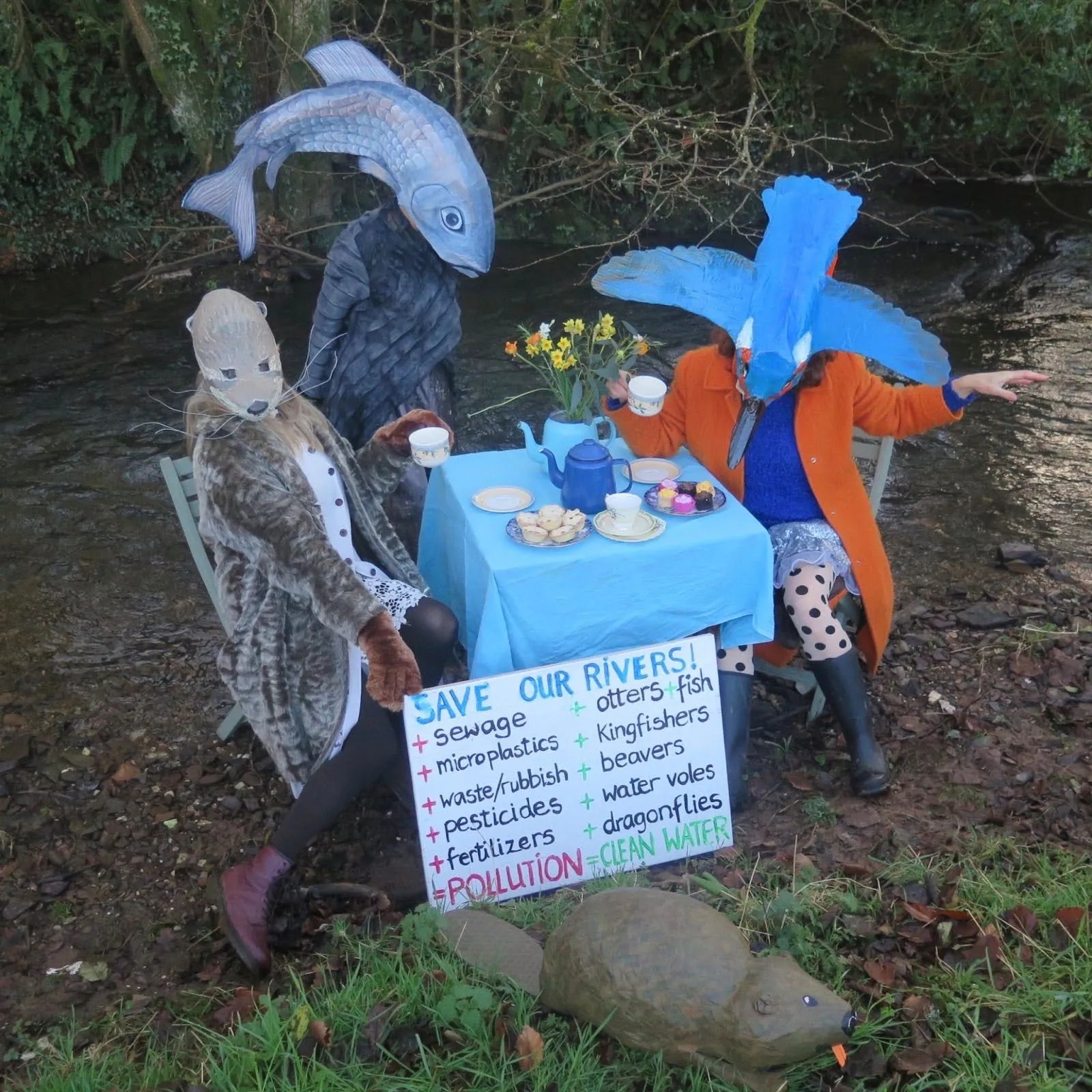
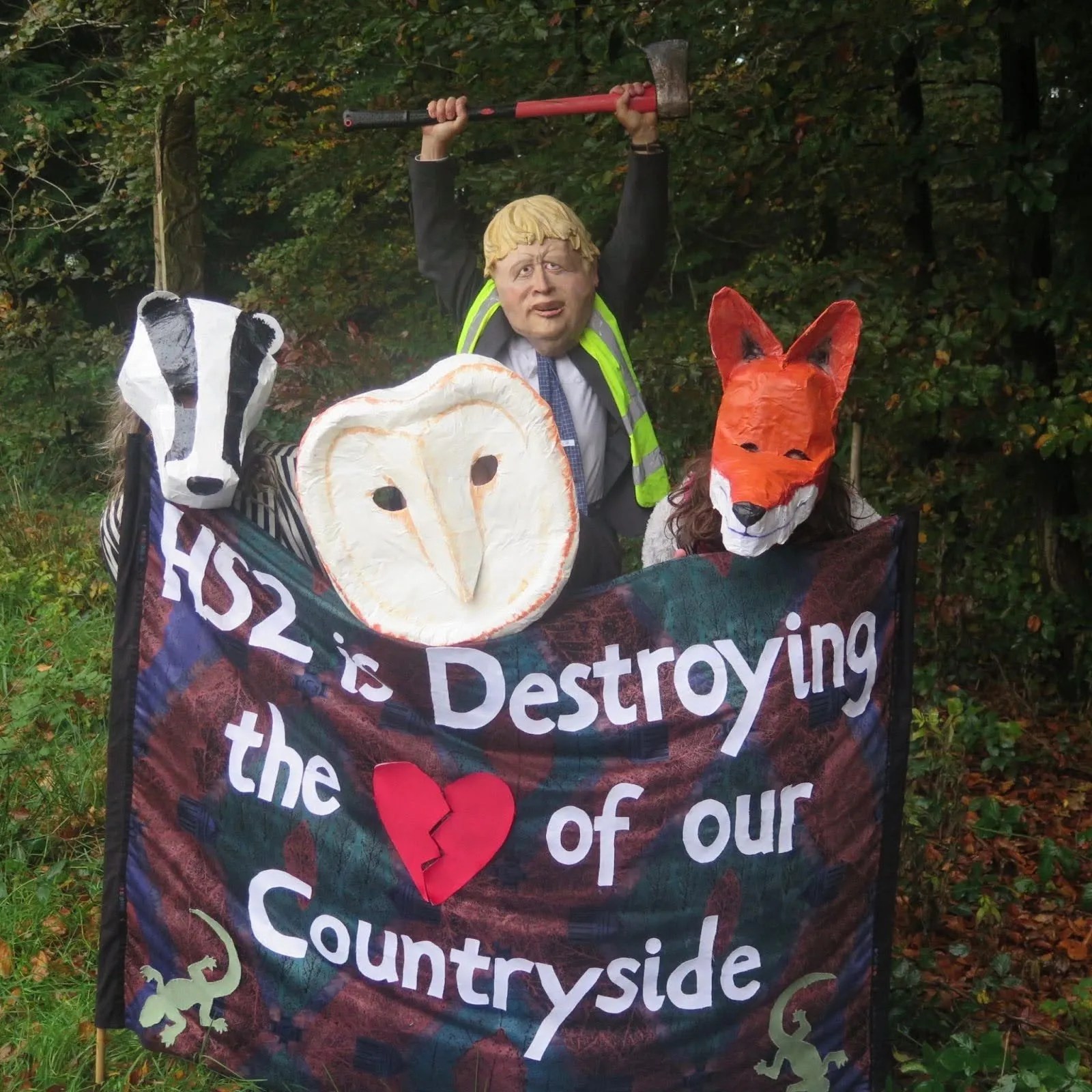
Back in the mists of time during the first pandemic lockdown, I became involved with a bunch of local creative people who were also into drumming and protesting about climate change with Extinction Rebellion. As a small group of enthusiastic activists based in a small west Somerset rural town, we were conscious that if we were to invest the time, energy and money in travelling to London to join other protesters, we should make it worthwhile by making as big an impact as possible. Hence the idea to make big animal masks that would transform us into creatures other than humans. We wanted to take nature into the protest and chose to become native animals that we saw in our countryside.

We are creatures: supported in a web of life

Sadly, today there is often more wildlife in cities and towns than in our increasingly sterile and denuded landscape. We rarely see large mammals such as foxes, insects are few around sprayed crop fields and amphibians are struggling with a lack of ponds. A study published by Buglife in 2020 showed that insects are in steep decline worldwide – with an average loss of over 8% per decade. Studies using other methods have produced even higher figures for insect population decline of over 2% per year. And we cannot survive without insects, for they form a critical part of the global food chain and maintain the soils we need to grow our food. There are some long words in the pyramid chart below, but you get the message: we need a lot of insect life at the bottom in order to support our food system at the top. For example, three-quarters of our food crops depend on insects for pollination. Without them we won’t survive for long.

“But man is a part of nature, and his war against nature is inevitably a war against himself.”
– Rachel Carson (Scientist and author of Silent Spring, the book that brought the dangers of pesticides to the general public in the 1960s.

Source: Buglife, ‘We are losing 9% of insects per decade’ https://www.buglife.org.uk/news/we-are-losing-9-of-insects-per-decade/

Here is a BBC Ideas film that explains it really well too – and with beautiful animation and a voiceover by the brilliant bee man Dave Goulson: Why insects are so crucial to life on Earth | BBC Ideas.

With the help of a fellow local artist, Jenni Dutton, who is extremely skilled in both creating and teaching, we made a range of masks that went on parades, demonstrations and protests around the country. It is amazing what can be made from corrugated cardboard boxes, newspaper, glue and paint. From the fox to the frog, the owl to the dragonfly, these creatures came alive and danced and drummed alongside the humans. They brought a little of the wild into our city streets. It felt like a reminder of our ecological crisis, which was often forgotten in the headlines of carbon, energy and climate. After all, humans are just one of the many creatures affected by climate change, although we are the only ones to have caused it.

When people disappeared

There is less space than ever for wildlife in our world today. More concrete and less earth, more chemicals and fewer insects. In the pandemic, without the endless noise of machinery and traffic, many of us heard the birds again and some experienced the dawn chorus for the first time. People saw some strange and wonderful sights as animals wandered fearlessly into spaces usually occupied by humans, like car parks and city streets. Security cameras caught bemused-looking deer wondering where the humans had all gone. It was surprising how quickly the wildlife found its feet and began to use paths and places long abandoned to people.

We talk endlessly about our need for connection with nature, but it feels as if this is always on our own terms. The wild is fabulous in the right place at the right time, leaving no mess and creating no inconvenience for humans. Mud must stay in the field — although of course it runs down the road as the rate of rainfall increases and blocks our drains. Weeds must stay out of gardens so that plants we choose to call flowers can flourish, since they might be weak and easily overcome if left to fend for themselves. Animals that are potentially dangerous, from the snake to the wolf, are banished, hunted, slaughtered in a range of grisly ways and treated as unworthy of life in comparison with humans. Creatures that we find unappealing or are too good at surviving alongside us and our mess are designated as ‘vermin’. I wonder if — according to the data of who is a real danger to who and how much filth they each create — if we aren’t perhaps the ultimate vermin. Superrats even. After all, we are also creatures.

Wearing an animal mask for a street protest was an interesting experience, as from inside we could see the reactions of people around us. Some laughed, lots took photos, many smiled and children often waved or held out their hands. Recognition was immediate and response warm — something animals help us to do is to connect with each other, perhaps? I think of the ease with which dog walkers start conversations and even become friends with someone they would otherwise just pass in a park or street.

Black and white

There is something about monochrome photography that gets to the very essence of a thing. I don’t know why this is, but time and again, I see the impact of black and white images cut through the constant colour and clatter of today’s busy world and strike at the heart of the matter. This is particularly true of portraits, and therefore my choice to make a series of monochrome photographic prints of people wearing animal masks at night going about their business in our local small town.

The very first image was a take on the Beatles album cover on the zebra crossing at Abbey Road. It was a cold winter night and we had fun arranging ourselves artfully across the road, only to have to scuttle out of the way when cars came along — just like real animals. The final image was both funny and poignant too — people-creatures trying to claim back some space in our world. 

We are creatures: Showing 'Crossing the zebra' a photograph by Nicky Saunter.
Crossing the zebra. Photograph: Nicky Saunter © 2025

I went on to take a series of ten images, imagining what might happen at night in a town as creatures show their faces in our human spaces. They are strong, confident and do not seem frightened of us. Have they come to take over? Or are they our almost forgotten selves walking the streets as we lie sleeping in our beds? Some are funny, and others are creepy or disturbing.

These images became part of an exhibition in a studio at East Quay in Watchet, an amazing art venue created by a local group of people called The Onion Collective. The main building houses national exhibitions, often with a local connection or collaboration, while several containers outside house artists’ studios. My exhibition was in one of these, loaned by the Somerset conceptual artist Jenni Dutton.

We are creatures: Showing 'Barn owl and ivy wall' a photograph by Nicky Saunter.
Barn owl and ivy wall. Photograph: Nicky Saunter © 2025
We are creatures: Showing 'Frog in the launderette' a photograph by Nicky Saunter.
Frog in the launderette. Photograph: Nicky Saunter © 2025

One of the things that visitors commented on most was how the combination of my statement and photos challenged their view of their own connection to nature. As we are in a rural area, many people recalled the pandemic quiet and how they took walks and saw wildlife differently — and how that had disappeared again so quickly once ‘normal’ life resumed. I had written about how my images intend to ask us to think differently about ourselves as animals and about the rest of the natural world that surrounds us and yet remains invisible in our daily lives. We see a beautiful vista, the blossom on a tree or enjoy the sound of birdsong, but rarely notice an ancient lichen, a pondskater on a forgotten pool or the perfection of a dandelion seed head. Our filters are set by our culture, which values some things randomly over others. Most of them need challenging.


Nicky Saunter is a writer and artist who uses mostly monochrome photography as part of her practice. She focuses on emotional connection to issues of the day, from women’s rights and colonialism to water pollution. She often features nature and in particular the wildlife of Somerset. More of her work — including the We Are Creatures series — can be seen at Through the Window. 

You can read the Buglife report Nicky mentions in this April 2020 post at their site: We are losing 9% of insects per decade.

Nicky mentions multimedia artist Jenni Dutton and you can explore her work here. And you can find out more about the work of the Onion Collective, a place-based social enterprise in the small coastal town of Watchet in Somerset, “working to reconfigure economics from the perspective of our attachments to community, culture, nature and the future we hope for.”

Nicky Saunter
Nicky Saunter
A practical activist, campaigner, social entrepreneur and artist with a particular focus on communication, between people and between humans and the rest of the natural world.

River / Run – Waterbodies from Dorset to Findhorn Bay

Poet and campaigner Fiona Moore finds joy and celebration alongside loss in fellow ecopoet Helen Moore’s river / run, a collection of long-form poems exploring a living ecology, history and language shared with waterbodies and our fellow animals.


1,930 words: estimated reading time = 7.5 minutes

NB: If reading on a phone, you might want to allow it to rotate the page and read as landscape rather than portrait, to maintain the format for the excerpts from the poems.


If a river is long-form water, then a long poem can run like a river. Ecopoet Helen Moore has written a trilogy of long-form river poems, set in Dorset and north-east Scotland. They explore ecology, history and language, and the plight of Atlantic Salmon. (I’ll follow Moore’s practice of capitalising all living beings.)

But is river ever singular, or is that a superficial, simplistic human concept, foreshadowing exploitation? Here’s what the river networks say in the poem ‘Dorset Waterbodies, a Common / weal’:

Don’t call us ‘river’
            as if we were singular - 
                 a blue, serpentine line on a map,
                                    an ‘s’ from source to estuary;
                                                                  an abstraction                       
                                                  to be navigated, straightened. 
                                                                  fished, dredged.

Opening a book of ecopoetry, even the most ecologically minded reader may think: will I feel preached at? Moore deftly avoids this in the passage above by allowing the water to speak and question our assumptions. The reader may also ask: will dread overcome me, or will there be some joy? river / run contains joy in the energy and diversity of water, its inhabitants and landscapes, alongside the dread and the pain of loss.

Showing the cover of 'river / run' (2024) by Helen Moore, published by Cape Farewell Books. Artwork by Animate Earth Collective
‘river / run’ (2024) by Helen Moore, published by Cape Farewell Books. Artwork: Animate Earth Collective

Findhorn – northern flow and flight

Joy also comes from the liveliness of the text – the varied, energising forms it takes, and the way description engages all the senses. Moore crafts her poems to embody riverine flow and eddy. The writing has a kinesthetic effect, if that’s the right way to say you feel it’s moving you along (often fast) and around. I found this most effective in the opening poem, ‘Findhorn Bay: Waves of Flow & Flight’. Even on a map this bay, east of Inverness, is an astonishing landscape. The poem begins “Tide pouring into the Bay as if through the neck/ of a wineskin -” and shows the impact:

Incoming waves flowing past boatsheds, The Captain’s Table, 
houses hunched against north-east winds -

           down past the Kirk, rippling over sand- & mudflats,
           brine filling the rough-stitched ‘Gut’ of salt-marsh,
           swelling it with the wine of Life. 

It’s a largely benign flow, but hugely powerful; the poem doesn’t need to remind us explicitly how destructive water can be, as part of the forces we’re letting loose while we fail to address climate emergency.

Showing 'River Findhorn', photo by David Buckland 2024
River Findhorn. Photo: David Buckland © 2024

The wineskin metaphor’s a rarity, all three poems being mostly deep in the ‘real’ world. As well as the movement of tide, rivers and burns, ‘Findhorn Bay’ describes two long journeys and a short one, first the ancient migration of Wild Salmon “sacred to Picts & Celts”, with “Miocene eyes”. Their route is extremely challenging, “from furthest Atlantic… through kelp forests, storms, gyres,” until the “leaps of faith” as they struggle upriver in Scotland. But

For every hundred Salmon that leave our rivers now,
less than five return. 

river / run includes photos by David Buckland, one depicting Wild Salmon infested by Sea Lice, spread by fish-farm escapees. It’s painful to look at. 

Pink-foot Geese take the second journey, and the poem shifts from the speaker’s viewpoint on ground

& the sky suddenly wrinkled, filled with tremulous lines
as if the weathermen had pencilled in the air-waves,
these marvellous patterns converging on the Bay.

Hairs on my skin rise spontaneously to meet them,
& in my chest, heart is a full crimson sail.

to imagining their summer in the far north and migration route back to Scotland, “following star-maps in their brains”. Apart from the “dragon flare of gas at Sullom Voe” these passages are exhilarating (heart as a sail, another rare, wonderful metaphor) until, arrived at Findhorn,

A dozen Pinkfeet stir, 
    beating hearts, 
  lifting, honking....

                                                  Pop! Pop! Pop!
                                                  Explosions of shots
                                                  ring out, shattering the calm - 

a slaughter begins. The unexpectedness delivers a jolt. Loosely indented text is shocked into two columns, straight-justified: geese dying on the left, shooters opposite. The anger comes through, and we’ve been flying with the geese and share it. 

  Most shooters travel
  long-distance for ‘action’
  they film & boast
  on YouTube channels - 

  600 miles to Findhorn Bay
  GREAT SPOT
  FOR SPORT - - - - - - -

The narrative turns to the human inhabitants’ perspective, from strongly against to appreciating the income the shooters bring, and the rights (or not) of Nature. 

Showing Pictish stone carving of goose and salmon in the National Museum of Scotland, 7th Century. Photo by Helen Moore © 2024.
Pictish stone carving of goose and salmon in the National Museum of Scotland, 7th Century. Photo by Helen Moore © 2024.

All this is done in three pages with a lot of white space for the reader’s own thoughts. The whole poem is only 12 pages long: rich in descriptive language and packed full of references, yet concise. Its last, short journey is a farm-to-farm route that Findhorn fishwives used to take, trading herring from their creels for cheese, eggs etc. It’s written in short prose paragraphs – a walk, at human speed. “Who are the descendants of these tough women? What tenacity of character, what knowing in their blood?” This idea of instinctive, inherited knowing likens the women to Salmon or Geese. The speaker’s rucksack becomes a creel:

... will a future culture come to honour Nature’s teachers, incise Goose & Salmon in their hearts? In my creel I’m placing all the man-made rubbish. There is no place for it in this cauldron of Life. 

Nature and culture – an ecopoetic palimpsest

‘Findhorn Bay’ was written for the Findhorn Bay Arts Festival. The other two poems were commissions from Cape Farewell, centring on Dorset river systems, as part of the RiverRun project “that connects Cape Farewell’s scientific partners with local farmers and artists… [on] the poor state of freshwater”. All three poems are divided into sections with titles, to help the reader follow the structure.

Showing The Wye x4. 40cm x 40cm mixed media. The canvases were immersed and part created by the River Wye over a period of weeks. Art: Jim Murray.
The Wye x4. 40cm x 40cm mixed media. The canvases were immersed and part created by the River Wye over a period of weeks. Art: Jim Murray

In her introduction, as well as helpful context for each poem, Moore explains her method: an interdisciplinary, collaborative, intuitive approach, with “roots in animistic European traditions”, alongside “gleanings” while out in Nature, engagement with scientists and others, and research into the many aspects of a landscape from geology to social history. She describes how from all this “the writing ferments and emerges as a poetic palimpsest”. When you read the poems, this makes perfect sense – and so it does that, she says, they take a long time to write. Other writers can imagine what the work might involve: choosing which material to use and how, ordering it, editing down and down, touching on themes often just in a short phrase, trusting the reader to do the work and make connections. 

‘Dorset Waterbodies’, the middle poem, takes varyingly indented forms, all across the page, to score the rhythm. I particularly liked the sections where other voices speak: the water (see opening quote) and its creatures. In ‘Nightmare slurry spill’, Fish and industrially farmed Cows speak in a loose pantoum, whose semi-repeated lines convey a powerful sense of claustrophobia: the Fish can’t breathe, and “Overcrowded Cows… feet in piss & shit” are unnaturally confined. As a whole, I wasn’t quite as swept along by this poem as by ‘Findhorn Bay’, but that’s by a very high standard. The introductory section, describing a visit to Durdle Door, captures a sense of post-lockdown relief, though empty cruise ships are “squatting the horizon… ticking over” (the filthy bunker fuel, the emissions, the waste!). It celebrates the new tourists’ diversity:

                & crowds of colour           break
                                                                the monotony
                                   of white, rural         m o n o c u l t u r e s.

Moore uses spaced-out letters to emphasise a few key words in this poem. I stumbled over these; maybe that’s the intention, but I’m not sure they add to what the form and language already do.

The poem ends with the river (“if you must make us ‘river’”) making the case for human respect and restoration, “the right to self-determine”. The descriptions of river life are beautiful, from Dippers and Dragonflies to Waterweeds to

                                       our single-celled beings
                                                 constellate    like s t a r s ...

The conclusion might have more impact in performance, perhaps less so on the page, however fervently we agree:

                                          let’s be communities of diverse voices
                                with a common future.

                                          A communion of subjects & one 
                                                             Commonweal

This kind of writing is so, so hard to do, even in a riverine voice – which, here, seems to shift a little from river towards human.

Dorset – southern spells and celebration

‘Edge of Wild River’, the third and shortest poem, begins with a dream of a Salmon. Moore explains in the introduction she dreamt it while living in difficult circumstances in Sydney, with the terrible 2019/20 bushfires raging. The Salmon collides with her, “like being struck by a waterlogged pillow”. “What has she to say?” 

Apart from the dream, in prose sentences with breaks, this poem is all written in short-lined verses, left-justified. The tone is song-like, spell-like, as if to will a different future into being. In ‘Water Blessing’ voices ask for forgiveness for pollution:

We this grey wreckage 
dumped on the bend in spate;
we the old bones of trees,
the breeze, swimmer, floating leaf ...

Human healers are celebrated: the scientists, litter pickers and amateur water testers.  Ecologists studying water samples and counting River Shrimps

                                            listen 
to sounds from underwater hydrophones - 
eerie bubbles, clicks, and echoes
bouncing off the sterile walls - 
Showing 'Dart, 2018' - still from the performance film by Hanien Conradie
Showing ‘Dart, 2018’ – still from the performance film by Hanien Conradie.

In a 2022 interview Helen Moore gave to Kathryn Alderman, on the Ink Sweat & Tears website, she was asked if there’s a difference between nature poetry and ecopoetry:

“Ecopoetry for me is all about consciousness. Consciousness of our deep interconnection with our planetary home and of our humanimal nature. Awareness too of the paradigm that has created our disconnection in Western cultures, and the power structures that have a vested interest in maintaining our disempowered state.” 

river / run puts these principles into action, but subtly, using the power of description, form and language. ‘Edge of Wild River’ ends with a couplet that sums up the book’s passionate message [poet’s ellipses]:

as we help wild river heal,
so we help and heal ourselves ...

Find more

Helen Moore’s river / run (2024) is published by Cape Farewell Books. Cape Farewell produces opportunities for artists, scientists and communities to work together: “by creating art founded in scientific fact, our projects highlight humanity’s destructive impact on the earth and inspire people to act towards a sustainable cultural shift.” As Fiona explains, two of the book’s poems form part of Cape Farewell’s RiverRun project, which interrogates the environmental impact of the way the Dorset land is farmed, and the impact on the rivers and waters that feed Poole Bay.

You can explore more of Helen’s work at her website — where you can also listen to her reading Findhorn Bay, Waves of Flow & Flight, the poem created for the Findhorn Bay Arts Festival 2018, with a soundtrack by VisionSonic.

Helen Moore is also a member of ClimateCultures and has written posts for us, including The Start of Something Going Wrong, her review of fellow member Joanna Guthrie‘s collection, Her Whereabouts. In The Ghosts of Fleas, her post for the Finding Blake website, she shares and discusses her poem inspired by William Blake’s 1819 painting, ‘The Ghost of a Flea’.

Fiona mentions Helen’s Ink Sweat & Tears interview. You can read that here.

Fiona Moore’s collection, Okapi (2024) is available from Blue Diode Press, and you can find her on Instagram at fionamoore555.

All images from the book, river / run. The final image is a still from a film by ClimateCultures members, Hanien Conradie and Margaret LeJeune. You can read Writing on Water, Hanien’s post discussing the film of her performance in the River Dart and reading Afrikaner poet Eugene Marais’s Diep Rivier.

Fiona Moore

Fiona Moore

A poet, editor and environmental campaigner, whose second book, 'Okapi', is a book-length eco-poem. She has edited issues of Magma Poetry on climate change and islands.