Artist and writer James Roberts shares Rise and Fall, his short, award-winning film-poem, which gives us all space, an invitation to find calm, to experience our local rivers, to find a practice of connection and show some reverence.
1,300 words: estimated reading time = 5 minutes + 5 minutes video
Rise and Fall developed from a short visit to the Cambrian Mountains above the Elan Valley dams one spring afternoon. I was trying to film red kites with my drone, but the kites had other ideas, disappearing over the peaks at speed. So instead I decided to do a shot of the little River Elan, starting almost at its surface, then sending the drone as high as it would go.
When I viewed the footage later, a poem began to write itself about the experience — about the high drift and growing distance, which seemed like a metaphor for where we are now in relation to the natural world. The further we rise, the more distant it gets. Rivers, it seems, show us where we are.
After that I began visiting other rivers whenever I was out and about, filming them handheld and up close, or floating the drone above them to record their contours: the Wye, the Lugg, the Cleddau, the Dart, and a few of their tributaries. I hadn’t set out to make a film, but that poem wanted to do more than just sit on a page. It wanted to be a film-poem.
Luckily I was told about the upcoming Rivers of Film Festival and encouraged to send in a film treatment. Even more luckily the film was accepted and then went on to win the inaugural Clare Crossman Prize. The process of making a film was a real adventure for me, for which I’m very grateful.
There’s so much in the news these days about the state of our rivers. They’re polluted, choked with sewage, nitrates, harmful bacteria. It’s the water companies’ fault, or privatisation, or chicken farms. But these are symptoms, not causes — indicators of a wider disconnection with the natural world which continues to widen. Rivers show us what we’re doing to the earth, our attitude towards it, our now-distant relationship with it. Everything flows into them: our poisons, but ultimately our ideas and ideologies.
It seems like there’s headway being made in the fight to save our rivers. Good souls are measuring nitrates, monitoring streams, building networks, litigating. They’re raising hundreds of thousands of pounds for this fight. Meanwhile, the great rollout of AI is being backed by every government and major investment company, estimated to cost tens of trillions in the next decade. As part of this, our children are being encouraged to develop relationships with companions that don’t exist. They’re being connected deeper and deeper into the wiring of machines. Machines that consume billions of litres of water. Will the rivers be spared?
What is the most important thing?
This is what I want to see: a farmer walking down to a nearby stream first thing in the morning, before they start their long workday. When they reach it, they spend a few minutes watching and listening. Then they bow. Or a group of children on their way to school going to the riverbank to drop flowers from their gardens into it, watched smiling by their investment banker parents. This is not part of some new-age religion — it’s simply a practice of connection. Start the day with something important. Show some reverence.
I remember reading about a man who visited a reservation in the US hoping for some instruction on how to live better. Two elders led him out into the desert early one morning. They told him to bring nothing, just to sit until they told him he could return to the village with them. They left him there for two hours. When they returned they asked him one question: What is the most important thing in life?
He thought about what they might want to hear and said: family. They shook their heads and walked away.
Two hours later, with the sun now reaching its zenith, they returned and asked the same question.
“Friends,” he answered.
They walked away again.
After another two hours they asked the same question. Again, the wrong answer. And again.
By late afternoon it was 100 degrees in the shade, and the man wasn’t in the shade. Again he gave them the wrong answer.
The next time he could barely speak. His head was spinning, there were sparks in his eyes, and his throat was like a sand chute.
“What is the most important thing in life?” they asked again.
“Water,” he croaked. “Water!”
They smiled, picked him up, embraced him, and let him drink before returning to the village.
My little film-poem ends with the line: “If you want to, you can find your way back” (sorry for the spoiler). I’m not trying to preach, only to offer a viewpoint in the most simple way I can. For me, we have to find practices that reconnect us to the real, to move away from the virtual. Find our way back to what we are — animals, dependent on other animals, the soil, the rivers. That reality will return to us whether we like it or not.
The film is deliberately slow; you might find the pace frustrating. It’s shot in black and white, as simple as I could make it. This is to give us all a little space. Nick Sergent composed a beautiful cello soundtrack, which helps slow the piece down further. It’s an invitation to calm, and hopefully a way for you to reconnect with your local river.
James Roberts is an artist and writer based in the Welsh Borders. For more of his writing, subscribe to intothedeepwoods.substack.com, where he writes about establishing practices of connection to the wild. His website is: seariverwood.com.
***
From 2026, ClimateCultures is inviting members to say a sentence or two about how they use AI in their work and in their posts for us. We will be exploring this in future posts here and at our ClimateCultures & more Substack.
James – “I do use AI. It’s an efficient spellchecker, it’s good at helping me fix my old car, and it’s excellent at interpreting Tarot decks. I don’t use it for creative work: AI ideas are pretty useless to me. I do think, however, that it will replace most professional creatives in the near future. This is already happening in the design industry where I used to work. See above for how it impacts the environment. Therefore, like meat and plastic, it should be consumed sparingly. I’m already weaning myself off it despite only experimenting with it for a few months.”
You can read about the Clare Crossman Prize, which James was awarded at the Rivers of Film Festival in Cambridge, here at Clare Crossman’s website. A ClimateCultures member, Clare (1954-2021) was a poet with a deep connection with the natural world and with place, which this prize celebrates. Along with filmmaker James Murray-White and other local champions of the River Mel in Cambridgeshire, Clare created the Waterlight Project, a website and film inspired by the chalk stream.
You can read more about the Rivers of Film Festival that James Murray-White devised and curated in Cambridge (September to October 2025) in his recent piece for our Creative Showcase, our growing portfolio of new and recent works from ClimateCultures members. The festival was commissioned by Cambridge Past, Present & Future as part of the RiverCamCAN Project (Climate Action Through Nature), and funded by the National Lottery Community Fund. Further screenings of the 10 films commissioned for the festival are planned around the UK — including at the Living Water exhibition in Cambridge (20th March – 5th December 2026) — the screenings on 28th May (University Library) and 25th June (Pembroke College) — and at the River Summit in Henley, September 2026 (date TBC).
A writer and artist who teaches practices of connection to the wild, author of 'Two Lights', and with artwork exhibited in several galleries in the UK.
Writer and filmmaker James Murray-White, in conversation with Veronica Strang about her new book, Water Beings, finds connections with his own work at a time when water is under threat and we need to rebalance our elemental relationship.
2,850 words: estimated reading time = 11.5 minutes
“Water serpent beings’ abilities to be monstrous also traverse scales. They can lurk within the individual psyche and represent the seething inner sea of instincts and emotions, or they can reflect tensions and fluid capacities for disorder at a societal level, such as the chaos represented by war or revolution… At a cosmic level, they can represent apocalyptic events – the Flood, the volcanic eruption, the earthquake, the tsunami.”
— Veronica Strang, Water Beings: From Nature Worship to the Environmental Crisis.
‘Water Beings’ by Veronica Strang (2023)
Water in crisis
Recently I’ve been sensing a disconnect between me and water. I live close to an iconic river, in which I learnt to swim and as a teenager had lucrative summer jobs punting tourists along it. However, the River Cam, like most if not all UK water systems, is heavily polluted, and I know of many local cases of humans and dogs who have been seriously unwell after a dip.
The data for the newly designated bathing status at Sheep’s Green in the Newnham area of Cambridge recenly showed high levels of e-coli and other nasties that have leached down from a sewage pumping station some miles away. In addition, the heavy winter, spring and now summer, rains we are getting in this normally drier part of the land often wash off concrete and create epic floods, with run-off washing into the rivers and through the soil.
I’ve just made a short film about one of East Anglia’s chalk streams, the Newmarket Brook, and I have been learning from geologists and hydrologists about chalk streams’ unique qualities and fragility. This one is in varying states of health. I also helped a friend, Tony Eva, make Pure Clean Water, a film about Hobson’s Conduit, which flows from the springs at Nine Wells, by the hospital, through various colleges and into Cambridge. It is in a perilous condition, continually abstracted and contaminated.
Away from just this one city, the human world is at war, and water gets scarce and used as a threat for those being persecuted and bombarded. We’re in a water crisis and if we are to survive as a species and remain equitable with our ecosystem, our relationship with all the elements must rebalance. Recognising this disconnect is the start, and framing our connection to the sacred and to older knowledges feels like an important way forward. A crucial way forward.
It’s timely then to discover Veronica Strang’s body of work, and engage with the growing movement towards river/nature rights. The vast body of human creativity around water and water beings comes to the fore in her book, which really resonates and brings joy to this jaded mind. If many of us unite around care for water and becoming water guardians, from a variety of faith beliefs, political and ecological opinions and none, our human power can make a real difference.
I’ve recently been a participant in two University of Cambridge conferences on water-human relationships where Veronica delivered keynote lectures. Her research straddles anthropology, archaeology, theology, philosophy and more — ranging across human history, our experience with and belief in beings that inhabit watery realms, and our cultural imaginations and psychological systems.
Water Beings – from Nature Worship to the Environmental Crisis is a very deep dive into watery worlds inhabited by a vast array of extraordinary more-than-human beings, and into our imaginative nature as an ancient species. Every society has developed complex and intricate beliefs and knowledges around water beings and their values, roles and responsibilities, including our projections on them as either benign or monstrous. Living alongside them, dreaming of them or even being devoured by them, has given humans a sense of fear, worship, adoration, and veneration. Perhaps now is the time to fully merge our substantive presence on the earth with water creatures?
Muisca tunjos, votive offerings to ancestral serpents believed to inhabit Lake Guatavita, Colombia, 10th–16th century CE, gold.
A confluence of knowledge and imagination
While grounded in academic scholarship, Water Beings reads like a flowing chronology of connectivity, an important congregation of how the planet’s climate and delicate ecosystems and the human creative impetus to respond all come together. Ultimately, this work is about narrative, fact and fiction: stories and images of water beings are part of our human construct, and now is a time to acknowledge and honour them. What might they mean? What might they anticipate?
The book’s ten chapters categorise types of water entities — irrigating beings, supreme beings, demonised beings, reformed and transformational beings and more — and frame our ways into their study. A key final chapter then sharply focuses on the now, why we are in this condition of crisis and dis-connection, and ways we might return to a closer, healthier framing. I’ll return to that important chapter.
Unknown artist, Nyai Blorong, Goddess of the South Sea, Java, before 1928, watercolour on paper.
I was particularly delighted to discover in chapter 8, ‘Supreme Beings’ — as Strang moves forward with her story, societies become urbanised and with that comes monotheistic faith structures and practices — an image from William Blake, ‘Moses erecting the brazen serpent’.
This chimes with an ongoing absorption into Blake’s prophetic work I have through the Finding Blake project, a fascination with his fourfold vision. Here, in an underwater realm, serpents are coiling around humans, literally squeezing the life out of corrupt sinners, while Moses stands watching upwards to the head of the main water serpent. Here is an image of the entwining of watery beings which has become the symbol of medicine and healing: caduceus.
William Blake, Moses Erecting the Brazen Serpent (Nehushtan), c. 1800–1803, pen and watercolour on paper.
Water is rare in Blake’s paintings, and where it does appear it often represents the subconscious, a metaphor for yearnings, regrets. Here it is a vessel, dominated by these beings of great power, human victims in their coils — and yet the interplay between them and Moses is highly significant: dominion and dominance. I’m not aware of Blake referencing the Thames in his work, despite living very close to it for most of his life, yet surely it played a role within his unconscious knowledge of the world. I wonder if he saw serpents and watery beings on his daily walks alongside it? I’m led to believe he and his wife Catherine could see the river from their last flat, where he died, which is now under a major London landmark hotel.
Chapter 10, ‘Reformed beings’, flows up to contemporary times, and the use of images of water beings in literature, films and more. This makes me think of the local town of Ely, once a town of eels, fished for and captured in plentiful supply and shipped off to London as a commodity. Now the eels are gone, with the last remaining eel catcher, into mythology of both creature and trade. Eels live on in artworks, sculptures by the river, and paintings aplenty in local galleries and markets — a symbol of this fenland town. Many tales of the fens are marked by the beings that once inhabited waterways since cut as agricultural drains: part of the industrialisation of land reclaimed from watery bog.
‘Turning The Tide’, the final chapter, forms a confluence, bringing together knowledges from countermovements — indigenous activists, campaigners for social and ecological justice, nature-worshipping religious groups, legal activists, and scholars — to include learnings and imaginings from all kinds of creative practitioners, strongly making the case for recognition of the rights of the more-than-human, and water itself: ultimately, the vessel and element that holds us all.
Here, the full power and resonance of the author’s research comes to the present day, and she offers the full weight of her learning and sharing:
“Today, in a world urgently in need of a change in direction, the stories that water serpent beings tell, and their capacities to represent alternate visions of human-non-human relations, may be the most crucial role that they have ever had.
“As our water serpent beings have shown, societies that have achieved long-term sustainability have done so by maintaining steady-state or circular economies, rather than embarking upon spirals of growth and expansion.”
Returning to my home city of Cambridge, plagued by the constant over-hanging clouds of development and the ‘growth agenda’, this message needs to ring loud — and just maybe the water beings may rise again from the Cam, or emerge in eel-like form to teach humans this lesson of steady state fluid dynamics. Human and watery other.
Double-headed water being in the form of a ship, Viking Age plate brooch from a grave in Lillevang, Bornholm.
Water Beings: a Q&A with Veronica Strang
JMW This is such an extraordinary work of rich, deep scholarship. I appreciate greatly the visual, literary and historical journey you take the audience on, and feel enriched by this book.
VS Thanks for this kind comment — this research has been a wonderful experience for me. Although water beings appear regularly in folklore, ethnography, history and theology, no one has previously researched aquatic deities systematically and comparatively, and venturing into this new research area has been an extraordinary adventure. Water beings have so much to tell us.
JMW Can you share how this study started, and tell us some of your journey following the waters and the watery beings?
VS My research as an anthropologist has always focused on human-environmental relationships, people’s beliefs and values, and particularly their engagements with water. I have explored a range of issues relating to water: ownership, governance and management; conflicts over water; religious beliefs about water; and rights to water, for humans and for non-human species and ecosystems. Much of this work has been in the UK, Australia and New Zealand, and more briefly in Malawi. But the issues around water that interest me recur all around the world.
Water beings swam into my research very early on. In the early 1990s I worked with indigenous Australian communities in Queensland and learned about the Rainbow Serpent that is so central to their lives. A decade in New Zealand, during which I conducted research with Maori iwis on water ownership, rights and management, brought me into contact with their beliefs about rivers as living ancestors, and their taniwha and other water beings. Realising the vital importance of these aquatic deities caused me to pay attention to them elsewhere.
It soon became clear that — since all early human societies worshipped the non-human domain, which we call Nature — water beings (as well as other elemental and non-human ancestral figures) were ubiquitous in human history. And in all of these early societies water beings performed similarly vital connective roles: personifying the creative and potentially destructive powers of water; forming the world and populating with human and non-human beings; providing humans with consciousness and enlightenment; exerting religious authority and, above all, generating water and life in annual cycles of production and reproduction. So for several decades I collected images and narratives about water beings all over the world: feathered and water lily serpents in Central America; African python deities, Arctic undersea beings; Indian nāgas; Japanese cloud dragons and Chinese imperial dragons; North-American Pueblo horned serpents or, on the north-west coast, wolf or bear headed beings; Amazonian giant anacondas and celestial boas; Celtic deities in rivers and springs; Norse sea serpents, and Eastern European rain dragons.
What happened to these water beings over time in different cultural and historical contexts gives us an illuminating narrative about different societal trajectories and transformations in people’s relationships with water and the non-human domain. And so the project grew into the major comparative study that forms the basis of my book. The study shows how growing instrumental control over the environment altered the relations of power between human societies and their environments, and led changes in beliefs and practices in relation to water deities. As humans gained more technological power over water, and felt more ‘god-like’, a fascinating pattern of deity humanisation emerged. This led to the semi-humanisation of water beings, or their displacement by deities in human form, and culminated in the major monotheisms assigning authority to human, male gods and demonising the non-human beings of earlier religions.
JMW Would you explain a little about how you chose to structure the book, and make these categories of beings? And which of the world wide canon of water beings you have researched most captures you?
VSWater Beings follows the changing patterns in societies’ relationships with water through a comparative study of their water deities. Although these changes happened at different times in different places, the book is loosely chronological, starting with the water beings of the earliest human societies and those that remain central today in place-based indigenous communities. Such societies understood the co-creative role of the non-human domain, manifested in water beings, and sought to have reciprocal and respectful relationships with them. They also maintained relatively egalitarian relationships in their political arrangements, being led by both male and female elders.
The text then moves to examining the effects of greater human control over water, for example in ancient irrigation societies, and considers how their religious and political arrangements changed alongside their new infrastructures. With new hierarchies and centralised governments, power shifted from water deities into the hands of (usually male) priests and deified rulers who became the figures responsible for bringing the rain and maintaining social order.
The following chapters explore how, as societies became more technologically powerful, water beings were made subservient or subsumed by new deities in human form until, with the rise of monotheisms that separated Culture from Nature, and sought dominion over the latter, they were demonised and slain. It also shows how emerging scientific visions disenchanted the world and consigned many nature deities to ‘folklore’. In the final part of the book, however, we see how this alienation from the non-human domain, and the exploitation of other species and environments that it encouraged, has led to the current environmental crisis. There is now an increasing understanding that there is an urgent need for humankind to regain more convivial, and therefore more sustainable, relationships with water, ecosystems, and other living kinds.
The book therefore also examines new visions of water beings in recent and contemporary art, literature and film, in which they are recognised and respected as key manifestations of the co-creative powers of the non-human domain. These emerging images and narratives express people’s growing desire to reconnect more positively with other living kinds and ecosystems.
As for which water beings have captured me the most? I can never choose. My first love was the Australian Rainbow Serpent, but they are all extraordinary and wonderful, beautiful and terrible, and endlessly fascinating.
JMW Anthropological research gives us an opportunity to look back at historical evidence and to engage with local/cultural knowledges. In this case there is such a desperate need to apply all this knowledge to how we respond to water now, which you explore in some depth in the final chapter. How might we look back in 100 years, with your assessment of the current trajectory of human/water relations?
VS My research helps, I hope, by showing how, for many millennia, human societies maintained respectful relationships with water and the non-human domain, in which people sought to protect their needs and interests as well as those of human beings. It shows how and why many societies moved away from such egalitarian visions to seek power and dominion over ‘Nature’ and how this increasing inequality led to exploitative and unsustainable practices. Most large societies are still on this trajectory, led by ideologies of growth and expansion, and the belief that yet more technological control will solve the problem. Meanwhile, species and biodiverse habitats continue to disappear, human populations and their use of resources continue to increase, and it seems that humankind is dragging the world towards a painful and potentially critical collapse.
But in almost all societies there are also passionate counter-movements: social and ecological activists and indigenous communities striving to promote alternate ways forward. They share a transformational vision of human and non-human equality, circular economies, more sustainable lifeways, and beliefs and values that recognise the vital co-creative role of the non-human world. These movements are growing: more and more people are pushing their local and national governments and international bodies to make better choices. What the world looks like 100 years from now will depend on whether they can succeed in turning the tide. And in this battle — and it is indeed a battle for human and non-human survival — water beings, as compelling personifications of non-human power and creativity, are a vital narrative device for communicating ideas about how we might engage with water differently.
JMW Do you feel positive about us working with the more-than-human to assert the rights of nature and the rights of water within human law/psychology?
VS How could one feel other than positive about working to uphold the rights of all living kinds in what is fundamentally a shared interconnected world, in which human and non-human wellbeing cannot be separated? This is surely the only rational and ethical position from which it is possible to see a future in which all of us can flourish. So yes, I feel immensely positive, and indeed privileged, to be able to work with these amazing water beings and their wonderful capacities to communicate a more hopeful vision of the future.
Find more
Water Beings – from Nature Worship to the Environmental Crisis by Veronica Strang is published by Reaktion Books (2023). Veronica is a Professor in the School of Anthropology and Museum Ethnography, University of Oxford. You can explore her work — and watch a summary video of a planned TV series based on Water Beings — at her website.
Writer David Thorpe introduces his forthcoming climate fiction collection, School Strike For Baby Hope, and explores how our imagined futures must include the costs and dilemmas of better pathways, even where we avoid the worst of climate change.
1,440 words: estimated reading time = 5.5 minutes
In November, just in time for Christmas, my new collection of climate fiction short stories will be published by Android Press. The ten stories have been published elsewhere, often in obscure places. For example, the title story, School Strike For Baby Hope, was published by Extinction Rebellion on one of their websites.
Cautionary tales and possible futures
If a citizen living in pre-20th century Britain were to be told that in the future they would be able to travel anywhere in the world in a few hours, to buy any food from anywhere in the world at a local shop throughout the year, have free healthcare, most likely live until their 90s, and hold a device in their hands which could give them any kind of knowledge they asked and permitted them to talk to anyone in the world, and to see their faces, they would think the future was some kind of paradise. Well, we live in that age and we know different. We have threatened ourselves with the end of life on Earth — including our own end — in order to have these unnatural luxuries. We know the cost.
It seems to me that in imagining a future free from climate change we must be careful to imagine what kind of costs that might have. Every decision presents a dilemma. The purpose of governance is damage limitation; minimising the negative consequences of any decision. Unintentional consequences must be thought through. Climate fiction consciously does this.
Some of these stories are about the unintended consequences of action on climate change, so they serve as cautionary tales. These stories – At the Crux and For the Greater Good – reflect my interest in ‘one planet’ thinking – the ecological footprint as a measure of sustainability. I asked myself: if the country set itself the same task as one planet development in Wales – of satisfying the needs of inhabitants within the confines of a global fair and equal distribution of environmental impact – what could be the implications for the population? Living like this would demand monitoring of the entire ecological impact of the country and dividing it by the population each year.
School Strike for Baby Hope and Beacon arose from my experience of being in my local Extinction Rebellion group. We had many successful actions in Swansea and joined the national demonstrations in London. School Strike For Baby Hope appeared in Teens Of Tomorrow: Stories of Near and Far-Flung Futures, which explored possible futures through the stories of twelve courageous teens.
What else is cli-fi? If you read the Wikipedia entry it cites Jules Verne’s 1889 novel The Purchase of the North Pole as an early harbinger, which imagines a climate change due to tilting of Earth’s axis. His Paris in the Twentieth Century, written in 1883 and set during the 1960s, has Paris have a sudden drop in temperature, which lasts for three years. Wikipiedia lists J. G. Ballard’s climate extremism novels from the early ’60s and then, as knowledge of climate change increased, says fiction about it really started coming out, one of the earliest being Susan M. Gaines’s Carbon Dreams.
Should we always go with our imagination?
Imaginative works can be used to reinforce people’s prejudices, too, such as Michael Crichton’s State of Fear (2004), which was pounced upon by climate sceptics for reinforcing their view that climate change was some kind of conspiracy.
Then we encounter lots of dystopic films. From Fritz Lang’s 1927 Metropolis and Charlie Chaplin’s 1936 Modern Times, through George Orwell’s 1948 book Nineteen Eighty-Four, George Lucas’ 1971 film THX 1138, Mega-City One from Judge Dredd, conceived in 1977, to Ridley Scott’s 1982 film Blade Runner, and The Day After Tomorrow (2004). They have all set the template for many other stories and films, such that in the popular imagination the sprawling mega-cities of the future will largely be over-populated, polluted, broken places, featuring dark towers, high levels of surveillance and crime, their citizens treated little better than battery-reared animals, and no room for nature.
But is the dystopic metropolis a self-fulfilling prophecy, subconsciously, if not consciously, reinforcing the mindsets of planners and architects? Does it soften up the public, preparing them to acquiesce in the face of grim and unimaginative design, polluted air, poor policing and service levels, corrupt or inefficient governance, long commute times, constant noise, high levels of personal danger?
Is this the reason why people do nothing despite being bombarded by the truth about the future and climate?
I think we need comedies about climate change and the future. For this reason, I have included The Chernobyl Effect and The Last Laugh in the collection. These are stories from my body of work about the character Doc Chaos, a darkly satirical character in the tradition of William Burrough’s Doctor Benway and Alfred Jarry’s Doctor Faustroll. This is dark comedy, exaggeration for comedic effect. Making people laugh is a way of slipping things under their radar.
The Chernobyl Effect & The Last Laugh – stories of David’s Doc Chaos character
The End
These days I spend all day in a wheelchair because of cervical myelopathy. I have become unable to feed myself or use both my phone and computer. The only way I can write this article is to dictate it, as a friend is kindly typing it for me. I have written elsewhere that my stroke in August 2021 was caused by high blood pressure and a result of climate change stress.
I now think that my present condition, and the fact that I see no hope in my future again, is a mirror of the present and the future of the planet as a whole. I wish it were not so, but I can’t believe anything else. For example, as the average temperature of the planet has risen, so has the myelopathy of my spine, and just as we find tipping points such as the melting of the ice caps in climate change, there are tipping points in my body when the nerves in my spine become trapped and suddenly I find I can no longer do something, like feed myself, that I could do yesterday. Then I think to myself “What will happen before it ends?”. And I’m glad I won’t be around to see the world shrivelling up as it gets too hot. Unfortunately, my sons will.
Look after yourselves and find something you love and stick with it.
Find more
School Strike For Baby Hope will be published by Android Press in November 2024. As well as other fiction — including novels Stormteller and Hybrids — David has written several books on sustainability, including One Planet Cities: Sustaining Humanity within Planetary Limits and The One Planet Life: A Blueprint for Low Impact Development. Find out more at his website. And you can read David’s blog on Substack.
The Fifth Estate published A personal story about climate anxiety and illness from our UK writer David Thorpe in August 2021: a “personal account of his illness and its connection to his absolute commitment to avoiding the worst of climate change. It’s a sobering and very worthwhile read”, where David talks about the link between climate stress and the stroke he had recently suffered. That article also links to his story Don’t Follow Leaders, which David wrote for the publication.
In previous posts for ClimateCultures, The Rise of Climate Fiction Part 1andPart 2, David explores how the term ‘Cli-fi’ reveals the tension between our twin fascinations with utopian and dystopian visions, how fiction engages readers with human stories within the climate change one, and writers’ responsibilities — given that “stories are fundamentally how humans understand and spread wisdom as well as entertain themselves.” David also contributed a piece for our Environmental Keywords theme on Environmental Justice.
In 2017, David was one of our inaugural authors at ClimateCultures. He was one of the short story writers, poets and non-fiction writers commissioned to produce new writing at Weatherfronts climate change conferences for writers — two TippingPoint events that also inspired the creation of ClimateCultures. In Utopia and Its Discontents, he explores the thinking that went into his winning story, For the Greater Good, which was included in the free Weatherfonts ebook anthology published by Cambria Books.
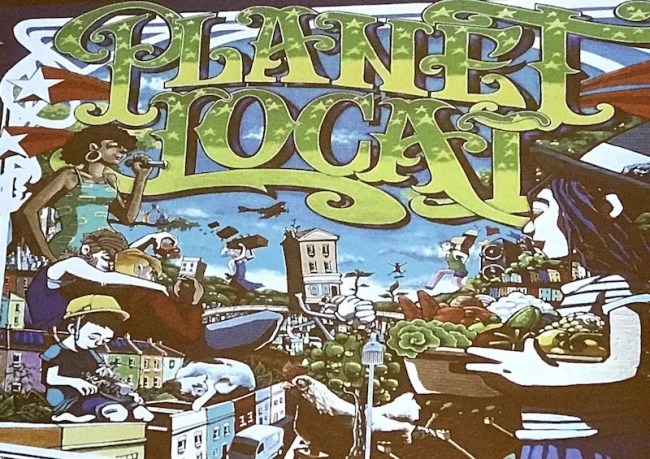
Writer and filmmaker James Murray-White visited the Planet Local Summit, finding in its examples of urgent work around the world to foster being and acting locally a cultural turning towards nature as antidote to climate and ecological breakdown.
1,800 words: estimated reading time = 7 minutes
Once in a while I’m fortunate to attend a gathering — truly in this case an in-gathering of a community — that is so warm and focused that my intuitive heart knows that this is a real crystallisation of the worldwide urgent work going on, and that this will be a big impetus for it to flourish, broaden and deepen.
Helena Norberg-Hodge, inspirational founder of Local Futures, the organising NGO, spoke in her opening address of the Planet Local Summit of all attendees being part of the ‘bacterial mycelia’ seeding the crucialness of acknowledging our local belonging. This felt a deep truth and, as I write and reflect, still feels the best take-home gift. I left Bristol feeling energised to return home (currently Cambridge) with many gifts, new and old connections made and refreshed, and a strong motivation to keep working at a local level. I returned specifically to co-host a public engagement event called Dear River, of which more later.
Helena set the term ‘localisation’ as the antidote to the twin threats of climate and ecological breakdown, happening at speed now in every corner and continent of our planet, and the death march of the industrial/economic system that capitalism has wrought upon the human world. By acknowledging, being and acting locally — in terms of fostering community, emphasising well-being, local food growing, and community care — including finance staying within our local systems, Local Futures describes localisation through these actions as “a cultural turning towards nature” and “an expression of our need for connection — both to others and to all living beings.”
This was the first post-pandemic gathering for me that I felt called to, due to both the high-profile speakers in-person and the sessions sharing case studies of specific local actions and issues. From Helena, Bayo Akomolafe, Morag Gamble, Iain McGilchrist and Charles Eisenstein to many other brilliant engagers, thinkers and philosophers, pragmatists, growers and weavers, the hall at St George’s, associated spin-off rooms — including the cafe/bar, and various rooms at the nearby Folk House venue, and The Tobacco Factory arts centre to which the summit relocated on day three — were all humming with conversations and ideas brewing and being dissected and unpicked.
The big evening conversation on the Friday, a much-hyped conversation between XR co-founder Roger Hallam and ex-Government Minister Zac Goldsmith felt almost a dampening of the enthusiasm during the day: neither seemed to absorb the energy of the gathering, and while they found a kind of middle ground around failures of policy, and the potential of coming bloody revolutions (and the history of previous ones), neither could really offer any threads to hold hope upon.
The community-building that XR and Just Stop Oil has created is hugely commendable and needs anchors and deep seeding across all levels of our societies. I recently heard about an elderly couple who watched Chris Packham’s incisive and timely documentary struggling with his conscience about being arrested for activism and using his powerful voice; and they are now inspired to act, in whatever local way they are able.
On the other hand, Goldsmith’s tale of woe and pressure from lobbyists, including in one notable case the National Farmers Union, against plans for environmental support he was proposing is simply insane, and needs calling out. This is the industrial death machine of chemicals, vested interest, power; the insecurity of the human mind, tragically, that has created this huge schism in a world with so much staggering beauty, potential, and constant flux and change. The next day, Charles Eisenstein’s words — “The idea that the change can happen with the right person in charge is inherently wrong” — reminded me of Goldsmith and Hallam, and also the pedestals and stages we create for leaders to stand on (and fall or get kicked off, because we’re fallible humans!).
It was a joy to hear philosopher Iain McGilchrist reflect upon the theme, both alone and in conversation with Bayo Akomalafe and then Helena. I’m struck by his phrase:
“We are here to respond to the values of the universe, both in belonging ourselves and as part of the human community; to develop and expand our relationship to the natural world, and, partly as a result of these two practices, to live within divinity.”
A one-to-one conversation with Iain became a beautiful engagement around the theme of grace, which is an enduring talisman for me to hold. I recommend Iain’s The Master & His Emissary for an erudite scientific dissection of the schism in our body-brain and how this permeates across human history.
Food and farming, and the systems that support them, was a key theme of the Summit. With another hat on, I’m a member of the team making Six Inches Of Soil, a new documentary on regenerative agriculture and new entrant farmers, which will be premiered at the Oxford Real Farming Conference early in 2024, so I’ve an interest here, as I hope we all have. It’s increasingly clear that knowing our local farmers and buying direct or from local farmers’ markets, with local supply chains, is vital to planetary health and soil-human survival and potential thriving.
Chris Smaje, smallholder, writer and food activist, based outside Frome, and Jyoti Fernandez, farmer, activist, and co-founder of the Landworker’s Alliance, are tremendous forces for good in this sphere. Both are making change, standing strong against big farm companies and food/meat manipulation and galvanising opinion.
It was refreshing to hear from Nelson Mudzingwa, a Zimbabwean farmer who has struggled to gather seed sovereignty and organic certification across his land and the African continent. By open source seed saving, his collective is developing crop resilience to climate change in their region. Words of hope from a country known for bitter political struggle. Farmer, former head of the Soil Association and now founder of the Sustainable Food Trust, Patrick Holden chaired this session with passion and aplomb, though I found his constant allusions to connections across the CEO worlds, including Bill Gates, distracting and pretty irrelevant given the brilliance within this audience and panel.
Speaking from a new story
A day and a half in, however, I was chomping at the bit for news from really local actions, initiatives and community building from these isles. As a former Bristol resident, I know that this city is bursting with creative social enterprise and strong community efforts, particularly around peri-urban food growing and combatting poverty. It’s a gritty sprawl of communities, and I sadly heard there had been a stabbing that led to a fatality in a neighbourhood nearby on Friday.
I had expected to meet the Street Goat Project bringing their furry troupe up the steps of St George’s to engage with us all. However I found the answer in a brilliant presentation from three members of Frocal in the village of Forest Row, Sussex: in a nutshell, asking themselves “what it might be like if we all lived and acted more locally?” They gave examples of their success and failures and acknowledged that it was a work in progress, albeit a vital effort for these times. I will visit friends there and investigate shortly. Frocal feels like a really valuable and catalysing project.
Other takeaways for me include the theme of colonisation of the mind as well as land and countries and continents: Vandana Shiva in her pre-recorded video highlighted this, reminding us that just 600 men created the East India Company treaty (that our monarch signed and sealed) to sail off and colonise that part of the world. Anthropologist Darcia Narvaez picked up on this with her fascinating presentation on her work on Nestedness, agreeing “we are all colonised”, and how might we respond to that knowing? Her thesis continues in the knowledge of our connectedness to, and acceptance of, our heritage.
Keynote speaker Charles Eisenstein delivered a meandering wander through his response to the topic — “ I trust the deployment of the intelligence that my gifts will be useful for” — and concurred with the broader theme that we “need to speak to people from a new story”. He brings a wisdom to our human need to really acknowledge that “technology is reaching deeper and deeper into the core of what it means to be human” and that our “common goal is to rekindle our connections”.
Sadly, I had to leave after two days, and the third and final day of the summit relocated to another Bristol venue, and I suspect drilled down more into very local UK and Bristolian specifics.
What called me very strongly back to my locale was an event I co-hosted to celebrate water and river systems at this time of waking up to the sorry state most rivers are in, and specifically how they are being abstracted from, and our human sewage dumped within. Dear River was a locally-organised gift to our community, to meet the issue with creativity, grief, and space — space to gather, to listen, to respond, and to ask “what can we do?” After two days of deep stimulation at Planet Local and then this event, I suspect that asking this question is our fullest human response.
Find more
The Planet Local Summit took place from 29th September to 1st October 2023, in Bristol, UK. You can find the full programme, find about the speakers and watch the livestream recording on the Local Futures website.
James highlights Iain McGilchrist’s book The Master & His Emissary (2009). You can find out more at Channel McGilchrist, and James shares his experiences taking part in and filming a retreat with Iain in a post for James’s Finding Blake project on William Blake: Exploring the Divided Brain.
And Six Inches of Soil is the film James has been working on: “the inspiring story of British farmers standing up against the industrial food system and transforming the way they produce food — to heal the soil, benefit our health and provide for local communities.”
And here on ClimateCultures, you will find many other pieces by James, including his review of fellow member Susan Holliday’s book, Hidden Wonders of the Human Heart.
Artist Hanien Conradie shares the impulse and process behind a Covid19-lockdown collaboration that brings together image and text; and how, in a period of human silence, her muse and the natural world seemed to work in similar ways.
2,170 words: estimated reading time = 8.5 minutes + gallery
What does it take for distracted creatives to surrender to the cries of their muse’s desires? For some it is simple, they hear, they listen and they translate through making. But some of us academically trained artists scold the muse for her infantile ideas, her need to play and her seemingly inconsistent barrage of desires. And then there are some of us who ignore her voice year after year…
In my practice I work in locally found natural pigments and burnt plant material as part of an expression of climate change and my concern with loss as we head toward a Sixth Mass Extinction. The global ecological anguish and my personal heartache inform the colour palette of my work: earthy ochres and monochromatic black paintings. Black, as a colour of grieving in the West, is also a colour that represents infinite creative potential and has become more and more prominent in my films, my ritual work and my paintings.
Human silence & other voices
As the severe restrictions of the Covid19 lockdown isolated South Africans in their homes, I considered what artworks I could make from a small desk in my bedroom. For quite a few years I have been an active environmental voice, calling for a change in the way we relate to the natural world. Suddenly, because of the virus, the Earth gained respite from our feverish pursuit of money; our disregard for the effect we have on the rest of the natural world. At the same time, everyone became quiet and introspective and the sounds of the natural world became more apparent than before; and people noticed. It seemed to me that the Covid19 lockdown provided the perfect opportunity for humanity to reconsider the way we live. For the moment it felt like my quest for change was interceded by an outer manifestation that was so severe that it forced us to adjust our habits naturally.
Within the human silence of the lockdown, the voice of my muse became more insistent than before. I realized that the workings of my muse and the natural world were similar somehow and that less noise and distraction increased the intensity of my creative compulsions. The very uncertain and unprecedented circumstances swept away my normal, considered academic approach to my practice. I felt like breaking free from all my self-imposed limitations, obligations and preconceptions about what my art should be. I imagined that this is how artists might feel during times of war: the focus shifts from making work for others to making work because this is what I do to keep myself sane. I thus found myself surrendering to whatever my muse wanted to make.
I had recently been gifted a set of Winsor & Newton Artists’ Watercolours with 24 colours in a beautiful transportable black box. The new paint had my muse salivating and my hunger to make small brightly coloured paintings seemed vast and insatiable. Before the lockdown, I had planned to make on-site landscape portraits with them. This idea was in keeping with my practice of visiting and relating to living natural landscapes, but traveling outside of my home was prohibited during lockdown.
In addition to the delicious paints, my partner inherited an equally delectable collection of National Geographic magazines from his father. Whenever I saw their bright yellow spines I remembered the remarkable pictures hidden inside and my childlike delight as I pored over the magnificent mysteries of our existence through their pages. Since my muse was completely uninterested in working with the only ‘living’ places I had access to — the interior of my home or my small garden — I decided to page through the magazines. I started to mark any images that thrilled me without pondering their meaning too much. I have used this technique in the past to access my subconscious feelings. It turned out that many of the images I paused on featured lone human figures in extreme natural surroundings; environments where the human body cannot survive naturally.
Surrendering to the muse: postcards from lockdown
My burning desire remained to make miniature paintings in my brand new luminous watercolours. I happened to have a few books of Fabriano Postcard watercolour paper available. There was something about the postcard format that appealed to me: the hint of possible travel and its capacity to carry messages beyond my forced incarceration. In the past, I have always used the actual place or my own photographs as references to paint from. Making use of magazine images was a departure from my usual way and alarmed me somewhat. Sailing this close to mere illustration had my academic fine-artist-self protesting: ‘I have a reputation to think of’ and ‘the Gallery will expect more consistency from you’… I ignored this voice and continued to surrender to what delighted and motivated my muse.
Thus, I commenced a ‘vigil’ dedicated to creating in isolation and produced one painting a day over many weeks. The human silence in the first three weeks of lockdown was heavenly: no traffic, no airplanes, and a communal energy of quiet withdrawal in the air. The comforting solitude punctuated by the occasional ringtone or electronic alert mingled with birdsong, a frog choir and the roaring river close by. This symphony of sound was the perfect context for delicate and detailed painting. I felt happy and at peace as my muse took me on an imaginative journey to some of the most extraordinary and far-off places on Earth.
These places, in relation to the inner places I discovered during this practice, made me consider what best-selling author and former monk, Thomas Moore, says in his book A Religion of One’s Own. Moore suggests that as human beings we know a considerable amount about our external world and that, in comparison, we know very little (maybe too little) about our internal worlds. The images from the National Geographic magazines were mostly about discovering and exploring our external world — not only the Earth and space but also the microcosm. In hindsight, I came to understand that the images I selected were not random at all. They resonated with and expressed the internal states I experienced during lockdown. I became conscious of the inherent wisdom of my muse and subconscious mind.
I have since come to an understanding that periods of isolation are essential for humans in order to cultivate inner stillness. It is important to make time to listen deeply to one’s inner reality and to know its terrain well. In my experience this practice also sensitizes us to be more receptive to the ‘voice’ of the natural world.
When lockdown was finally over, I walked down to the river and it was as if I saw an old and dear friend again after a long time of absence. This little ecosystem on my doorstep was so much more magnificent than ever before. And I delighted in noticing that so much had healed and grown since I had last visited: in the vegetation and birdlife but also within me. This enchanting encounter resulted in another postcard series of 21 portraits of the river, titled ‘My Sanctuary’ (2020), which I made for a South African friend living in the UK.
40 nights / 40 DAYS
Allowing my muse to direct my creative process opened up a more spacious attitude to the flow of life in general and, more concretely, helped me to manifest my desires; in this case 40 small bright coloured paintings. I am now able to ‘hear’ and act on subtle prompts from my creative spirit. One of these ‘nudges’ that came to me was a dissatisfaction with the blankness of the backs of the postcards; where greetings and messages should be. Without text the 40 postcards from lockdown did not seem complete.
I recalled fashion-predictor Li Edelkoort’s podcast about the future of fashion design after Covid19. It was a brilliant talk containing some strange capitalistic approaches to the crisis that I found intriguing. I sent this off to friends and one of them, John Higgins, responded with a voice poem.
As a writer and academic, John has long been interested in the question of montage — in film, visual media and in writing. As lockdown took hold, John says he found himself, “like many people in the first phase of Covid19 and the ensuing lockdown … overwhelmed by the tsunami of media coverage … [and] at the same time, reading it obsessively as some form of comfort or distraction.” As something of an active response to the increasingly eerie situation, he began to assemble a number of montage texts from the various books, podcasts, news bulletins and online media available within his lockdown environment.
From the talk by Edelkoort, John selected key sentences and put them together in a montage that revealed the underlying philosophical questions in a very humorous way. I sent him a picture of one of my postcard paintings in response. The combination of the text and the picture revealed a fascinating new meaning, which was a delight to both of us. And, unashamedly, I found my muse asking John to join the project.
Thus two parallel projects commenced, each serving as an antidote to calm our anxiety during uncertain times. John created 40 texts and I painted 40 images, independently from each other. Each project maintains a distinct identity when seen in isolation. In my process I selected images from National Geographic magazines, painted them, and — together as a montage — they revealed something about my inner world during this time. One could say that the 40 paintings are reliant on each other to create the meaning (or full picture) of my exploration. John in turn brought together, and set against each other, fragments of national and international news coverage and commentary with other varied readings from his day; also illuminating his questions and thoughts in relation to the pandemic. The 40 texts John crafted can be read separately but are more potent as one long text that leaves one with a sense of the strangeness of the lockdown experience.
Once we completed our separate projects we carefully paired the texts with the paintings. This process took some time, but eventually we settled on some intriguing combinations: some that were easy to understand, and others that created discomfort and ambiguity.
[Best_Wordpress_Gallery id=”55″ gal_title=”40 nights / 40 DAYS postcards”]
Since the images were painted on blank postcards, we decided to incorporate the text as part of each piece. On the reverse of the cards (where address and message are normally written), I give thanks to my inspiration by referencing the National Geographic ‘address’ of the image: the article title, edition, page number and the photographer. In the ‘message’ section of the postcard I ‘performed’ John’s text by transcribing them by hand. The final artwork is thus double-sided and consists of 40 painted images each with its own message on the back.
Because of the double-sided nature of the final work, it was difficult to display the text and painting simultaneously. To solve this, John and I created a printed book titled 40 nights/40 DAYS: from the lockdown. Here we present the text and image together at a glance. This is when what we describe as a ‘third work’ emerges through the viewer, who makes associations and assumptions based on the information gathered from both sources. One could say that the viewer becomes the creator in this ‘third work’.
Our short film presented here, is another attempt to bring this third meaning to life.
40 nights/40 DAYS is a playful project about serious things. We hope it will both delight and provide some solace in these extraordinary times.
Find more
You can see a different selection from Hanien’s postcard collaboration with John in her contribution to our Quarantine Connection series from April-June 2020. Hanien Conradie: 40 nights / 40 DAYS appeared on Day 36. All 40 images that Hanien used for the series are displayed at her website, and the original paintings are available from the Everard Read Gallery in Cape Town, South Africa. Contact ctgallery@everard.co.za for a portfolio.
Also available for purchase is the hardcover book, 40 nights/40 DAYS: from the lockdown. This can be ordered from Hanien at hanienconradie@gmail.com.
You can listen to the Business of Fashion podcast (27/3/20) featuring futurist Li Edelkoort, which triggered Hanien’s collaboration with John Higgins. The sources from which John took the textual fragments included media coverage from radio, television, and online sources such as Daily Maverick, The Guardian, the Washington Post and the New York Times; Li Edelkoort’s Business of Fashion podcast; and (dusted off and taken down from the bookshelves) Sir Edmund Burke’s Philosophical Inquiry into the Origins of our Ideas of the Sublime and the Beautiful (T. Noble: London 1845); Plato’s Protagoras and Meno (Penguin: Harmondsworth 1956); John Ruskin’s Modern Painters Volume 1 (Dent: London 1935); John Ruskin’s The Stones of Venice (George Allen: London 1906).
A fine artist concerned with place and belonging, informed by the cosmology of African animism within the complex human and other-than-human networks that encompass a landscape.

 Artist and writer James Roberts shares Rise and Fall, his short, award-winning film-poem, which gives us all space, an invitation to find calm, to experience our local rivers, to find a practice of connection and show some reverence.