On Being Water Beings — “A Return to Water, Rather Than Dust”

Writer and filmmaker James Murray-White, in conversation with Veronica Strang about her new book, Water Beings, finds connections with his own work at a time when water is under threat and we need to rebalance our elemental relationship.


2,850 words: estimated reading time = 11.5 minutes


“Water serpent beings’ abilities to be monstrous also traverse scales. They can lurk within the individual psyche and represent the seething inner sea of instincts and emotions, or they can reflect tensions and fluid capacities for disorder at a societal level, such as the chaos represented by war or revolution… At a cosmic level, they can represent apocalyptic events – the Flood, the volcanic eruption, the earthquake, the tsunami.”

— Veronica Strang, Water Beings: From Nature Worship to the Environmental Crisis.

Showing the cover of 'Water Beings, by Veronica Strang (published 2023)
‘Water Beings’ by Veronica Strang (2023)

Water in crisis

Recently I’ve been sensing a disconnect between me and water. I live close to an iconic river, in which I learnt to swim and as a teenager had lucrative summer jobs punting tourists along it. However, the River Cam, like most if not all UK water systems, is heavily polluted, and I know of many local cases of humans and dogs who have been seriously unwell after a dip.

The data for the newly designated bathing status at Sheep’s Green in the Newnham area of Cambridge recenly showed high levels of e-coli and other nasties that have leached down from a sewage pumping station some miles away. In addition, the heavy winter, spring and now summer, rains we are getting in this normally drier part of the land often wash off concrete and create epic floods, with run-off washing into the rivers and through the soil.

I’ve just made a short film about one of East Anglia’s chalk streams, the Newmarket Brook, and I have been learning from geologists and hydrologists about chalk streams’ unique qualities and fragility. This one is in varying states of health. I also helped a friend, Tony Eva, make Pure Clean Water, a film about Hobson’s Conduit, which flows from the springs at Nine Wells, by the hospital, through various colleges and into Cambridge. It is in a perilous condition, continually abstracted and contaminated.

Away from just this one city, the human world is at war, and water gets scarce and used as a threat for those being persecuted and bombarded. We’re in a water crisis and if we are to survive as a species and remain equitable with our ecosystem, our relationship with all the elements must rebalance. Recognising this disconnect is the start, and framing our connection to the sacred and to older knowledges feels like an important way forward. A crucial way forward.

It’s timely then to discover Veronica Strang’s body of work, and engage with the growing movement towards river/nature rights. The vast body of human creativity around water and water beings comes to the fore in her book, which really resonates and brings joy to this jaded mind. If many of us unite around care for water and becoming water guardians, from a variety of faith beliefs, political and ecological opinions and none, our human power can make a real difference.

I’ve recently been a participant in two University of Cambridge conferences on water-human relationships where Veronica delivered keynote lectures. Her research straddles anthropology, archaeology, theology, philosophy and more — ranging across human history, our experience with and belief in beings that inhabit watery realms, and our cultural imaginations and psychological systems.

Water Beings – from Nature Worship to the Environmental Crisis is a very deep dive into watery worlds inhabited by a vast array of extraordinary more-than-human beings, and into our imaginative nature as an ancient species. Every society has developed complex and intricate beliefs and knowledges around water beings and their values, roles and responsibilities, including our projections on them as either benign or monstrous. Living alongside them, dreaming of them or even being devoured by them, has given humans a sense of fear, worship, adoration, and veneration. Perhaps now is the time to fully merge our substantive presence on the earth with water creatures?

Water Beings - showing 'Muisca tunjos', votive offerings to ancestral serpents believed to inhabit Lake Guatavita, Colombia, 10th–16th century CE, gold.
Muisca tunjos, votive offerings to ancestral serpents believed to inhabit Lake Guatavita, Colombia, 10th–16th century CE, gold.

A confluence of knowledge and imagination

While grounded in academic scholarship, Water Beings reads like a flowing chronology of connectivity, an important congregation of how the planet’s climate and delicate ecosystems and the human creative impetus to respond all come together. Ultimately, this work is about narrative, fact and fiction: stories and images of water beings are part of our human construct, and now is a time to acknowledge and honour them. What might they mean? What might they anticipate?

The book’s ten chapters categorise types of water entities — irrigating beings, supreme beings, demonised beings, reformed and transformational beings and more — and frame our ways into their study. A key final chapter then sharply focuses on the now, why we are in this condition of crisis and dis-connection, and ways we might return to a closer, healthier framing. I’ll return to that important chapter.

Water Beings - Showing Nyai Blorong, Goddess of the South Sea, Java, before 1928: Unknown artist, watercolour on paper.
Unknown artist, Nyai Blorong, Goddess of the South Sea, Java, before 1928, watercolour on paper.

I was particularly delighted to discover in chapter 8, ‘Supreme Beings’ — as Strang moves forward with her story, societies become urbanised and with that comes monotheistic faith structures and practices — an image from William Blake, ‘Moses erecting the brazen serpent’.

This chimes with an ongoing absorption into Blake’s prophetic work I have through the Finding Blake project, a fascination with his fourfold vision. Here, in an underwater realm, serpents are coiling around humans, literally squeezing the life out of corrupt sinners, while Moses stands watching upwards to the head of the main water serpent. Here is an image of the entwining of watery beings which has become the symbol of medicine and healing: caduceus.

Showing William Blake, Moses Erecting the Brazen Serpent (Nehushtan), c. 1800–1803, pen and watercolour on paper.
William Blake, Moses Erecting the Brazen Serpent (Nehushtan), c. 1800–1803, pen and watercolour on paper.

Water is rare in Blake’s paintings, and where it does appear it often represents the subconscious, a metaphor for yearnings, regrets. Here it is a vessel, dominated by these beings of great power, human victims in their coils — and yet the interplay between them and Moses is highly significant: dominion and dominance. I’m not aware of Blake referencing the Thames in his work, despite living very close to it for most of his life, yet surely it played a role within his unconscious knowledge of the world. I wonder if he saw serpents and watery beings on his daily walks alongside it? I’m led to believe he and his wife Catherine could see the river from their last flat, where he died, which is now under a major London landmark hotel.

Chapter 10, ‘Reformed beings’, flows up to contemporary times, and the use of images of water beings in literature, films and more. This makes me think of the local town of Ely, once a town of eels, fished for and captured in plentiful supply and shipped off to London as a commodity. Now the eels are gone, with the last remaining eel catcher, into mythology of both creature and trade. Eels live on in artworks, sculptures by the river, and paintings aplenty in local galleries and markets — a symbol of this fenland town. Many tales of the fens are marked by the beings that once inhabited waterways since cut as agricultural drains: part of the industrialisation of land reclaimed from watery bog.

‘Turning The Tide’, the final chapter, forms a confluence, bringing together knowledges from countermovements — indigenous activists, campaigners for social and ecological justice, nature-worshipping religious groups, legal activists, and scholars — to include learnings and imaginings from all kinds of creative practitioners, strongly making the case for recognition of the rights of the more-than-human, and water itself: ultimately, the vessel and element that holds us all.

Here, the full power and resonance of the author’s research comes to the present day, and she offers the full weight of her learning and sharing:

“Today, in a world urgently in need of a change in direction, the stories that water serpent beings tell, and their capacities to represent alternate visions of human-non-human relations, may be the most crucial role that they have ever had.

“As our water serpent beings have shown, societies that have achieved long-term sustainability have done so by maintaining steady-state or circular economies, rather than embarking upon spirals of growth and expansion.”  

Returning to my home city of Cambridge, plagued by the constant over-hanging clouds of development and the ‘growth agenda’, this message needs to ring loud — and just maybe the water beings may rise again from the Cam, or emerge in eel-like form to teach humans this lesson of steady state fluid dynamics. Human and watery other.

Showing 28 Double-headed water being in the form of a ship, Viking Age plate brooch from a grave in Lillevang, Bornholm.
Double-headed water being in the form of a ship, Viking Age plate brooch from a grave in Lillevang, Bornholm.

Water Beings: a Q&A with Veronica Strang 

JMW This is such an extraordinary work of rich, deep scholarship. I appreciate greatly the visual, literary and historical journey you take the audience on, and feel enriched by this book. 

VS Thanks for this kind comment — this research has been a wonderful experience for me. Although water beings appear regularly in folklore, ethnography, history and theology, no one has previously researched aquatic deities systematically and comparatively, and venturing into this new research area has been an extraordinary adventure. Water beings have so much to tell us.

JMW Can you share how this study started, and tell us some of your journey following the waters and the watery beings?

VS My research as an anthropologist has always focused on human-environmental relationships, people’s beliefs and values, and particularly their engagements with water. I have explored a range of issues relating to water: ownership, governance and management; conflicts over water; religious beliefs about water; and rights to water, for humans and for non-human species and ecosystems. Much of this work has been in the UK, Australia and New Zealand, and more briefly in Malawi. But the issues around water that interest me recur all around the world.

Water beings swam into my research very early on. In the early 1990s I worked with indigenous Australian communities in Queensland and learned about the Rainbow Serpent that is so central to their lives. A decade in New Zealand, during which I conducted research with Maori iwis on water ownership, rights and management, brought me into contact with their beliefs about rivers as living ancestors, and their taniwha and other water beings. Realising the vital importance of these aquatic deities caused me to pay attention to them elsewhere.

It soon became clear that — since all early human societies worshipped the non-human domain, which we call Nature — water beings (as well as other elemental and non-human ancestral figures) were ubiquitous in human history. And in all of these early societies water beings performed similarly vital connective roles: personifying the creative and potentially destructive powers of water; forming the world and populating with human and non-human beings; providing humans with consciousness and enlightenment; exerting religious authority and, above all, generating water and life in annual cycles of production and reproduction. So for several decades I collected images and narratives about water beings all over the world: feathered and water lily serpents in Central America; African python deities, Arctic undersea beings; Indian nāgas; Japanese cloud dragons and Chinese imperial dragons; North-American Pueblo horned serpents or, on the north-west coast, wolf or bear headed beings; Amazonian giant anacondas and celestial boas; Celtic deities in rivers and springs; Norse sea serpents, and Eastern European rain dragons.

What happened to these water beings over time in different cultural and historical contexts gives us an illuminating narrative about different societal trajectories and transformations in people’s relationships with water and the non-human domain. And so the project grew into the major comparative study that forms the basis of my book. The study shows how growing instrumental control over the environment altered the relations of power between human societies and their environments, and led changes in beliefs and practices in relation to water deities. As humans gained more technological power over water, and felt more ‘god-like’, a fascinating pattern of deity humanisation emerged. This led to the semi-humanisation of water beings, or their displacement by deities in human form, and culminated in the major monotheisms assigning authority to human, male gods and demonising the non-human beings of earlier religions.

JMW Would you explain a little about how you chose to structure the book, and make these categories of beings? And which of the world wide canon of water beings you have researched most captures you? 

VS Water Beings follows the changing patterns in societies’ relationships with water through a comparative study of their water deities. Although these changes happened at different times in different places, the book is loosely chronological, starting with the water beings of the earliest human societies and those that remain central today in place-based indigenous communities. Such societies understood the co-creative role of the non-human domain, manifested in water beings, and sought to have reciprocal and respectful relationships with them. They also maintained relatively egalitarian relationships in their political arrangements, being led by both male and female elders.

The text then moves to examining the effects of greater human control over water, for example in ancient irrigation societies, and considers how their religious and political arrangements changed alongside their new infrastructures. With new hierarchies and centralised governments, power shifted from water deities into the hands of (usually male) priests and deified rulers who became the figures responsible for bringing the rain and maintaining social order.

The following chapters explore how, as societies became more technologically powerful, water beings were made subservient or subsumed by new deities in human form until, with the rise of monotheisms that separated Culture from Nature, and sought dominion over the latter, they were demonised and slain. It also shows how emerging scientific visions disenchanted the world and consigned many nature deities to ‘folklore’. In the final part of the book, however, we see how this alienation from the non-human domain, and the exploitation of other species and environments that it encouraged, has led to the current environmental crisis. There is now an increasing understanding that there is an urgent need for humankind to regain more convivial, and therefore more sustainable, relationships with water, ecosystems, and other living kinds.

The book therefore also examines new visions of water beings in recent and contemporary art, literature and film, in which they are recognised and respected as key manifestations of the co-creative powers of the non-human domain. These emerging images and narratives express people’s growing desire to reconnect more positively with other living kinds and ecosystems.

As for which water beings have captured me the most? I can never choose. My first love was the Australian Rainbow Serpent, but they are all extraordinary and wonderful, beautiful and terrible, and endlessly fascinating. 

JMW Anthropological research gives us an opportunity to look back at historical evidence and to engage with local/cultural knowledges. In this case there is such a desperate need to apply all this knowledge to how we respond to water now, which you explore in some depth in the final chapter. How might we look back in 100 years, with your assessment of the current trajectory of human/water relations? 

VS My research helps, I hope, by showing how, for many millennia, human societies maintained respectful relationships with water and the non-human domain, in which people sought to protect their needs and interests as well as those of human beings. It shows how and why many societies moved away from such egalitarian visions to seek power and dominion over ‘Nature’ and how this increasing inequality led to exploitative and unsustainable practices. Most large societies are still on this trajectory, led by ideologies of growth and expansion, and the belief that yet more technological control will solve the problem. Meanwhile, species and biodiverse habitats continue to disappear, human populations and their use of resources continue to increase, and it seems that humankind is dragging the world towards a painful and potentially critical collapse.

But in almost all societies there are also passionate counter-movements: social and ecological activists and indigenous communities striving to promote alternate ways forward. They share a transformational vision of human and non-human equality, circular economies, more sustainable lifeways, and beliefs and values that recognise the vital co-creative role of the non-human world. These movements are growing: more and more people are pushing their local and national governments and international bodies to make better choices. What the world looks like 100 years from now will depend on whether they can succeed in turning the tide. And in this battle — and it is indeed a battle for human and non-human survival — water beings, as compelling personifications of non-human power and creativity, are a vital narrative device for communicating ideas about how we might engage with water differently.

JMW Do you feel positive about us working with the more-than-human to assert the rights of nature and the rights of water within human law/psychology?

VS How could one feel other than positive about working to uphold the rights of all living kinds in what is fundamentally a shared interconnected world, in which human and non-human wellbeing cannot be separated? This is surely the only rational and ethical position from which it is possible to see a future in which all of us can flourish. So yes, I feel immensely positive, and indeed privileged, to be able to work with these amazing water beings and their wonderful capacities to communicate a more hopeful vision of the future.


Find more

Water Beings – from Nature Worship to the Environmental Crisis by Veronica Strang is published by Reaktion Books (2023). Veronica is a Professor in the School of Anthropology and Museum Ethnography, University of Oxford. You can explore her work — and watch a summary video of a planned TV series based on Water Beings — at her website.

James has made or collaborated on water-related films and projects, including The Waterlight Project, Pure Clean Water (2023), River Of Light (details to be published at The Newmarket Chalk Stream Trust). He took part in the recent Being With Water Otherwise conference, where  Veronica was keynote speaker. You can read Un-tending the World – A Geopoetics of the Wild, his recent review of Two Lights by James Roberts. James is also creator of the Finding Blake film and project; Mark Goldthorpe, ClimateCultures editor, is editor of that website and the Waterlight site. In a recent Waterlight blog post, Religion and Climate Futures – Waterlight Screening & Cambridge Unseen ‘Chalk Walk’, James discusses a recent screening of the Waterlight film at a Cambridge University and LSE joint summer school and the interest in chalk streams and further film making that Waterlight has helped stimulate.

James will be in conversation with Veronica at the Into The Wild gathering in Sussex on 25th August. The festival itself runs 22nd-26th August.

Chalk-streams is a blog by Charles Rangeley-Wilson, a writer and conservationist with a lifelong passion for rivers.

James Murray-White
James Murray-White
A writer and filmmaker linking art forms to dialogue around climate issues, whose practice stretches back to theatre-making.

Regional Futures: Giving Voice to Human and More-Than-Human

Artist Kim V. Goldsmith shares her work with Regional Futures in NSW, Australia, exploring people’s feelings for rural territories. We need to listen better to each other, ourselves, and more-than-human worlds for more collaborative approaches to the future.


2,600 words: estimated reading time = approximately 10 minutes + option audio pieces


Few of us in the ClimateCultures network would dispute that rural and regional territories across the world are on the frontline of climate change. In the past six years, south-eastern Australia has experienced severe drought (2017- 2019), described by our national weather bureau as “a situation with no clear historical precedent” [1], followed by the unprecedented bushfires of 2019/20 that burnt 5.5 million hectares or seven percent of New South Wales (NSW) [2], and just last year, record rainfall events resulted in floods across south-east Queensland and NSW considered to be in our top three historical natural disasters. These are not records to take pride in.

Listening to regional futures in New South Wales

In early 2022, when I was given the opportunity to delve into how people in the regions of NSW feel about the future, it was knowing I’d be working in the heartland of politically conservative Australia [3], where farming and other primary industries are heavily reliant on fossil fuels. I have lived and worked in this part of Australia for most of my life. Despite the devastating impact of drought, fire and floods on these communities, the majority in rural Australia will unfailingly continue to vote for conservative parties. As happened in May 2022, when the Labor Party returned to power in Canberra but little changed in regional electorates. This pattern of voting behaviour continued to result in a similar outcome in the 2023 NSW State election — where the political battlefront was Western Sydney not Western NSW. The only real change has been more conservative Independent candidates in the race against the parties they were once part of.

In her book, How to Talk About Climate Change in a Way That Makes a Difference, Dr Rebecca Huntley writes: “There is clearly a disconnect between what people say they are worried about and want action on and who, when given the chance, they pick to lead their country.” Huntley references Per Espen Stoknes’ book, What We Think About When We Try Not To Think About Global Warming, where he writes: “For those of us who find ourselves stuck in the moral conundrum of the climate doom story, passive denial offers an easy way out.” One might argue that voting actions are perhaps more active denial, as we’ve seen in regional electorates.

However, Huntley also talks about the constant repetition of climate change facts and figures as a familiar script that can leave us cold or, even worse, bored, creating a collective stupor. What the science tends not to recognise is our messy social realities — the rising cost of living, housing shortages, poor health services, personal safety, and mental health issues. The day-to-day chore of living tends to take priority over environmental concerns.

Showing artist Kim V. Goldsmith listening to a solar inverter with an electromagnetic microphone.
Artist, Kim V. Goldsmith listening to a solar inverter with an electromagnetic microphone.

As an artist, my interest over the past decade has largely been creative interpretations of acoustic and social ecologies — the intersection of human and more-than-human species in often fragile and vulnerable rural and regional territories. When the opportunity to be part of a project called Regional Futures came up through the NSW Regional Arts Network — funded by the State Government — I was keen to develop a series of works that would give a voice to the voiceless in our regional environments, and provide a platform for under-represented individuals in the regions to share their fears, anxieties, hopes and dreams of the future — things we are not often asked about. My project is called Vaticinor (The Augur), a reference to predicting the future by observing natural signs.

Over several months, I spoke with 18 residents of the Central West and the Mid North Coast regions of NSW, in an inland/coastal conversation about how the transition to renewable energy sources might shape net-zero regional futures.


Aged 15 to 70, the storytellers in this montage all believe Regional NSW is a wonderful place to live but their stories and concerns are genuine and their messages urgent.

My home region of the Central West was the first Renewable Energy Zone (REZ) to be declared in Australia because of its potential (and proximity) to contribute energy to the national electricity market through large-scale solar and wind developments. It’s being billed as a power station of the future. The NSW Government is overseeing the development of the zone, including transmission projects, and expects up to A$5 billion in private investment to the region by 2030. The intended network capacity of this zone is three gigawatts, enough to power 1.4 million homes [4].

What this looks like on the ground is kilometre after kilometre of rolling hills or cleared flat, red soil country covered in black solar panels — shiny sun-seeking faces dominating the landscape; and giant, white wind turbines, blades gracefully arcing against blue skies, spread across thousands of hectares of farmland. Some of these developments sit on farming land while other parcels of land are dedicated to the cause.

Regional Futures: Showing wind turbines near Wellington NSW, part of the Bodangora Wind Farm. Photograph: Kim V. Goldsmith
Wind turbines near Wellington NSW, part of the Bodangora Wind Farm. Photograph: Kim V. Goldsmith

Communities within the REZ are torn about the good these massive clean energy developments offer, despite the negotiation and distribution of community fund sweeteners. Some see solar panels and wind turbines as an eyesore — impacting the visual amenity some regions have come to rely on for attracting new residents and tourism; others believe it is poor use of productive agricultural land needed to feed and clothe us into the future.

The regions, particularly those inland, are doing much of the heavy lifting when it comes to energy supply in the form of food and power production. Cities and more densely populated coastal areas are facing critical land and housing shortages, with limited capacity to produce food or power for their growing populations; they will lean more heavily on the regions in years to come [5].

Investments into renewables is an opportunity for some who have fought to remain viable through droughts, floods and seasons of low productivity; solar or wind hosting arrangements are providing the financial security they need to remain on the land they love.

Karin Stark lives on a farm near Narromine — a particularly conservative rural community in the Central West, where she has driven the conversation around renewable energy in agriculture. With her credentials in environmental science and farming, she’s keen to see rural and regional communities empowered in the transition to renewables, particularly in areas where there’s large-scale development.

“It’s important that agriculture does continue to develop and adapt to different technologies, different weather events, to secure our food supplies. But I think really with energy and food we need to have a more interconnected or integrated way of thinking, so that we can do both in this region.

“There needs to be more focus on the distribution level of allowing farmers and regional communities to produce the energy themselves rather than (rely on) these massive solar and wind farms.”

Some are quietly fearful of what the future holds for rural communities despite the work being done to adapt. Fourth-generation Narromine farmer, Bruce Maynard won the prestigious National Landcare Award in 2022 for his agroecology work and advocacy, believing that broadening the on-farm biodiversity base also means broadening the productive capacity. He firmly believes people are the reason behind doing any of this.

Regional Futures: Showing Bruce Maynard, 2022 National Landcare Award winner and fourth-generation farmer at Narromine in Central West NSW. Photo by Kim V. Goldsmith.
Bruce Maynard, 2022 National Landcare Award winner and fourth-generation farmer at Narromine in Central West NSW. Photograph: Kim V. Goldsmith

“I do feel somewhat challenged and pessimistic about rural communities in Australia in particular, in that they continue to shrink. I put people first, landscape, and then business third as serving those other two main factors … for any of our efforts out here to be worthwhile, I believe it needs a thriving community.”

Conversations with discomfort and hope

Transitions to new ways of being and thinking don’t come without discomfort and a strong sense of inequity. For those not privileged enough to buy into the renewables revolution or who are simply more concerned about their personal safety and putting food on the table, the conversation about climate change and what that means is still abstract.

Having recently moved to the Central West for a job following tertiary study, 25-year-old Bageshri still has close ties to India.

“There are people I have grown up with that have way more complex issues to deal with, just regarding their safety or the place that they live.

“I definitely think people who can make change are people in positions of power, people with money, people with influence. We just need to really look at who we’re voting for, and elect people who actually think about the future.”

Stephen Callaghan moved to Dubbo in Central West NSW about six years ago, to an area of the city he describes as a low socio-economic area. To offset rising power costs, his family used a small inheritance to invest in a solar battery system. It’s something they felt they couldn’t afford not to do.

“I honestly don’t know, looking at our electricity bill, how some of our neighbours are coping. 

“I can see a future where it’s not going to be survival of the fittest, but it’s definitely going to be the haves and have-nots, and it’s going to be related around power and energy.”

Net-zero targets by 2050 were described by 16-year-old high school student, Madelyn Leggett as being like a homework assignment. She has a very strong sense of her place in the world and is itching for the day she can exercise her vote.

“People procrastinate and procrastinate, and nothing gets done and then we reach December 2049, and we go ‘Oh! Nothing’s happened!’ We still haven’t changed enough, and there still hasn’t been enough policy or legislation passed to make an effective change or impact on the environment.

“I think the political push for a net zero world is there. And I think it does affect people’s outlook on how we see the future and I think it affects the way that people consider not just consumerism but voting and democracy, and how they consider their political actions.”

Regional Futures: showing High school student, Madelyn Leggett, from Wellington NSW. Photograph by Kim V. Goldsmith
High school student, Madelyn Leggett, from Wellington NSW. Photograph: Kim V. Goldsmith

As parents of young children and living off-the-grid in a coastal forest on the Mid North Coast, Aliya Aamot and her partner are passionate about guiding their children through a more ‘self-efficient’ way of life.

“These children that grow up in the bush, with parents who are teaching them life skills, this is what the planet needs for the future.

“It’s very important for us, especially kids in cities to know this process of where the food comes from, how it’s been grown… There’s just so much nature will teach the children just by letting the children be in nature.”

Collaborative, more-than-human regional futures

It’s very easy to put humans at the centre of this conversation — we do it all the time. However, there’s a growing awareness that our future hinges on a more collaborative approach, where more-than-human species gain more rights [6] and a greater voice. This is what has really underpinned my interest in the Regional Futures project and the works I developed through Vaticinor.

I’ve observed the discord at the intersection of the human and more-than-human species across rural and regional territories, yet to be resolved. The multi-track soundscape composition, Humi, I created for the Regional Futures exhibition brings the sounds of the more-than-human together with the built structures and technologies we’ve created for our convenience, including renewables, weaving together a story around this uncertain period of transition between our past and our future. The work is accompanied by a haptic experience, reducing the soundscape to vibrations through 3D-printed hands, reminding us we are one with the sonic world whether we hear it or not.

Showing Humi Haptic Hands co-designed by Kim V. Goldsmith and Brian McNamara, which reduce the Humi soundscape to four frequencies experienced as vibrations through 3D printed hands. Photo by Kim V. Goldsmith.
Humi Haptic Hands co-designed by Kim V. Goldsmith and Brian McNamara, reduce the Humi soundscape to four frequencies experienced as vibrations through 3D printed hands. Photograph: Kim V. Goldsmith

The signs of what potentially lies ahead have been there for some time now, but as Stoknes suggests, ignoring them may have been a way of dealing with the discomfort. The cocoons we’ve woven around our lives in rural and regional Australia and beyond are unravelling in the face of extreme weather events, or as James Bridle puts it in Ways of Being: Beyond Human Intelligence: “…tiny moments of turbulent activity through which we can barely grasp an unseen, unknowable totality.”

As we come to terms with that totality, the challenge will be creating equity for all in the transition to a fossil-fuel-free world at the same time as developing a more connected and entangled life with those other species we share the planet with — those who remain mostly voiceless. We need to listen better to each other, to ourselves, and to more-than-human worlds. In the meantime, we shall continue to sit with the discomfort of our choices.


The Humi soundscape composition is a story of the discordant interdependence of human and more-than-human species against a backdrop of pressing time. Weaving their way through the composition are sounds of species not often heard by the naked human ear or those given little thought to in our daily busyness — earthworms, bats, fish, individual birds in choruses of birdsong reverberating through remnant forests on the edges or urban development and cleared farmland. Meanwhile, manmade structures click and thrum, boom and hum — solar arrays, wind turbines, dam walls, motorboats, and fossil-fuelled vehicles — designed for our convenience and enjoyment, creating around-the-clock noise within worlds we do not hear or see.


References

[1] Australian Bureau of Meteorology: Previous Droughts.

[2] NSW Department of Planning and Environment: Understanding the effects of the 2019-20 fires.

[3] Australian Electoral Commission: Results from the 2022 Australian Government election at which the Australian Labor Party won (last in power in 2013).

[4] NSW Government: Central-West Orana Renewable Energy Zone.

[5] Greater Cities Commission: Past, present and future.

[6] The Brooks McCormick Jr. Animal Law & Policy Program at Harvard Law School: One Rights: Human and Animal Rights in the Anthropocene (3/1/23).

Find more

Kim V. Goldsmith was commissioned by Dubbo Regional Council in partnership with Orana Arts to be part of the Regional Futures project. For more information about the Vaticinor project and resulting artwork, see Vaticinor.

The first Soundcloud audio piece in Kim’s post is a 39-minute montage of 18 storytellers sharing their thoughts about the future, presented for exhibition as part of the ‘Regional Futures’ series of exhibitions in NSW Australia, in a vintage suitcase, upholstered in custom-printed fabric, with postcards of links and invitations to audiences to share their story. 

The second Soundcloud audio piece is ‘Humi’ (in/on/to the ground), a 15-minute composition of field recordings, transitional tones and chords melding sounds of the Mid North Coast, Manning Valley and Central West of NSW into one story; a story of the discordant interdependence of human and more-than-human species against a backdrop of pressing time. 

The sound and text works of Vaticinor will be shown in Sydney from 24th June – 24th September 2023 in Regional Futures: Artists in a Volatile Landscape, at Casula Powerhouse Arts Centre, Western Sydney.

You can read Kim’s previous post for ClimateCultures, co-authored with Andrew Howe: Mosses and Marshes: Creative Engagement with Wetlands.

The books Kim quotes from are:

Kim V. Goldsmith

Kim V. Goldsmith

An artist exploring layers of nuance, complexity and hidden elements to present rural, regional and remote landscapes and communities in ways that make the familiar, unfamiliar.

Ecoart in Action – Provocations to Creative Engagement

In their third collaborative post reviewing Ecoart in Action, artists Claire Atherton, Beckie Leach, Genevieve Rudd and Nicky Saunter explore the provocations this book offers for ecoart practices and discourse — complementing their earlier discussions on the book’s activities and case studies.


2,100 words: estimated reading time = 8 minutes + optional 20-minute video


In their previous collaborative posts on this book, participatory arts practitioner Claire Atherton, teacher and storyteller Beckie Leach, environmental community arts projects leader Genevieve Rudd, and entrepreneurial thinker and practical activist Nicky Saunter reviewed the earlier sections, which provide ecoart activities and case studies from around the world. The book ends with this section — a series of provocations where contributors from the international Ecoart Network focus on theories underpinning ecoart practices, offering ideas for creativity in different learning environments and communities. As you will see in their video discussion, our four artist-reviewers found many opportunities in the wide-ranging provocations on offer.

The full set of eleven provocations is:

— Allodoxic Interventions as a Form of Ecoart
— Ecoartists as Key Educators in Eco-Transdisciplinary Learning
— A Framework for Ecosocial Art Practice: Integrating Guattari’s Ecosophy and Action Research
— The Art of Inquiry: A Learning Manifesto
— Collaboration, Complexity, and Systems Change: Interview with Newton Harrison
— Village Triangles: Complexity with and Beyond Systems Thinking
— The Role of Life-Centered Learning and Interdependency in an Interdisciplinary Curriculum
— Curating Ecoart Practices: Interview with Amy Lipton
— Scores for Climate Justice
— Organizing the Approach to Sensitive Conditions: Applying a Boolean Analysis to Trigger Point Theory as Aesthetic Activism
— A Call to Embrace Ecological Grief

Validation and realisation

Claire and Nicky both selected Hans Dieleman’s Ecoartists as Key Educators in Eco-Transdisciplinary Learning. For Claire, the piece resonated strongly: “The whole provocation to me felt like a massive validation. Yes, finally someone gets the relevance, the point of what I’m actually doing! So I just read the whole thing with a huge smile on my face.” For Nicky, this provocation had meaning because of a lack she perceives in modern education:

“I had enormous freedom as a child. I was given the ‘bones structure’ of how to do something and then sent off to play quite a lot, which children today seem to rarely get outside of Forest School. I’ve come to realise more and more that for some children the whole of school is just not a good idea … I love the fact that at some point in there, he says artists have the ’embodied and enacted knowing’, so they are key. I thought that’s interesting, that’s where I feel the connection to it. Yes, I feel that that for me is not difficult, it’s effortless — and trying to explain it to other people is so hard.”

Nicky also highlighted Newton Harrison’s Collaboration, Complexity, and Systems Change as a good example of using an interview to convey the value of collaborative approaches and as an alternative format among the more essay-like pieces: “I liked the fact that it was written as an interview; I found it easier to read than a piece of text if the text had been that long.”

And Beckie also chose this example to focus on, sharing that she was attracted to Newton and Helen Harrison’s work together as artists. “That was why I went to it because I’m really interested in how you do more collaboration around ecoart, and work with people so you can bounce off them and not do things alone. I think that’s a really important way forward for art. It’s not doing things in isolation, it’s doing things in community, and it’s working against that whole myth of the artist being this solo creative genius doing things on their own — that doesn’t work in the world in the same way anymore.”

Provocations to collaboration. Showing 'Wish jars' (2018), a collaborative performance. Photograph: Beckie Leach.
‘Wish jars’ (2018) A collaborative performance. Photograph: Beckie Leach © 2018.

Ecoart creativity for grief and love

Genevieve chose Ruth Wallen’s A Call to Embrace Ecological Grief, having also looked at  Ecoartists as Key Educators in Eco-Transdisciplinary Learning. Whereas the latter offered a boost, speaking to the value of the practice, the provocation on ecological grief “spoke to something deeper in me. … It made me think of the work of ONCA and the Remembrance of Lost Species Day and that sense of ritual practice.

“And this feels like it’s coming from a very different direction, really facing that pain, that difficulty, and the total avoidance of that that happens a lot. This feels like the real guts of it … It’s hard and it’s scary. And I think the framing of this as the last piece in the book felt really powerful. … This is our real lived experience, loss. There it is, at the end of the book, before the bibliography, the closing of the book. The quiet power of that.”

This sparked a very interesting series of reflections between all four on our approaches to death — of people, of habitats and species — and how art might have a role in dealing with these endings. Might ecoartists create rituals for loss, for example, maybe taking provocations from the book as a way into using or developing some of its earlier activities and case studies? Beckie reflected that “This is why a lot of us do it. It’s at the heart of why most of us are here. And I feel like there’s this incredibly fine line between grief and love, where they’re always intertwined. How do you get into the heart of that when it’s culturally avoided? … Drawing that out with some compassion and some humour is a very tricky but potentially beautiful thing.”


From provocations back to activities

Reflecting on this section as a whole, Claire said that although the text of some of the provocations might seem wordy and “you do have to sit in a quiet space with a cup of tea where no one’s going to interrupt you … once you get into that it kind of takes you somewhere, I think: it is a provocation, like a space where you enter … It feels different to the other two sections in the sense that I think I could have just sat there with a notepad and pen and made loads of mind maps…”

Provocations to creativity. Showing land art on the beach, created by a workshop group in 'Coasters' (a project by Genevieve Rudd). Photograph by Claire Atherton.
Land art on the beach – created by a workshop group in ‘Coasters’ (a project by Genevieve Rudd). Photograph: Claire Atherton © 2022

And delving into the final section of a book like this does naturally invite reflections on the book as a whole and on this shared experience of it, as Beckie, Claire, Genevieve and Nicky did in the final part of their time together. This was also an opportunity to think about how the book might be updated or adapted in ways that fellow artists might find even more valuable.

Nicky: “I think it’s a really, really good resource, and I know that over time I will go back and look up some more of the people and the ideas. I really enjoyed, last time [the case studies] going in more deeply and looking them up to see these people speaking about their work and to see examples. That’s been an absolute joy. I wondered if it would be nice with each case study, if it would be possible, to have a short interviewy bit with the person who’d written it, just to find out what drives them.”

Beckie: “I think I love this book. And really I love the process of doing this together as well. I feel like I’ve got so much out of the different bits we’ve all chosen and the different ways we’ve gone into it and interpreted it. I would like a map for this book. I think I find it a bit overwhelming, that it is so big and so full of text and I don’t know where to start. And when you’ve pulled back the layers, it’s so deep and it’s so rich and there are so many gems in there — but I don’t see it when I flick through. And I have a tendency to read books backwards, so sometimes I want pictures and I want a map, something to just grab me a little bit and pull me into a page. There’s so many amazing ideas in here and I’m excited to read more of them, and I’m just thinking about the best way to dip into it for me, as well.”

Genevieve: “A book like this usually takes me years to read. I am a slow reader. Doing it all together has really brought it alive and I really love the process. This would be perfect as a ‘book club’ book. Trying out the different workshop sessions on each other — that could be another way that other audiences could connect with it. It is a lot, but it feels like something I want to keep going back to.”

Claire: “I am a visual learner so the fact there are so few pictures. … Something to help guide you through, because it is so huge… I do think the accessibility of it for people who are dyslexic or neurodiverse or come at things from a different perspective and maybe aren’t able to sit and read loads and loads of text, that could be a barrier that I do think we need to acknowledge. So, some keys or some guides or maps.”

Nicky: “They do have the themes that they’ve pulled out, but don’t give you the ability to look through by themes. On an online book you could do that: you could use them as tags and look back. You could colour code those. It’s interesting, isn’t it, that the cover is so colourful and the book is so uncolourful?”

Beckie: “It’s not a comment on the quality of the book, because there’s so much in it: it’s like an addition.”

All four saw the book as a starting point, a help when thinking through future activities, but also a great support in terms of offering contexts for their practices and evidence of the great heritage that the work of ecoartists offers internationally — as well as a stimulus for rich conversations such as these in the shared review process. In a sense perhaps, the book acts as one of its own provocations: a collaborative practice that has brought together a mix of approaches in theories and examples that offer valuable insight and stimulus.

As Nicky observes: “Art is part of our shared culture and at all levels it contributes to the ongoing conversation by reaching parts that other methods just don’t permeate. We believe because we feel, and art helps us to communicate and sense emotions. Ecoart is providing a vital bridge between us and the rest of nature. We seem unable to stop our destructive behaviour through factual knowledge alone; we need to feel it in our bones.”

Provocations to Joy. Showing a collage created by Nicky Saunter during covid lockdown.
JOY. Collage produced during lockdown. Nicky Saunter © 2021

***

Completing this phase of what promises to be an ongoing conversation between them, our four artist-reviewers came up with a provocation of their own to share. Beckie, Claire, Genevieve and Nicky hope that you will find in this a way to recognise, reflect and move on with experiences of ecological loss in your own neighbourhood and the grief this entails.

Make space to notice and connect with ecological loss. Where is this happening in your local patch? In gardens, public spaces, high streets or developed land, for example.

Create a simple ritual to honour the moment — such as a sipping on a foraged tea, creating a ‘gathered material’ mandala, walking barefoot or scattering (native, environment-appropriate) seeds. The ‘right’ ritual will emerge as you spend time in the space of loss. Remember to take good care — of yourself, of others, of the place you are in — as you embark on this discovery.

And, when your ritual encounter with this loss has settled in the moment, look also for something that offers you hope. Something nearby, on the ground or water, among plants or trees, or in the sky. Whether ‘human’ or ‘natural’, mark this sign of ecological hope amidst grief.

Provocations to hope. Showing a rainbow over the North Sea and eroding cliffs in Suffolk". Photograph by Genevieve Rudd.
“A rainbow, for hope, over the North Sea and eroding cliffs at Corton, Suffolk” (March 2023). Photograph: Genevieve Rudd © 2023

Find more

Ecoart in Action: Activities, Case Studies, and Provocations for Classrooms and Communities, edited by Amara Geffen, Ann Rosenthal, Chris Fremantle, and Aviva Rahmani (2022) is published by New Village Press (outside the USA, published here). It is compiled from 67 members of the Ecoart Network, a group of more than 200 internationally established practitioners. The book is also available as an ebook, which may be an easier format to navigate between the various themes for some users. The Ecoart website includes discussion on the book and its ideas, with recordings from various events with various contributors and other Ecoart members.

In Ecoart Activities – Working With Place & People, Beckie, Claire, Genevieve and Nicky review the book’s first section, which offers 25 different ecoart activities.

In Ecoart Case Studies – Theory into Practice, they share their responses to Section 2, which offers 26 case studies.

You can find out more about Remembrance Day for Lost Species (30th November) and the work that ONCA, amongst others, does to mark this day of art and activism.

Claire Atherton

Claire Atherton

An artist inspired by nature and using paint, clay, fabric and natural materials to explore how we intuitively respond to nature and the environment around us.

Beckie Leach

Beckie Leach

An artist, teacher and storyteller creating experiences for participation with the natural environment, and training as a facilitator in deep listening and the work that reconnects.

Genevieve Rudd

Genevieve Rudd

An artist exploring time and seasons using Cyanotype and Anthotype photographic techniques and leading heritage and environmental community arts projects through drawing, textiles and found materials

Nicky Saunter
Nicky Saunter
A practical activist, campaigner, social entrepreneur and artist with a particular focus on communication, between people and between humans and the rest of the natural world.

Ecoart Case Studies – Theory into Practice

In the second of three collaborative posts reviewing Ecoart in Action, artists Claire Atherton, Beckie Leach, Genevieve Rudd and Nicky Saunter find plenty to discuss in a sample of the book’s rich collection of international ecoart case studies, complementing its earlier activities.


2,000 words: estimated reading time = 8 minutes + optional 18-minute video


The book Ecoart in Action: Activities, Case Studies, and Provocations for Classrooms and Communities has contributions from 67 members of the Ecoart Network, a group of more than 200 internationally established practitioners. This is the second part of a three-part review from four members of the ClimateCultures network, conducted as a set of conversations and short personal texts.

In their first post — Ecoart Activities – Working With Place & People — participatory arts practitioner Claire Atherton, teacher and storyteller Beckie Leach, environmental community arts projects leader Genevieve Rudd and entrepreneurial thinker and practical activist Nicky Saunter looked at some of the book’s 25 suggested activities and shared their experiences trying some of them. They’ve since met again on Zoom to share their thoughts on Section 2 of the book, which offers a wide range of 26 case studies from around the world.

As with the ecoart activities they discussed last time, part of the value of this conversational approach has been the different affinities and interests that our four reviewers bring to the exercise and the different access points they find in the case studies. The book’s intended audience is, of course, very diverse in terms of practices, backgrounds and areas of focus, and different readers will want to apply their learning from the case studies in different ways.

Free range conversation

While one of our artists read all the case studies to explore the range of theories and approaches, others flicked through, picking one or two case studies that most resonated with them. An early part of the conversation picked up on what is naturally a more theory-based quality to case studies compared with suggestions for practical activities, and how the book navigates the pros and cons of this. What Genevieve had identified as the ‘dip-in-and-outable’ approach of the activities in Section 1 is clearly an advantage here too.

Showing 'My Lonely Tree', a photograph featured in one of the ecoart case studies ('Sick-amour').
‘My Lonely Tree’, featured in the Ecoart in Action case study ‘Sick-amour’. Photograph: Joel Tauber © 2006

Claire: “What I like about it is that it goes into a lot more detail and you’ve got some of the theory and some of the pedagogy behind it, in terms of why they’d done what they’ve done. And I liked the more academic approach [but] I wouldn’t read through all the case studies from the start, because they are long and weighty.”

Genevieve: “I was really glad that, like the first section, it wants you to read on; it’s been designed to be really accessible. It’s littered with these diagrams and graphics. For me, that kept my attention because big blocks of text, I just find that too much. I really value that there’s the same approach as with the participatory, ‘how to’, part — the same style of presenting it is in this more theoretical side. It feels more digestible to me.”

Nicky: “Some of them are quite text heavy but they are broken up very clearly… Being the ‘action’ person, sometimes I went straight to the outcome section and looked at that and thought ‘That looks interesting’ and went back and read it. And sometimes it was useful to read it in that order so I knew what they were getting at.”

Beckie: “I think I’m slightly torn between how theoretical they were, that theory side — and feel that reading all the case studies together would get very repetitive in a way, whereas dipping into one or two was really nice — but also, as case studies of things that happened with people in them, I didn’t quite feel like I got enough of the people and their stories and how they found it. Which maybe is coming from a different angle.”

That last point was important to Claire too, who as a community artist feels that knowing what the people involved got from the project would help her decide what and how to take from the case study: “At the end of the day, the reason that I do what I do is for the people that I’m doing it for.” And Genevieve took this further, reflecting on how some of the themes in the case studies address climate justice or violence in different contexts, which can be “a really personal, direct experience, and something more of that could have been amplified. That ‘humanness’ of it.”

As you will see in the video extract from their free-ranging conversation, as well as taking ideas from several of the book’s case studies and their personal impact, our four reviewers took these and the book itself as opportunities to touch on important questions: what is included in ‘ecoart’ and who decides, what remains accessible and for how long after a project has ended, what is the legacy, and how might this field of practice become more visible with funding for cross-disciplinary work? In some ways, this book is an embodiment of the value of these questions and current responses to them.

Showing a group reflection in a pond, Lancashire, 2016 - featured in the 'Faculty of Social Arts Practice': one of the ecoart case studies.
Kerry Morrison and Chrissie Tiller, Reflection in Pond: FoSAP Cohort Launching their Paper Boats, First Residential, Coldwell Activity Centre, Lancashire, 2016. As featured in the ‘Faculty of Social Arts Practice’ case study. Photo: William Titley.

Ecoart case studies: creative activism

Each reviewer also offered a short text to say more about the case studies they picked out.

Nicky

As I seemed to be drawn to case studies that focus either on broad community-wide projects or single engaging actions, I decided to choose one of each to comment on here.

Sick-Amour is the name given to Joel Tauber’s case study on a tree in a “sea of asphalt” in front of the Rose Bowl Stadium in Pasadena, California. Over a period of time, Joel lobbied on behalf of this tree’s health, drawing attention to its beauty and the possibility that it could be propagated. Using film, community participative sculpture, and a local programme to take care of over two hundred of its “babies”. There is a reality and poignancy to this case study, as the original tree was chopped down some time later — a sad and shocking end to such a compassionate and inclusive piece of work. But the babies survive to make new trees for other places in the future.

Artist Residencies for Environmental Change is at the other end of the spectrum — a series of activities by a variety of artists along the thirteen kilometres of Plum Tree Creek in Taiwan, polluted by rapid industrialisation, high-density population and intensive agriculture. Together they engaged over 80,000 people over more than a decade. Five different local artist teams used participatory programmes to create a huge range of activities together with educational institutions, NGOs, professionals and local residents. The main idea was to re-engage people in this fairly new town with their environment through this single river, which had been artificially straightened and was struggling ecologically. Partnerships with international artists brought different perspectives and activities, ranging from puppetry to walking maps, story-led conversations to local business engagement.

These two examples — and there are many more in the book — give a flavour of the range and scale of the work described. Whatever your own practice and working environment, there is something here you might replicate or gain inspiration from.

Beckie

The range of case studies in EcoArt in Action is exciting — there is such a variety of projects. For the purposes of this exercise, I have focussed on one (but it was very hard to choose). I was drawn to Kerry Morrison and Chrissie Tiller’s The Faculty of Social Arts Practice. This case study draws important links between socially engaged arts practice and Ecoart practice, looking at how both are collaborative and interdisciplinary. This is a boundary that my arts practice regularly walks and I found nuggets of gold in the suggested activities as an artist, and in their pedagogical approach as a teacher, particularly around the exploration of individual and collective identity and embodiment.

The case studies are short and I would have loved to see more depth — either from an artistic or pedagogical viewpoint (or both) — and heard more on the contents of the activities and experiences of participants. I can see beautiful ideas emerging about trust and risk, vulnerability and not knowing.

After reading this case study I am left wondering how I can find ways to let go of control in my practice — how can I collaborate more? Can I collaborate beyond the boundaries of species and discipline?

Genevieve

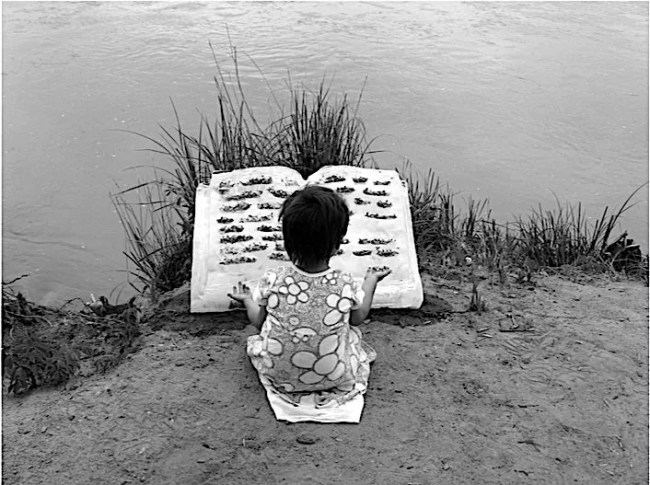
When we moved on to exploring the Case Studies section of the EcoArt in Action book, there was one image that stopped me in my tracks whilst flicking through the pages. Basia Irland’s Ice Receding/Books Reseeding is a fascinating case study of climate art. The image of a young child sitting on the bank of a river, ‘reading’ a book that — in the place where the words and images might be — sprouts lines of living seeds. The child sits with their legs crossed on the floor and their hands open, as if the stories of the living plants might be absorbed into their body from their still presence. I loved this example of climate art, which deftly balances expressing the melting and rising of sea levels with the quenching and reseeding of land.

Showing Basia Irland's 'Cleo Reading TOME II by the Banks of the Río Grande, New Mexico' (2007), one of the ecoart case studies featured in 'Ecoart in Action'.
Basia Irland’s ‘Cleo Reading TOME II by the Banks of the Río Grande, New Mexico’. Photograph: Claire Cote © 2007

This book carved from ice has, as Irland describes, been recreated around the world. In the way of water, my own imagination swells from the idea that each book melts and another book freezes from the same matter, flowing through the world’s water courses. For me, this case study is a beautiful example of an environmentally ‘light touch’ creative project, which is ephemeral in nature, whilst connecting with people and seamlessly communicating its rich complex message — I’m inspired!

It’s not enough to simply make art about the environment; as this book demonstrates, when you consider the lifespan and impact of the work beyond its installation or engagement, that’s ecoart in action.

Claire

I was drawn to Mo Dawley’s Wondering the Artist Book (an ecoinspiracy), as I am currently designing and producing a professional development and wellness support programme for Freelance Artists and this caught my attention. As it states in the overview, “the artist book [is] a consciousness-raising art form that conspires to question weary paradigms by inspiring wonder through multisensory connectivity”.

I was most interested in the different examples that are quoted throughout the case study and enjoyed looking up all the examples (although it must be noted that not all the links were active, which led to an interesting discussion about digital legacies and what happens when websites are no longer active or you leave a place of work and are removed from the website).

I totally resonate with Mo Dawley’s comment “At its essence, the artist book experience helps us to discover that our willingness to be open and engaged is ‘activism'” and I look forward to using the concept of Artist Books within my programme and await, excitedly, the outcome.


Find more

Ecoart in Action: Activities, Case Studies, and Provocations for Classrooms and Communities, edited by Amara Geffen, Ann Rosenthal, Chris Fremantle, and Aviva Rahmani (2022) is published by New Village Press (outside the USA, published here). It is compiled from 67 members of the Ecoart Network, a group of more than 200 internationally established practitioners. The book is also available as an ebook, which may be an easier format to navigate between the various themes for some users. The Ecoart website includes discussion on the book and its ideas, with recordings from various events with various contributors and other Ecoart members.

This has been a review of the book’s second section, which offers 26 different ecoart case studies. For their discussion on Section 1 — with 25 activities for artists to experiment with — see Ecoart Activities – Working With Place & People.

In Ecoart in Action – Provocations to Creative Engagement they share their responses to Section 3, which offers 11 provocations.

Following up on the mentions of the Artist’s Book case studies, you can find interesting examples in an online collection from the National Museum of Women in the Arts in Washington, DC.

In their final post for this collaborative review, Beckie, Claire, Genevieve and Nicky will share their responses to Section 3, which offers 11 ecoart provocations.

Claire Atherton

Claire Atherton

An artist inspired by nature and using paint, clay, fabric and natural materials to explore how we intuitively respond to nature and the environment around us.

Beckie Leach

Beckie Leach

An artist, teacher and storyteller creating experiences for participation with the natural environment, and training as a facilitator in deep listening and the work that reconnects.

Genevieve Rudd

Genevieve Rudd

An artist exploring time and seasons using Cyanotype and Anthotype photographic techniques and leading heritage and environmental community arts projects through drawing, textiles and found materials

Nicky Saunter
Nicky Saunter
A practical activist, campaigner, social entrepreneur and artist with a particular focus on communication, between people and between humans and the rest of the natural world.

Ecoart Activities – Working With Place & People

Artists Claire Atherton, Beckie Leach, Genevieve Rudd and Nicky Saunter have joined up to review Ecoart in Action: Activities, Case Studies and Provocations for Classrooms and Communities. This first of three collaborative posts samples the guide’s ecoart activities.


2,900 words: estimated reading time = 11 minutes + optional: up to 26 mins video clips


ClimateCultures editor Mark Goldthorpe describes the context for this innovative review:

In Autumn 2021, researcher and producer Chris Fremantle and I discussed a review of Ecoart in Action. Chris had co-authored this practical volume with other members of the Ecoart Network to showcase a wide range of ecoart activities, case studies and provocations to use with classrooms and communities. My discussions with interested members suggested a ‘multi-voiced’ approach: a collaborative process, generating dialogue from different practitioners’ insights. This review approach is well suited to the nature of the book — and ClimateCultures is all about stimulating creative conversations. 

Our four artist-reviewers — participatory arts practitioner Claire Atherton; teacher and storyteller Beckie Leach; environmental community arts projects leader Genevieve Rudd; entrepreneurial thinker and practical activist Nicky Saunter — work in different contexts and practices around the UK, based variously in South East London, Wiltshire and Norfolk. They held an ‘orientation’ Zoom call to introduce themselves and discuss possible approaches, before coalescing around the idea of together taking the book’s three parts, producing a blog post for each section.

Ecoart in Action. Cover design: Kevin Stone

A collaborative review – orientation

Their initial conversation brought out the book’s value as an inspiration, a resource with stories of contributors’ different approaches to ecoart, and a rich reference book of examples, artists and theories; there are clearly many ways to approach it.

Claire: “It’s a book you can use to get inspiration from in terms of your own ecoart practice, but also to look at different people’s approaches. To me, it’s a reference book, one you would go to and say ‘I’ve got this project, I want to work with this group of people, what could I do?’”

Nicky: “I found it interesting with some of the theory. I tend to duck away from the theory, and sometimes it can be useful. It was interesting to see where some of those practices came from, even if you don’t really need that in order to ‘do it’. So it being a reference book is useful: there’s intellectual learning, and practical learning and experiential learning that could come out, and I liked that: you don’t have to take all of it but there’s quite a lot there to take.”

Genevieve: “One of things I liked is there’s the practical examples and the process, that’s really important to me: it’s not just an activity that’s plucked out of nowhere, it’s grounded in something, and as you go through there’s the sense of people’s biographies, people’s stories — that it’s rooted. As a resource, it’s ‘dip-in-and-out-able’, because it’s not linear. You can flick it open and find something. And it’s introducing me to practices and artists I wasn’t aware of. For me there was a real sense of discovery, and now there’s so many wormholes to go down and people and projects to look up.”

Beckie: “I think there’s something important about how intangible ecoart is, and it’s not something usually you can go and see in a gallery or there’s not big shows of it because it’s not something that you can show in that way. And that makes it very hard to be aware of what’s going on and to experience it. So there’s something really valuable in seeing all the international practices and how it might be interpreted differently in different cultures.”

Settling on the post-per-section approach, the four decided they’d each scan the different entries in each section, share which ones grabbed them most to work with and then come together for a Zoom to compare experiences and reflect on the book. They’d then send in texts and images, with my role being to bring these together with clips from the Zoom recordings for added depth.

Discussing what use ecoart is in the world, they homed in on the Venn diagram from the book’s introduction, and how — as Claire observed — “It gave it a space in which it exists.”

Ecoart activities: showing a Venn diagram with Ecaort as the intersection of Art, Science and Community. From the book, 'Ecoart in Action'.
Three interconnecting fields of Ecoart practice. Image developed by the editors of Ecoart in Action © 2018

Claire: “It’s difficult when you’re moving away from traditional art practice; where do I sit, who am I? Am I a scientist, am I community worker, am I an artist? Well actually I’m all three of those things, to a certain degree. So that’s how I’ve looked at this book — it can help me to explore those three different facets within myself and bring those together in terms of my practice. … Arguing for its (ecoart’s) value, this book can really help in positioning that.”

Nicky: “We have a system that so clearly splits people between being scientists and being artists. Most people tend one way or another but use both, and can be very strong in both areas, and other areas as well. So I liked that, and it feels inclusive and therefore very positive. Sometimes even the word ‘art’ can feel quite exclusive in itself, to people who feel it’s not their space.”

Our reviewer-artists came at Section 1 with different needs, reflecting some of the diverse uses the book is likely to be engaged in. While Beckie wanted activities to try with her own toddler as an example of a non-formal teaching environment, and Nicky selected ideas to use spontaneously with a couple of young people in her own garden, Genevieve was looking for something to use with a set group of people in a session she already had planned, and Claire wanted the book’s help in creating a workshop she’d been commissioned to deliver in the New Year.

The immersion in Section 1, on ecoart activities, came just before Christmas. As it happened, Beckie couldn’t join in just yet because of family circumstances, so the first of the Zoom sessions went ahead with just Claire, Genevieve and Nicky, with Beckie then able to send in her reflections for this first post.

Planning ecoart activities

Genevieve

I purchased the book when it launched in 2022 and I was excited to have lots of inspiring ecoart ideas to draw from. As a community artist, I work with groups in an iterative way – the previous activity informs the next through reflective practice – so it has been refreshing to have external input to spark ideas. I was invited by a local arts university to run a talk with a workshop element to students, as part of an annual week-long programme encouraging students to try something new, explore different creative practices, and experience new ways of thinking and doing. This was the ideal chance to draw upon this book’s wisdom!

When I was flicking through the book, I found it really useful to have a ‘key’ to each activity in Section 1. For example, I knew I was looking at something suitable for undergraduate or graduate students, for a two-hour session and with an estimated group size of 10. The Perceiving Embeddedness through Collage activity by Cameron Davis stood out for me, as it fitted this context. Whilst the activity began with a walk as a core element for inspiring the activity that followed (which would be my own ‘usual’ format in my participatory arts practice), this wasn’t possible in the format I was delivering. The brief was for a talk with a workshop element, so I instead brought along a range of objects that had been collected in journeys from participants at previous projects and through my own arts practice.

Nicky

I started reading the book with an open mind, wondering which of my various groups might be up for participating in an activity. In the back of my mind, my criteria were: less than a day in timescale; something I could do in my local neighbourhood; low cost as I would not be using it in paid work.

Part 1 of the book is easy to read, with the consistency of layout meaning it is easy to find what each activity entails, how long it might take and what sort of audience it is suitable for. I quickly picked out a few activities that appealed to me and suited the criteria:

      • Award Ribbons for Places: making and giving awards to favourite places in a particular outside area, and sharing your reasons for your award. (This is the one I chose.)
      • Story Circles: people in a group each telling a story on a theme, adding to the overall richness and different points of view. (A bit too verbal and performative for my participants.)
      • Rethinking Fashion: exploring the footprint of fashion and making sustainable alternatives. (Too much time for my participants, but I would love to do this with our local XR group perhaps.)
      • Botanical Art Banners: studying local plants and painting findings onto banners for display. (I love this and think it’s a great way to appeal to different groups who might be interested in detail and science too.)
      • Lines of the Hand: using the lines on the palms of our hands as a starting point for patterns in the wider natural world. (This looks great.)

Claire

After initially being drawn to the activities Awards Ribbons for Places and Perceiving Embeddedness Through Collage, time commitments meant I wasn’t able to deliver either activity before our scheduled chat, so I used the book as a reference tool to provide inspiration for a forthcoming workshop I have been commissioned to deliver in January. Looking through the list of activities was simple and straightforward and I have chosen Story Circles as I feel this has the most relevance to my audience. I will report back on the delivery of this activity in future blog posts.

Showing 'Lines of the Hand', one of the ecoart activities in Ecoart in Action. Photograph by Claire Atherton
An example of ‘Lines of the Hand’, one of ecoart activities in the book that Nicky had considered using and both Genevieve and Claire had previous experience with: using the lines on the palms of our hands as a starting point for patterns in the wider natural world. Photograph: Claire Atherton, from a workshop led by Genevieve Rudd.

I spent a lot of time looking through all the activities to see the audiences, number of participants, duration etc in order to find one that fit the parameters of my commission. It would be helpful to have a grid at the beginning of the book that gives an easy way to drill down, based on audience type, ability (able-bodied / sitting activities), duration etc so that you can see instantly the activities, case studies and provocations that are relevant to your specific brief.

Beckie

I found this section of the book quite intimidating – it is dense and packed full of interesting ideas, but lacking pictures. Actually the premise of a lot of the activities was quite simple and accessible once I got into the text. I was drawn to Creating Rituals, Aborescence: a Score, and Cultivating an Ecocreative Mindset. I wonder if there is a way to format the activities so they are a little easier to read through quickly and adapt for different audiences?

It was challenging to adapt the activities to a non-formal teaching environment — but I think my particular context was also challenging as I wanted to find things I could do with my toddler and all of the activities in the book were designed for older participants and many required a much longer time frame. 

Working with ecoart activities on the ground

Genevieve

To find flow with my adaptation to the Perceiving Embeddedness through Collage activity plan, I framed the exercise around stories: how we’re each guided by different stories, values and experiences, and how this feeds into community arts practice. In my introductory talk, I shared examples of the elements that inform my work (I talked about these as my ‘deep roots’), and shared a couple of case studies of community arts projects that have evolved from these ideas (these are the ‘emerging shoots’). I was inspired by Davis’s ideas in the activity introduction on “embeddedness within this dynamic living whole we call life”, and reinterpreted this with my own drawing and thought process about these relationships.

Showing ecoart activities in context and metaphorically as deep roots and emerging shoots. Image by Genevieve Rudd.
Deep roots & Emerging shoots. Image: Genevieve Rudd © 2022
Ecoart activities: showing a drawing created during the workshop, inspired by the objects used. Image: Genevieve Rudd © 2022
A drawing created during the workshop, inspired by the objects used. Image: Genevieve Rudd © 2022

What I found particularly interesting about working from Davis’s idea was voicing someone else’s ideas and considering my own connection with them. It was useful for me to experience, as a facilitator. The provocations that particularly stood out to me were: “do you feel, in any way, that your object chose you?” and “entertain the notion that your object has presence”.

The group were really responsive to the activity and, whilst collage materials were made available to the group, they all chose to work in drawing throughout. To warm-up, I also added in some extra short exercises, some simple drawing methods that celebrated the qualities of the objects. The group generated some really thoughtful and evocative ideas in response to the objects they chose, including childhood memories, noticing the details and enjoying the texture, and reflecting on how their ideas could find a place in the world. I will certainly be using this activity as a starting point in different contexts, and can also see how it could be adapted for different ages and settings.

Nicky

Within our given timeframe, I happened to have two teenagers staying with me who did not know each other, one of whom is very shy and not strong at communication. I wanted something with a very low entry point, involving minimal art skills and some physical outside activity. The length of time was given as one day, which gives time to delve into the historical and social background of a place, but I found the activity could easily be shortened if focused on a more basic “what do you love here” question. We took about two hours and used my garden, which is large and has wild and woody areas as well as more open traditional lawn spaces, many trees, bushes and sheds. I hoped there would be enough interest for them.

After explaining to the two girls what we would be doing, we walked around the garden, looking for places we particularly liked, making a few comments, touching trees and plants, getting a feel for the place. Having each chosen two places we particularly liked, we went inside to create our own ‘awards’. I also participated, so I wouldn’t be hovering over them too much. I had some basic card, ribbons and string for hanging and paints/pens for decoration or writing that would all be biodegradable and so could be left outside to disappear naturally. I made a sample label-type award to help and one girl copied this, while the other made her own shapes and hangers. They seemed to crack on immediately with an easy understanding of what they were doing, despite one of the girls often finding art activities very difficult as she is unable to think of what to do. The prescriptive nature of this was helpful here.

We then went back outside, circling round to each of our own chosen favourite places, gave our awards and said a few words about why we had chosen this place. It was interesting to see we had all chosen different places and that we all chose trees and shrubs of some kind rather than the built environment. There was an instant connection to nature and an appreciation of its beauty not noticed before.

The girls seemed to find it fun and participated in taking photos and I found it quite moving to see their direct connection with other living organisms.

Using Awards Ribbons for Places in a wooded place. Photographs: Nicky Saunter © 2022 [click on images for full size]

I only touched on the possibilities of this activity, which could include so much more about a place and would work with bigger groups and over longer periods of time. Its flexibility is impressive.

Beckie

In the end we spent some time doing the Creating Rituals activity – making snow rock trolls and feeding the birds and squirrels. This was really fun and feeding the birds and squirrels together has continued as a regular activity – and I am thinking a lot about everyday rituals. 

Ecoart activities: Showing a photo of 'snow rock trolls' by Beckie Leach
Snow rock trolls. Photograph: Beckie Leach © 2022

In the following clips from their Zoom chat, Claire, Genevieve and Nicky share additional insights into how they worked with the ecoart activities in the book:

Clip 1 (6 minutes): Example activity – Awards Ribbons for Places.

Clip 2 (9.5 minutes): Example activity – Lines of the Hand; the book’s value as something you can come at as a starting point, a detailed, theory-led instruction, or a source of interesting thinking to spark your own ideas for activities.

Clip 3 (6.5 minutes): Example activity – Perceiving Embeddedness through Collage; the book as a rich source of references you can follow up.

Clip 4 (4.5 minutes): Using the book as inspiration for planning your work; issues navigating the book for different contexts; example activity – Story Circles.


Find more

Ecoart in Action: Activities, Case Studies, and Provocations for Classrooms and Communities, edited by Amara Geffen, Ann Rosenthal, Chris Fremantle, and Aviva Rahmani (2022) is published by New Village Press (outside the USA, published here). It is compiled from 67 members of the Ecoart Network, a group of more than 200 internationally established practitioners. The book is also available as an ebook, which may be an easier format to navigate between the various themes for some users. The Ecoart website includes discussion on the book and its ideas, with recordings from various events with various contributors and other Ecoart members.

This has been a review of the book’s first section, which offers 25 different ecoart activities.

In Ecoart Case Studies – Theory into Practice, Beckie, Claire, Genevieve and Nicky share their responses to Section 2, which offers 26 ecoart case studies.

In Ecoart in Action – Provocations to Creative Engagement they share their responses to Section 3, which offers 11 provocations.

Assembling the Raven’s Nest is Chris Fremantle‘s review of fellow member Sarah Thomas‘s ecological memoir.

Claire Atherton

Claire Atherton

An artist inspired by nature and using paint, clay, fabric and natural materials to explore how we intuitively respond to nature and the environment around us.

Beckie Leach

Beckie Leach

An artist, teacher and storyteller creating experiences for participation with the natural environment, and training as a facilitator in deep listening and the work that reconnects.

Genevieve Rudd

Genevieve Rudd

An artist exploring time and seasons using Cyanotype and Anthotype photographic techniques and leading heritage and environmental community arts projects through drawing, textiles and found materials

Nicky Saunter
Nicky Saunter
A practical activist, campaigner, social entrepreneur and artist with a particular focus on communication, between people and between humans and the rest of the natural world.