On Being Water Beings — “A Return to Water, Rather Than Dust”

Writer and filmmaker James Murray-White, in conversation with Veronica Strang about her new book, Water Beings, finds connections with his own work at a time when water is under threat and we need to rebalance our elemental relationship.


2,850 words: estimated reading time = 11.5 minutes


“Water serpent beings’ abilities to be monstrous also traverse scales. They can lurk within the individual psyche and represent the seething inner sea of instincts and emotions, or they can reflect tensions and fluid capacities for disorder at a societal level, such as the chaos represented by war or revolution… At a cosmic level, they can represent apocalyptic events – the Flood, the volcanic eruption, the earthquake, the tsunami.”

— Veronica Strang, Water Beings: From Nature Worship to the Environmental Crisis.

Showing the cover of 'Water Beings, by Veronica Strang (published 2023)
‘Water Beings’ by Veronica Strang (2023)

Water in crisis

Recently I’ve been sensing a disconnect between me and water. I live close to an iconic river, in which I learnt to swim and as a teenager had lucrative summer jobs punting tourists along it. However, the River Cam, like most if not all UK water systems, is heavily polluted, and I know of many local cases of humans and dogs who have been seriously unwell after a dip.

The data for the newly designated bathing status at Sheep’s Green in the Newnham area of Cambridge recenly showed high levels of e-coli and other nasties that have leached down from a sewage pumping station some miles away. In addition, the heavy winter, spring and now summer, rains we are getting in this normally drier part of the land often wash off concrete and create epic floods, with run-off washing into the rivers and through the soil.

I’ve just made a short film about one of East Anglia’s chalk streams, the Newmarket Brook, and I have been learning from geologists and hydrologists about chalk streams’ unique qualities and fragility. This one is in varying states of health. I also helped a friend, Tony Eva, make Pure Clean Water, a film about Hobson’s Conduit, which flows from the springs at Nine Wells, by the hospital, through various colleges and into Cambridge. It is in a perilous condition, continually abstracted and contaminated.

Away from just this one city, the human world is at war, and water gets scarce and used as a threat for those being persecuted and bombarded. We’re in a water crisis and if we are to survive as a species and remain equitable with our ecosystem, our relationship with all the elements must rebalance. Recognising this disconnect is the start, and framing our connection to the sacred and to older knowledges feels like an important way forward. A crucial way forward.

It’s timely then to discover Veronica Strang’s body of work, and engage with the growing movement towards river/nature rights. The vast body of human creativity around water and water beings comes to the fore in her book, which really resonates and brings joy to this jaded mind. If many of us unite around care for water and becoming water guardians, from a variety of faith beliefs, political and ecological opinions and none, our human power can make a real difference.

I’ve recently been a participant in two University of Cambridge conferences on water-human relationships where Veronica delivered keynote lectures. Her research straddles anthropology, archaeology, theology, philosophy and more — ranging across human history, our experience with and belief in beings that inhabit watery realms, and our cultural imaginations and psychological systems.

Water Beings – from Nature Worship to the Environmental Crisis is a very deep dive into watery worlds inhabited by a vast array of extraordinary more-than-human beings, and into our imaginative nature as an ancient species. Every society has developed complex and intricate beliefs and knowledges around water beings and their values, roles and responsibilities, including our projections on them as either benign or monstrous. Living alongside them, dreaming of them or even being devoured by them, has given humans a sense of fear, worship, adoration, and veneration. Perhaps now is the time to fully merge our substantive presence on the earth with water creatures?

Water Beings - showing 'Muisca tunjos', votive offerings to ancestral serpents believed to inhabit Lake Guatavita, Colombia, 10th–16th century CE, gold.
Muisca tunjos, votive offerings to ancestral serpents believed to inhabit Lake Guatavita, Colombia, 10th–16th century CE, gold.

A confluence of knowledge and imagination

While grounded in academic scholarship, Water Beings reads like a flowing chronology of connectivity, an important congregation of how the planet’s climate and delicate ecosystems and the human creative impetus to respond all come together. Ultimately, this work is about narrative, fact and fiction: stories and images of water beings are part of our human construct, and now is a time to acknowledge and honour them. What might they mean? What might they anticipate?

The book’s ten chapters categorise types of water entities — irrigating beings, supreme beings, demonised beings, reformed and transformational beings and more — and frame our ways into their study. A key final chapter then sharply focuses on the now, why we are in this condition of crisis and dis-connection, and ways we might return to a closer, healthier framing. I’ll return to that important chapter.

Water Beings - Showing Nyai Blorong, Goddess of the South Sea, Java, before 1928: Unknown artist, watercolour on paper.
Unknown artist, Nyai Blorong, Goddess of the South Sea, Java, before 1928, watercolour on paper.

I was particularly delighted to discover in chapter 8, ‘Supreme Beings’ — as Strang moves forward with her story, societies become urbanised and with that comes monotheistic faith structures and practices — an image from William Blake, ‘Moses erecting the brazen serpent’.

This chimes with an ongoing absorption into Blake’s prophetic work I have through the Finding Blake project, a fascination with his fourfold vision. Here, in an underwater realm, serpents are coiling around humans, literally squeezing the life out of corrupt sinners, while Moses stands watching upwards to the head of the main water serpent. Here is an image of the entwining of watery beings which has become the symbol of medicine and healing: caduceus.

Showing William Blake, Moses Erecting the Brazen Serpent (Nehushtan), c. 1800–1803, pen and watercolour on paper.
William Blake, Moses Erecting the Brazen Serpent (Nehushtan), c. 1800–1803, pen and watercolour on paper.

Water is rare in Blake’s paintings, and where it does appear it often represents the subconscious, a metaphor for yearnings, regrets. Here it is a vessel, dominated by these beings of great power, human victims in their coils — and yet the interplay between them and Moses is highly significant: dominion and dominance. I’m not aware of Blake referencing the Thames in his work, despite living very close to it for most of his life, yet surely it played a role within his unconscious knowledge of the world. I wonder if he saw serpents and watery beings on his daily walks alongside it? I’m led to believe he and his wife Catherine could see the river from their last flat, where he died, which is now under a major London landmark hotel.

Chapter 10, ‘Reformed beings’, flows up to contemporary times, and the use of images of water beings in literature, films and more. This makes me think of the local town of Ely, once a town of eels, fished for and captured in plentiful supply and shipped off to London as a commodity. Now the eels are gone, with the last remaining eel catcher, into mythology of both creature and trade. Eels live on in artworks, sculptures by the river, and paintings aplenty in local galleries and markets — a symbol of this fenland town. Many tales of the fens are marked by the beings that once inhabited waterways since cut as agricultural drains: part of the industrialisation of land reclaimed from watery bog.

‘Turning The Tide’, the final chapter, forms a confluence, bringing together knowledges from countermovements — indigenous activists, campaigners for social and ecological justice, nature-worshipping religious groups, legal activists, and scholars — to include learnings and imaginings from all kinds of creative practitioners, strongly making the case for recognition of the rights of the more-than-human, and water itself: ultimately, the vessel and element that holds us all.

Here, the full power and resonance of the author’s research comes to the present day, and she offers the full weight of her learning and sharing:

“Today, in a world urgently in need of a change in direction, the stories that water serpent beings tell, and their capacities to represent alternate visions of human-non-human relations, may be the most crucial role that they have ever had.

“As our water serpent beings have shown, societies that have achieved long-term sustainability have done so by maintaining steady-state or circular economies, rather than embarking upon spirals of growth and expansion.”  

Returning to my home city of Cambridge, plagued by the constant over-hanging clouds of development and the ‘growth agenda’, this message needs to ring loud — and just maybe the water beings may rise again from the Cam, or emerge in eel-like form to teach humans this lesson of steady state fluid dynamics. Human and watery other.

Showing 28 Double-headed water being in the form of a ship, Viking Age plate brooch from a grave in Lillevang, Bornholm.
Double-headed water being in the form of a ship, Viking Age plate brooch from a grave in Lillevang, Bornholm.

Water Beings: a Q&A with Veronica Strang 

JMW This is such an extraordinary work of rich, deep scholarship. I appreciate greatly the visual, literary and historical journey you take the audience on, and feel enriched by this book. 

VS Thanks for this kind comment — this research has been a wonderful experience for me. Although water beings appear regularly in folklore, ethnography, history and theology, no one has previously researched aquatic deities systematically and comparatively, and venturing into this new research area has been an extraordinary adventure. Water beings have so much to tell us.

JMW Can you share how this study started, and tell us some of your journey following the waters and the watery beings?

VS My research as an anthropologist has always focused on human-environmental relationships, people’s beliefs and values, and particularly their engagements with water. I have explored a range of issues relating to water: ownership, governance and management; conflicts over water; religious beliefs about water; and rights to water, for humans and for non-human species and ecosystems. Much of this work has been in the UK, Australia and New Zealand, and more briefly in Malawi. But the issues around water that interest me recur all around the world.

Water beings swam into my research very early on. In the early 1990s I worked with indigenous Australian communities in Queensland and learned about the Rainbow Serpent that is so central to their lives. A decade in New Zealand, during which I conducted research with Maori iwis on water ownership, rights and management, brought me into contact with their beliefs about rivers as living ancestors, and their taniwha and other water beings. Realising the vital importance of these aquatic deities caused me to pay attention to them elsewhere.

It soon became clear that — since all early human societies worshipped the non-human domain, which we call Nature — water beings (as well as other elemental and non-human ancestral figures) were ubiquitous in human history. And in all of these early societies water beings performed similarly vital connective roles: personifying the creative and potentially destructive powers of water; forming the world and populating with human and non-human beings; providing humans with consciousness and enlightenment; exerting religious authority and, above all, generating water and life in annual cycles of production and reproduction. So for several decades I collected images and narratives about water beings all over the world: feathered and water lily serpents in Central America; African python deities, Arctic undersea beings; Indian nāgas; Japanese cloud dragons and Chinese imperial dragons; North-American Pueblo horned serpents or, on the north-west coast, wolf or bear headed beings; Amazonian giant anacondas and celestial boas; Celtic deities in rivers and springs; Norse sea serpents, and Eastern European rain dragons.

What happened to these water beings over time in different cultural and historical contexts gives us an illuminating narrative about different societal trajectories and transformations in people’s relationships with water and the non-human domain. And so the project grew into the major comparative study that forms the basis of my book. The study shows how growing instrumental control over the environment altered the relations of power between human societies and their environments, and led changes in beliefs and practices in relation to water deities. As humans gained more technological power over water, and felt more ‘god-like’, a fascinating pattern of deity humanisation emerged. This led to the semi-humanisation of water beings, or their displacement by deities in human form, and culminated in the major monotheisms assigning authority to human, male gods and demonising the non-human beings of earlier religions.

JMW Would you explain a little about how you chose to structure the book, and make these categories of beings? And which of the world wide canon of water beings you have researched most captures you? 

VS Water Beings follows the changing patterns in societies’ relationships with water through a comparative study of their water deities. Although these changes happened at different times in different places, the book is loosely chronological, starting with the water beings of the earliest human societies and those that remain central today in place-based indigenous communities. Such societies understood the co-creative role of the non-human domain, manifested in water beings, and sought to have reciprocal and respectful relationships with them. They also maintained relatively egalitarian relationships in their political arrangements, being led by both male and female elders.

The text then moves to examining the effects of greater human control over water, for example in ancient irrigation societies, and considers how their religious and political arrangements changed alongside their new infrastructures. With new hierarchies and centralised governments, power shifted from water deities into the hands of (usually male) priests and deified rulers who became the figures responsible for bringing the rain and maintaining social order.

The following chapters explore how, as societies became more technologically powerful, water beings were made subservient or subsumed by new deities in human form until, with the rise of monotheisms that separated Culture from Nature, and sought dominion over the latter, they were demonised and slain. It also shows how emerging scientific visions disenchanted the world and consigned many nature deities to ‘folklore’. In the final part of the book, however, we see how this alienation from the non-human domain, and the exploitation of other species and environments that it encouraged, has led to the current environmental crisis. There is now an increasing understanding that there is an urgent need for humankind to regain more convivial, and therefore more sustainable, relationships with water, ecosystems, and other living kinds.

The book therefore also examines new visions of water beings in recent and contemporary art, literature and film, in which they are recognised and respected as key manifestations of the co-creative powers of the non-human domain. These emerging images and narratives express people’s growing desire to reconnect more positively with other living kinds and ecosystems.

As for which water beings have captured me the most? I can never choose. My first love was the Australian Rainbow Serpent, but they are all extraordinary and wonderful, beautiful and terrible, and endlessly fascinating. 

JMW Anthropological research gives us an opportunity to look back at historical evidence and to engage with local/cultural knowledges. In this case there is such a desperate need to apply all this knowledge to how we respond to water now, which you explore in some depth in the final chapter. How might we look back in 100 years, with your assessment of the current trajectory of human/water relations? 

VS My research helps, I hope, by showing how, for many millennia, human societies maintained respectful relationships with water and the non-human domain, in which people sought to protect their needs and interests as well as those of human beings. It shows how and why many societies moved away from such egalitarian visions to seek power and dominion over ‘Nature’ and how this increasing inequality led to exploitative and unsustainable practices. Most large societies are still on this trajectory, led by ideologies of growth and expansion, and the belief that yet more technological control will solve the problem. Meanwhile, species and biodiverse habitats continue to disappear, human populations and their use of resources continue to increase, and it seems that humankind is dragging the world towards a painful and potentially critical collapse.

But in almost all societies there are also passionate counter-movements: social and ecological activists and indigenous communities striving to promote alternate ways forward. They share a transformational vision of human and non-human equality, circular economies, more sustainable lifeways, and beliefs and values that recognise the vital co-creative role of the non-human world. These movements are growing: more and more people are pushing their local and national governments and international bodies to make better choices. What the world looks like 100 years from now will depend on whether they can succeed in turning the tide. And in this battle — and it is indeed a battle for human and non-human survival — water beings, as compelling personifications of non-human power and creativity, are a vital narrative device for communicating ideas about how we might engage with water differently.

JMW Do you feel positive about us working with the more-than-human to assert the rights of nature and the rights of water within human law/psychology?

VS How could one feel other than positive about working to uphold the rights of all living kinds in what is fundamentally a shared interconnected world, in which human and non-human wellbeing cannot be separated? This is surely the only rational and ethical position from which it is possible to see a future in which all of us can flourish. So yes, I feel immensely positive, and indeed privileged, to be able to work with these amazing water beings and their wonderful capacities to communicate a more hopeful vision of the future.


Find more

Water Beings – from Nature Worship to the Environmental Crisis by Veronica Strang is published by Reaktion Books (2023). Veronica is a Professor in the School of Anthropology and Museum Ethnography, University of Oxford. You can explore her work — and watch a summary video of a planned TV series based on Water Beings — at her website.

James has made or collaborated on water-related films and projects, including The Waterlight Project, Pure Clean Water (2023), River Of Light (details to be published at The Newmarket Chalk Stream Trust). He took part in the recent Being With Water Otherwise conference, where  Veronica was keynote speaker. You can read Un-tending the World – A Geopoetics of the Wild, his recent review of Two Lights by James Roberts. James is also creator of the Finding Blake film and project; Mark Goldthorpe, ClimateCultures editor, is editor of that website and the Waterlight site. In a recent Waterlight blog post, Religion and Climate Futures – Waterlight Screening & Cambridge Unseen ‘Chalk Walk’, James discusses a recent screening of the Waterlight film at a Cambridge University and LSE joint summer school and the interest in chalk streams and further film making that Waterlight has helped stimulate.

James will be in conversation with Veronica at the Into The Wild gathering in Sussex on 25th August. The festival itself runs 22nd-26th August.

Chalk-streams is a blog by Charles Rangeley-Wilson, a writer and conservationist with a lifelong passion for rivers.

James Murray-White
James Murray-White
A writer and filmmaker linking art forms to dialogue around climate issues, whose practice stretches back to theatre-making.

Un-tending the World — A Geopoetics of the Wild

Writer and filmmaker James Murray-White finds in James Roberts’s ‘Two Lights’ a profound, close observation of the living world: a wise blending between writer and subject that encapsulates the essence of geopoetics as the sensitive expression of reality.


1,780 words: estimated reading time = 7 minutes


“There is a skill in un-tending to our spaces, in patiently leaving them to their own remaking. It’s a skill that is vital now, when the damage we’ve done to earth has become so urgently in need of reversal. Some of the best examples we have are found in old churchyards. We can enter and quietly watch the slow unfurling of the space. Perhaps we can rediscover our sense of the sacred.”

James Roberts’s work has been on my radar since I received and reviewed a copy of his astounding Winged four years ago, as the UK and much of the world remained in lockdown during the Covid pandemic. My gut feeling then was that this book
marked the emergence of an artist whose observation and awareness of the creatures of this earth are precise, startling, and vital. And needed, urgently.
I wrote then that he is ultimately a realist interlocutor, and now I’m convinced.

“In this twilight space that echoes with the sound of the falls there is an elsewhere that is almost touchable. Children, every one a little animist, are born with a sense of mystery in nature, though we educate it out of them. It returns at times, in places like this. “

Here, in his new work, it is James’s words and narrative that lead, with a carefully curated collection of images that stand alongside — supporting, not dominating. And his words track difficult and often unimaginable terrain: his wife’s illness, his depression, and the various ecological crises we are foisting upon our world that are accumulating into a bigger disaster of ecosystem collapses that we cannot understand.

Geopoetics in ink: Showing a Swift from the book 'Two Lights' by James Roberts
Swift from the book ‘Two Lights’ by James Roberts

Geopoetics — seeking a renewed sense of world

All of this has sent James out to walk, wander, explore and observe: bigger journeys in earlier days, across Africa and the Algerian desert, and then more recently closer to home, along rivers and streams meandering through Wales and the Welsh/Herefordshire Marches, woods, fields and edgeland strips and crevices.

“I’m doing my best to imagine a species of bird on a planet like ours, but utterly different, thousands of light years away. I imagine this planet spins on a more oblique axis to its sun so that twilight in its northerly and southerly regions lasts for days. Here evolution has favoured creatures which can create their own light. Its oceans glow, lit by clouds of algae. In its strange forests trees have evolved needles which shine like Christmas decorations. And in its skies are great birds blocking out the pointillist patterns of the surrounding galaxies. The birds have long necks and wide wings. They are covered with phosphorescent feathers, standing out against the sky, like luminous swans or comets.”

This is from the opening chapter, ‘Chasing the Dawn’, tracking the start and spread of each dawn across the world, and demonstrates a deftness, an acuteness, and a sense of an observer-participant in this universe, that really fizzles. It sets this book up beautifully.

He leads us across different terrains and habitats, describing how different species of birds interact with and are moved or motivated by the sun’s rising, and then brings us back to ‘home’ with him, with a placing and drawing of his own terrain, and then an overview of how he came to be there.

The chapter delves into a description of his connection to bird life, birding, or bird knowledges — this is such a wise blending between writer and subject. It is as though we are being gently told or forewarned that from here on in, the writer becomes bird, and will be shamanicly moving between these worlds throughout the book.

Showing 'Watching for Swans' from Two Lights by James Roberts (2023)
‘Watching for Swans’ from Two Lights. Image by James Roberts © 2023

The words flow as black marks making narratives on the page, and then as we turn some pages we find a resonant wash of a bird flying across the whiteness. A swan champions upwards, neck and wings extended (I searched for the right descriptive word there, and championing feels like the very best at my disposal right now), within or against a black/grey gloom or miasma, passing across and over.

I’m influenced by the Scottish poet/philosopher Kenneth White, who advocated an approach to life known as geopoetics, defined by The Scottish Centre for Geopoetics as “seeking a renewed sense of world, a sensitive and intelligent contact with the world by means of a poetics, expressing reality in different ways, through de-conditioning and using all our senses”. This work — I’m unable to call it simply ‘a book’ — encapsulates all of that, glued together with feathers held and dropped by all the avian community flying past James’s close-observing eye.

Swans abound minutes from my house close to a bend in the River Cam, and I too stop and watch and wonder as they glide and move, inhabiting and dominating watery space. There’s a bird interplay, along this hallowed river space, between swans, ducks, and a heron (I assume it’s a single solitary heron, with a defined hunting ground, though there is a ‘heron tree’ a mile or so further down, which is known to house a dozen or so at various times). And of course there’s at times a very active human layer, University and town teams rowing along at speed, their coaches on cycles bellowing from the towpath. Then there’s the below-the-water-line interplay, although with three sewage inputs within a couple of hundred metres any aquatic life is seriously threatened. And yet, the swans live here! They arch, and breed, and feed. Life.

“It’s our fate on this ocean-facing island, if our direction of travel as a culture continues, to face the rising waters, the ever-more-frequently-boiling rivers. We may continue to poison them, to carve, block, and silt them up for a time yet, believing as we do that they are simply our resources to be harnessed. But they will outlast us and their waters will run clean, eventually. There will come a time when this stretch of river will flow wilder than it does now.”

Creation in the ruins

In another striking sequence, within the chapter titled ‘The Church and the Island’, James writes about visits to ancient churches, creates pictures, discusses religious practices, especially asceticism — fascinating histories of hermits Evagrius and Cynog — and even hearing an ethereal voice testing the acoustics in one building.  He then returns us to the ruins, to the wild, and the becoming that transcends facilitated worship towards an other-worldly deity.

Other snapshots he brings us include tragic moments of hatred invested upon the natural world by some of us. Shooting at swans, tearing apart foxes, throwing an owl’s already dead body onto a road to be crushed by vehicles, and the ugly reality of compulsive photography — of everything! — rather than seeing, observing, sensing, listening, and being with.

Two Lights is writings and images in the ruins. The desolation of despoliation, and not knowing the catastrophe that humans are catapulting ourselves towards. And yet, through close witness, and perhaps the collapse of our ego clutching to all we think we know, the avian world is just there — here, right alongside us. Whether or not they might save us is immaterial. Their equal existence is what’s important, and how we may come to notice that through the witnessing experiences, reflections, and decline of our own mortal lives. He really is writing and creating work about passageways through time and air, led by avian species that live their lives in focussed flights of movement, within landscapes of loss and life.

“Across the continent many species are on fire, crops withering in the prolonged drought and vulnerable people dying. Every single community on Earth, human or wild, has now encountered losses caused by the depletion of nature and by global warming. Unless we find a way to heal the damage we’ve done the losses will accelerate. It will take a huge shift in our psyches to achieve this. Every country, city and village, every community and family needs to ask the question: who speaks for wolf, for bear, for fox, for gull, for heron, for kingfisher – for all species, not just our own?”

'Wolf' from Two Lights by James Roberts (2023)
‘Wolf’ from ‘Two Lights’. Image by James Roberts © 2023

Find more

Geopoetics as untending the world: Showing the cover of 'Two Lights' by James Roberts, published in 2023.Two Lights – walking through landscapes of loss and life by writer and artist James Roberts is published by September Publishing (2023).

You can read a sample chapter at the link above — and explore much more at Night River Wood, James Roberts’s website and his Instagram.

In our Quarantine Connections series, you can read A River of Sound, a piece that James Roberts contributed during Week 8 of our communal sharing of creative content and reflections during the UK’s first Covid lockdowns of 2020. James said of this piece: “I wrote this piece a year ago as a response to an increasing awareness of my own gradual loss and also the almost unnoticeable fading of natural sounds from the landscape. A year later there is a noticeable increase of birds in the landscape, and particularly in the surrounding uplands where the curlews are calling more than I’ve ever heard before. I’m not sure if this equates to me being hopeful for the future of declining species, but it shows how very easy it would be for us to give the wild the space it needs to thrive.”

James Murray-White mentions The Scottish Centre for Geopoetics, a network developing an understanding of geopoetics as the creative expression of the Earth. “It looks for signs of those who have attempted to leave ‘the motorway of Western civilisation’ in the past in order to find a new approach to thinking and living … It seeks a new or renewed sense of world, a sense of space, light and energy which is experienced both intellectually, by developing our knowledge, and sensitively, using all our senses to become attuned to the world, and requires both serious study and a certain amount of de-conditioning of ourselves by working on the body-mind.” You canalos explore the International Institute of Geopoetics.

All the Little Gods Surrounding Us, his review of James Roberts’s earlier Winged is one of 14 posts that James Murray-White has written for us. ClimateCultures was seven years old this March! James was one of our first authors back in 2017. Throughout this year we’re delighted to celebrate our anniversary with new posts from some of those inaugural contributors, alongside other returning — and new — ClimateCultures authors.

James Murray-White
James Murray-White
A writer and filmmaker linking art forms to dialogue around climate issues, whose practice stretches back to theatre-making.

Planet Local — Community and Connection

Writer and filmmaker James Murray-White visited the Planet Local Summit, finding in its examples of urgent work around the world to foster being and acting locally a cultural turning towards nature as antidote to climate and ecological breakdown.


1,800 words: estimated reading time = 7 minutes


Once in a while I’m fortunate to attend a gathering — truly in this case an in-gathering of a community — that is so warm and focused that my intuitive heart knows that this is a real crystallisation of the worldwide urgent work going on, and that this will be a big impetus for it to flourish, broaden and deepen.

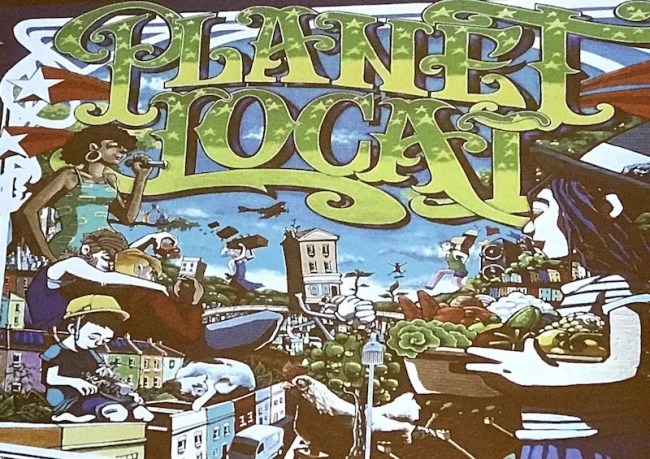
Planet Local - promotion for the summit in Bristol, October 2023

Helena Norberg-Hodge, inspirational founder of Local Futures, the organising NGO, spoke in her opening address of the Planet Local Summit of all attendees being part of the ‘bacterial mycelia’ seeding the crucialness of acknowledging our local belonging. This felt a deep truth and, as I write and reflect, still feels the best take-home gift. I left Bristol feeling energised to return home (currently Cambridge) with many gifts, new and old connections made and refreshed, and a strong motivation to keep working at a local level. I returned specifically to co-host a public engagement event called Dear River, of which more later.

Planet Local - showing speaker Dolma Tsering with Helena Norberg-Hodge at Planet Local.
Speaker Dolma Tsering with Helena Norberg-Hodge at Planet Local. Photograph: James Murray-White © 2023

Planet Local – our need for connection

Helena set the term ‘localisation’ as the antidote to the twin threats of climate and ecological breakdown, happening at speed now in every corner and continent of our planet, and the death march of the industrial/economic system that capitalism has wrought upon the human world. By acknowledging, being and acting locally — in terms of fostering community, emphasising well-being, local food growing, and community care — including finance staying within our local systems, Local Futures describes localisation through these actions as “a cultural turning towards nature” and “an expression of our need for connection — both to others and to all living beings.”

This was the first post-pandemic gathering for me that I felt called to, due to both the high-profile speakers in-person and the sessions sharing case studies of specific local actions and issues. From Helena, Bayo Akomolafe, Morag Gamble, Iain McGilchrist and Charles Eisenstein to many other brilliant engagers, thinkers and philosophers, pragmatists, growers and weavers, the hall at St George’s, associated spin-off rooms — including the cafe/bar, and various rooms at the nearby Folk House venue, and The Tobacco Factory arts centre to which the summit relocated on day three — were all humming with conversations and ideas brewing and being dissected and unpicked.

The big evening conversation on the Friday, a much-hyped conversation between XR co-founder Roger Hallam and ex-Government Minister Zac Goldsmith felt almost a dampening of the enthusiasm during the day: neither seemed to absorb the energy of the gathering, and while they found a kind of middle ground around failures of policy, and the potential of coming bloody revolutions (and the history of previous ones), neither could really offer any threads to hold hope upon.

The community-building that XR and Just Stop Oil has created is hugely commendable and needs anchors and deep seeding across all levels of our societies. I recently heard about an elderly couple who watched Chris Packham’s incisive and timely documentary struggling with his conscience about being arrested for activism and using his powerful voice; and they are now inspired to act, in whatever local way they are able.

On the other hand, Goldsmith’s tale of woe and pressure from lobbyists, including in one notable case the National Farmers Union, against plans for environmental support he was proposing is simply insane, and needs calling out. This is the industrial death machine of chemicals, vested interest, power; the insecurity of the human mind, tragically, that has created this huge schism in a world with so much staggering beauty, potential, and constant flux and change. The next day, Charles Eisenstein’s words — “The idea that the change can happen with the right person in charge is inherently wrong” — reminded me of Goldsmith and Hallam, and also the pedestals and stages we create for leaders to stand on (and fall or get kicked off, because we’re fallible humans!).

Belonging in the human and the natural

Bayo Akomalafe and Iain McGilchrist. Photograph: James Murray-White © 2023

It was a joy to hear philosopher Iain McGilchrist reflect upon the theme, both alone and in conversation with Bayo Akomalafe and then Helena. I’m struck by his phrase:

“We are here to respond to the values of the universe, both in belonging ourselves and as part of the human community; to develop and expand our relationship to the natural world, and, partly as a result of these two practices, to live within divinity.”

A one-to-one conversation with Iain became a beautiful engagement around the theme of grace, which is an enduring talisman for me to hold. I recommend Iain’s The Master & His Emissary for an erudite scientific dissection of the schism in our body-brain and how this permeates across human history.

Food and farming, and the systems that support them, was a key theme of the Summit. With another hat on, I’m a member of the team making Six Inches Of Soil, a new documentary on regenerative agriculture and new entrant farmers, which will be premiered at the Oxford Real Farming Conference early in 2024, so I’ve an interest here, as I hope we all have. It’s increasingly clear that knowing our local farmers and buying direct or from local farmers’ markets, with local supply chains, is vital to planetary health and soil-human survival and potential thriving.

Chris Smaje, smallholder, writer and food activist, based outside Frome, and Jyoti Fernandez, farmer, activist, and co-founder of the Landworker’s Alliance, are tremendous forces for good in this sphere. Both are making change, standing strong against big farm companies and food/meat manipulation and galvanising opinion.

It was refreshing to hear from Nelson Mudzingwa, a Zimbabwean farmer who has struggled to gather seed sovereignty and organic certification across his land and the African continent. By open source seed saving, his collective is developing crop resilience to climate change in their region. Words of hope from a country known for bitter political struggle. Farmer, former head of the Soil Association and now founder of the Sustainable Food Trust, Patrick Holden chaired this session with passion and aplomb, though I found his constant allusions to connections across the CEO worlds, including Bill Gates, distracting and pretty irrelevant given the brilliance within this audience and panel.

Speaking from a new story

A day and a half in, however, I was chomping at the bit for news from really local actions, initiatives and community building from these isles. As a former Bristol resident, I know that this city is bursting with creative social enterprise and strong community efforts, particularly around peri-urban food growing and combatting poverty. It’s a gritty sprawl of communities, and I sadly heard there had been a stabbing that led to a fatality in a neighbourhood nearby on Friday.

I had expected to meet the Street Goat Project bringing their furry troupe up the steps of St George’s to engage with us all. However I found the answer in a brilliant presentation from three members of Frocal in the village of Forest Row, Sussex: in a nutshell, asking themselves “what it might be like if we all lived and acted more locally?” They gave examples of their success and failures and acknowledged that it was a work in progress, albeit a vital effort for these times. I will visit friends there and investigate shortly. Frocal feels like a really valuable and catalysing project.

Darcia Narvaez of The Evolved Nest. Photograph: James Murray-White © 2023

Other takeaways for me include the theme of colonisation of the mind as well as land and countries and continents: Vandana Shiva in her pre-recorded video highlighted this, reminding us that just 600 men created the East India Company treaty (that our monarch signed and sealed) to sail off and colonise that part of the world. Anthropologist Darcia Narvaez picked up on this with her fascinating presentation on her work on Nestedness, agreeing “we are all colonised”, and how might we respond to that knowing? Her thesis continues in the knowledge of our connectedness to, and acceptance of, our heritage.

Keynote speaker Charles Eisenstein delivered a meandering wander through his response to the topic — “ I trust the deployment of the intelligence that my gifts will be useful for” — and concurred with the broader theme that we “need to speak to people from a new story”. He brings a wisdom to our human need to really acknowledge that “technology is reaching deeper and deeper into the core of what it means to be human” and that our “common goal is to rekindle our connections”.

Planet Local.

Sadly, I had to leave after two days, and the third and final day of the summit relocated to another Bristol venue, and I suspect drilled down more into very local UK and Bristolian specifics.

What called me very strongly back to my locale was an event I co-hosted to celebrate water and river systems at this time of waking up to the sorry state most rivers are in, and specifically how they are being abstracted from, and our human sewage dumped within. Dear River was a locally-organised gift to our community, to meet the issue with creativity, grief, and space — space to gather, to listen, to respond, and to ask “what can we do?” After two days of deep stimulation at Planet Local and then this event, I suspect that asking this question is our fullest human response.


Find more

The Planet Local Summit took place from 29th September to 1st October 2023, in Bristol, UK. You can find the full programme, find about the speakers and watch the livestream recording on the Local Futures website.

James highlights Iain McGilchrist’s book The Master & His Emissary (2009). You can find out more at Channel McGilchrist, and James shares his experiences taking part in and filming a retreat with Iain in a post for James’s Finding Blake project on William Blake: Exploring the Divided Brain.

You can read about the work of Water Sensitive Cambridge, the local organisation James has helped create and which organised the Dear River event that took him away from the final day of Planet Local, in this piece from Cambridge Independent: ‘We need to make the shift’: Water Sensitive Cambridge joins Accelerate Cambridge programme’s new cohort.

And Six Inches of Soil is the film James has been working on: “the inspiring story of British farmers standing up against the industrial food system and transforming the way they produce food — to heal the soil, benefit our health and provide for local communities.”

And here on ClimateCultures, you will find many other pieces by James, including his review of fellow member Susan Holliday’s book, Hidden Wonders of the Human Heart.

James Murray-White
James Murray-White
A writer and filmmaker linking art forms to dialogue around climate issues, whose practice stretches back to theatre-making.

Seeing Nature’s Wonders in the Human Heart

Writer and filmmaker James Murray-White reviews fellow member Susan Holliday‘s creative guide, Hidden Wonders of the Human Heart, and finds ‘wise friends on the path’ of seeing deeply into connections, and a fellow traveller in the landscape of human nature.


1,600 words: estimate reading time = approximately 6.5 minutes


“It may be that some little root of the sacred tree still lives. Nourish it then, that it may leaf and bloom and fill with singing birds.”
— Sioux medicine man Black Elk, quoted in Hidden Wonders of the Human Heart.

Lockdown, for me and many, once I’d got through the initial shock of the newness, became an opportunity to really look, listen. To see and to hear.

To hear the birds — in my case the red kites circling the Oxford streets where I spent a large chunk of lockdown time, and to see those birds close up for the first time. And the deer, emboldened by lack of traffic, explored the concrete and the human-inhabited world. It was a time to both see and hear inquisitively at first, and then more deeply, to enjoy the artfulness and insight, and to start to peer further into the nature of the physical, and the metaphysical.

A guide into the human heart

Of course, this is the first part of the process, to see and to hear, followed then by to feel, and to know. Finding guides, wise ones, therapists, gurus, seers — in Buddhism the term is sangha, ‘wise friends on the path’ — is crucial, otherwise we mainline on experience alone.

Showing the cover of Hidden Wonders of the Human Heart
Hidden Wonders of the Human Heart cover: ‘For the Love of Spring’, original artwork © Dee Nickerson

Therapist, photographer, and seer Susan Holliday has produced a clear, close, and wise guide to the process of deeply looking — a ‘when and how to, and what we might encounter’ book that should be alongside us as we navigate pandemics, liminal times, and all our explorations of this, the human journey. Natural insight is key to Holliday’s vision: it is what we all have, and have probably buried or veneered over with the hurly-burly of life. If we unpeel, and find ways back to it — through deep looking, creative expression, and seeing through the grief and the reasons we paper over our own cracks — this heartful insight enables a visionary life full of magic and wonder, connected to and part of the natural ecosystem of all life:

“Disconnected from the vital intelligence of our hearts we look to things, mountains of things, to replenish the void in our being. We plunder the natural world around us to fill the bottomless pit within. Our myopia, it seems, is costing us the earth.”

Holliday shares six client stories from her psychotherapy practice, which go deeply into how she can hold a client’s grief seemingly in her own soul:

“When the decisive moment came, I was able to ‘capture it immediately’ because my spirit was already full of him, full of his grief and pregnant with the shape of the beautiful carefree boy who once tumbled down the hills of his moorland home,” she writes of one client, named here as Jake. Of another, Cassy, Holliday says: “She has wandered into the heart of her own wilderness.”

Her professional beholding of clients, and leading them to a place of change, which she articulates so clearly and incisively, is matched throughout with her understanding of her own striving for seeing, and sensing the world through her own arts practice — through the lens. Although none of her images are found within the book, you can see her work shared on Twitter, and the book is full of references to the writers, artists, and activists who inform her journey.

The art of seeing deeply

Showing the coast and the North Sea, by James Murray-White
Photograph: James Murray-White © 2022

I was delighted when first opening the book to see so many quotes and nods to photographer Bill Brandt, whose black and white explorations of human forms on a beach, and wartime documentary stills, inspired me so much in my early studies in image-making, that has in turn informed the last 20 years as a filmmaker.

Holliday describes herself midway through Hidden Wonders as a “traveller in the landscape of human nature”, and this powerfully resonates with me. Equipped with an MSc in Human Ecology some years ago, I too set out to navigate that path through the hills of both articulated and mediated expression. Time and again, I need to return to that centred space of heartful hearing and insight from the natural worlds within — my own microfauna of emotional fungi and mycelial vessels of coursing blood.

A visual metaphor for the human heart
Photograph: James Murray-White © 2022

“At its best I believe that therapy is akin to painting, to playing an instrument, to speaking a poem or performing a play. Like those it has the potential to lift us, both seer and seen, towards a quality of vision which is equivalent to art, in that it opens us up to the richness, vitality and truth of our existence. So to explore the nature of insight, this book asks what painters, photographers, poets, sculptors and performers have to teach us about seeing deeply.”

There is a flow of both process and experience articulated with these particular clients and their often deeply painful and acutely alive stories, and in this expansive referencing of artists’ understanding of their creative practices, coupled with current advances in neuroscience, perception, and some religious philosophies. However, Hidden Wonders is to my mind a book that someway fills that space where retreating religions in the West have allowed our own creative expansiveness to fill, if we so wish it. It is a strong challenge, not to succumb to the industrial ‘achievement’ mindset, or be lashed by depression in response to systemic failures and collapse and all its latent traps that bind us to its synthetic portals.

I’ve been rereading this book while on a break in England’s North East, staying in a small coastal town ravaged by its mining past. Elemental materials were not long ago hauled out from deep bowels beneath the town, and now, as the pandemic opens into another era here, it is currently awash with regeneration funding, promoting mining museum culture and walking breaks across moors and stunning coastline. Instead of cracking the earth and removing its core, this locality now seems to be all about promoting looking, stretching, walking, seeing, planting, and engaging with a remediated landscape.

I’ve been fixated on walking past all that, nodding and chatting to locals, admiring the many huts of the local pigeon fancying group (some 30,000 birds kept here for racing and message carrying), and getting in some serious beach time along the coast: looking, and seeing past the material, soaking up the elements and seeking to understand myself within this process of stones and sand. Ebb and flow. Time and tide. Human industry and human leisure.

I sense that we, the human-sphere, are in what writer and eco-philosopher Mick Collins calls the ‘transformocene’, not the ‘anthropocene’ as some say, where we as a species rise to transform our reliance upon industrialisation, economic dependence, and the mechanical thinking that has grown from these mindsets. As Fritjof Capra describes ‘the systems view of life’: to finally fully understand our place within the ecology of all things, perhaps returning to the biblical Garden of Eden, or in the holistic sense of animal nature within the Gaian theory, as proposed by James Lovelock et al.

Choosing another path

While this is not a book dealing with climate grief per se, it does point us toward tools of awareness, which is the key to healing from the overload of trauma, and how we respond to and hold news of this climate breakdown and ecological collapse. Holliday acutely picks up on our possible human response of calcifying, or cracking, as “Our human ecology is becoming overheated. A sign that environmental stresses are overwhelming the inherent limits of our nature.”

She wisely returns with another choice: “We could hold the reciprocal qualities of strength and sensitivity in equal regard. We could understand that resilience depends on their intimate correlation.”

Photograph: James Murray-White © 2022

Social movements, uprisings, rebellions, protests — all are about change and resistance to old ways, changing seemingly dominant narratives of doing and exploiting that ultimately damage the earth’s resources and exploit ourselves as a species. These are vital community-building events; whether or not the object of rebellion or resistance is changed, a community has been formed around a ‘thing’, and now the energy exists — and change will come. Transformation will occur, and we will overcome. Transformation of our own selves and our stuck patterns, of subtle griefs and trauma, will happen, and in this vital book, Susan Holliday gives paths and examples to return to our natural insight, and live within ‘the vital ecology of the human heart.’

“Seeing through the heart of our sorrow, we discover a realm of human nature full of hidden wonders. Reconnected to our own source of replenishment and renewal, we might begin to cherish, rather than to plunder, the natural world around us.”


Find more

Hidden Wonders of the Human Heart: How to see through your sorrow – a creative guide to revelation and renewal by Susan Holliday (2021) is published by Troubador Publishing, where you can preview the book. You can find out more about Susan’s work as a psychotherapist and her writing and photography on Twitter @SusanHolliday0 and at susanholliday.co.uk.

James also mentions eco-philosopher Mick Collins and his proposal of the Transformocene in contrast to the concept of the Anthropocene. You can read more in Mark O’Connell’s 2018 Permaculture review of his book The Visionary Spirit. In April, Mick has a new book coming out, The Restorative Spirit, and James has recently been filming Mick for the launch.

James Murray-White
James Murray-White
A writer and filmmaker linking art forms to dialogue around climate issues, whose practice stretches back to theatre-making.