Hey! Earthlings! A Field Guide to Connecting

Artist Andrew Howe shares a collaborative project with fellow artists and migrants to bring together creativity, community and heritage, building trust, reframing narratives in an era of climate crisis and showing we are all earthlings, connected with nature.


2,230 words: estimated reading time = 9 minutes


At a time when the ground beneath us is shifting — politically, ecologically, socially — what does it mean to belong? 

Environmental crises are intensifying and so is human movement — quietly, unevenly, and often without recognition. Creative practice has a vital role to play in response: not simply to draw attention to change, but to hold space for connection, dignity, and shared experience.

Hey! Earthlings! emerged from this context as both a project and a provocation — an invitation to rethink how we connect across difference, and how art might help cultivate belonging in an age of displacement.

Beginnings — from idea to collective action

This project began as an idea some years ago to invite people who have moved across borders, or with connections to other places through family and heritage, to join with us and share stories, sounds, and creative responses through walks and making. A simple idea, but multi-layered and rich with potential to help participants build stronger connections to local nature and heritage and, perhaps, find a new sense of place and belonging in Shropshire.

As conversations developed, a core team formed: myself, as an artist working in sound, painting, printmaking, and other media; Jill Impey – an artist working in video, sound and printmaking; and Jean Atkin – a poet and writer. Together, under Participate Contemporary Artspace CIC (now Participate Co-labs), we shaped the project and secured funding from the National Lottery Heritage Fund in Summer 2024. After a period of careful planning, our activities got underway during Spring/Summer 2025.

Hey! Earthlings! unfolded amid increasing social division in the UK and growing hostility toward migrants and refugees. Against this background, the project took on a deeper significance: to offer a counter-narrative grounded in generosity, creativity, and welcome.

“The project challenged the idea that we live in a world of ‘not enough’. In reality, the Earth is abundant, and people naturally want to contribute meaningfully to the places they live and without the negative narrative and fear-based leadership in the world, humans would naturally share without fear.”
— Amanda Jones, Founder of Shropshire Supports Refugees

Climate Change and the movement of people

Practitioners engaging with climate themes cannot ignore migration.

The relationship between climate change and migration is complex, but the global effects of both phenomena are undeniable. Extreme weather events — floods, storms, droughts — are already forcing millions to move. Slower environmental changes, such as desertification or rising sea levels, impact on livelihoods too. The frequency and severity of these events are increasing.

UNHCR estimates indicate that tens of millions of people are displaced each year by sudden environmental events, while projections produced by the World Bank indicate that by 2050, hundreds of millions could be internally displaced due to long-term climate impacts.

These figures reduce human lives to statistics and do not capture the lived experience of losing home, identity, culture, agency, assets and dignity and the search for belonging.

This is where art has a humanising role to hold spaces where people can speak, create, and connect.

Walking as method: reconnecting through landscape

We held three Hey! Earthlings! creative events at each of two pairs of locations in Shropshire, offering important natural and historic heritage to explore by walking together:

  • Old Oswestry Iron Age Hill Fort and Oswestry Memorial Hall
  • Doctor’s Field countryside site and Darwin House, The Mount, Shrewsbury (Charles Darwin’s birthplace and childhood home).

These are all located within or very close to the towns of Oswestry and Shrewsbury, and so were relatively easily accessible, with the potential for participants to return again in future.

Each of the events comprised an artist-led walk followed by a creative workshop. 

We were inspired by artist Henna Asikainen and her use of walks in projects with refugees and migrants. Walking offers a shared rhythm. It dissolves hierarchies. It allows for informal conversation, chance encounters, quiet reflection and freedom to explore the surrounding landscape.

The group bonded through creativity and shared experience, taking opportunities to translate for each other and share food and song whilst gathered around a fire.

Showing Hey! Earthlings! participants listening to the river. Photo: by Anna Martin 2025. Project by Andrew Howe.
Hey! Earthlings! listening to the river. Photo: Anna Martin © 2025

Each walk started with a grounding meditation. We then listened to the river and trees, we foraged, shared stories and words about nature, and played parachute games. The group(s) learned about local history and nature, sharing oral histories, making films and co-creating art. 

After scrambling over steep ramparts to the top of the Old Oswestry Hillfort, we used a compass at this 360-degree viewpoint to orient ourselves to local landmarks and distant homelands.

These multi-sensory walks enabled people to compare common or shared experiences from other places, and find meaning, empathy and compassion.

“Being in nature evokes a sense of home and belonging (the trees are not lost): the wind is the wind, the rain is the rain, the sun rises for all the stars and moon are the same ones their families see across the world. This reinforced the idea that humans are children of the Earth and of the stars. The Earth has no borders; birds and fish do not need passports.”
— Amanda Jones, Founder of Shropshire Supports Refugees

Hey! Earthlings! Expressing belonging through creativity

Following the walks we returned to workshop venues to respond creatively. 

The approach was intentionally open, flexible and welcoming. We offered printmaking, drawing, writing, small book-making, and other collaborative activities, allowing participants of all ages and abilities to engage in ways that felt comfortable, safe and meaningful.

The workshops were not set up as places of instruction, but as opportunities for exchange. Participants brought their own knowledge, skills, and creative traditions. It was a delight when two young Ukrainian participants asked if they could lead some creative sessions during the workshops — an offer we embraced and celebrated.

The shift from facilitator to co-creator crucially challenges the notion of participants as recipients and instead recognises them as contributors and artists with knowledge to share.

Showing Hey! Earthlings! participants preparing cyanotype prints. Photo: Andrew Howe Project by Andrew Howe.
Hey! Earthlings! participants preparing cyanotype prints. Photo: Andrew Howe © 2025

The resulting artworks were vibrant, layered, and deeply personal. They spoke of journeys, memories, loss, resilience, and joy. They reflected not only the challenges of displacement, but also the richness that diverse communities bring to local contexts.

Building trust: the role of an ethical framework

Underpinning the whole of our project was an ethical framework devised by Jill Impey. This guided our delivery to ensure everyone involved felt safe and welcome, providing a reference or set of prompts to guide actions and relationships throughout from beginning to end.

The ethical framework aims to embed respect, honesty and understanding in working with participants, with our supporting organisations and with each other. When working with people who may have experienced trauma, displacement, or marginalisation, the stakes are high. 

Showing the Hey! Earthlings! Ethical Framework.
Hey! Earthlings! Ethical Framework.

The framework emphasises:

  • Empathy and compassion as foundational values, cultivating a culture of care
  • Inclusion and accessibility to remove barriers to participation
  • Respect and honesty in all interactions
  • Agency and consent, ensuring participants retained control over their stories and contributions
  • Reciprocity, recognising that exchange must be mutual, not extractive.

This framework was not simply theoretical. It informed practical decisions — from how we structured workshops, to how we developed relationships with partner organisations, to how we shared outcomes.

It also provided a crucial anchor for the team, offering a shared language and set of principles to navigate complex situations.

Partnership and participation

The project was made possible through a network of partnerships, including community organisations, cultural institutions, and local authorities.

Participants came from a wide range of backgrounds: young people from Bulgarian schools, asylum seekers from countries including Afghanistan, Iran, Sierra Leone and Vietnam, newly settled Ukrainians, and individuals connected through refugee support networks and community groups.  Each event was tailored towards the particular group attending.

We were very fortunate to be able to appoint two experienced community co-ordinators, Anna Martin and Marina Churm. During project planning, we consulted with various community groups to gauge interest and shape the activities for the events.

Both Anna and Marian proved invaluable to the project as they engaged so positively with groups they had existing connections with and with other community leaders who could help link to a wider network and invite people to work with us. Building trust takes time, sensitivity, and existing relationships. Their work ensured that participants felt welcomed, informed, and supported throughout the process.

The team were supported by local artists, Jamila Walker Thomas and Niki Holmes, and project evaluator and mentor, Cerin Mills.

Meaningful engagement cannot be rushed or assumed. It requires investment in relationships, and often collaboration with those who already hold trust within communities.

Sharing responses: rethinking the ‘Cabinet’

We showed the work made at the events in a travelling cabinet at exhibitions in local libraries and museums. These took place at Oswestry Library; Gateway Arts and Education Centre, Shrewsbury Library and Shropshire Archives. The mobile cabinet is made with reclaimed furniture and is able to host and display a range of materials, sounds and video. Its many drawers, compartments and fold-out doors invite visitors to interact with the cabinet and explore for themselves.

Showing the Hey! Earthlings! cabinet in Shrewsbury library. Photo: Andrew Howe 2025. Project by Andrew Howe.
Hey! Earthlings! cabinet in Shrewsbury library. Photo: Andrew Howe © 2025

Cabinets like this one have long been used to collect and display objects deemed unfamiliar, unusual or exotic — often telling stories about people rather than with them. We aimed to do things differently by inviting the participants to have a stake in curating the exhibition and deciding how to present their work on their own terms.

Rather than turning lives into curiosities, this Cabinet asks us to be curious with empathy — and to reflect on how we might tell richer, more respectful stories in the future.

Shared responses also included a series of collaborative poems edited by Jean Atkin, a short film edited by Jill Impey and a series of soundscapes of stories, reflections and field recordings edited by me. The soundscapes were installed as audio trails at Old Oswestry Hillfort and at Doctor’s Field in Shrewsbury, and can also be streamed from the Participate website.

A Field Guide to Connecting

Towards the end of the project, we prepared a Field Guide to Connecting: a resource for sharing our experience to help other practitioners deliver multi-cultural community arts and heritage projects effectively. 

The Guide is aimed towards:

  • Artist peers/creative practitioners
  • Community workers and organisations
  • Fundraisers seeking funding for similar projects

The Guide provides some key reference sheets, such as the Ethical Framework and Ingredients for Success, which include prompts and practical advice. This is supplemented by information from our Hey! Earthlings! project describing our approach, supported by sample documents.

The document is designed not as a fixed methodology, but as a flexible, adaptable resource — something that can be used, questioned, and reshaped. It moves beyond theory into practice, offering grounded insights into what works, what challenges arise, and how they might be navigated.

Showing the Hey! Earthlings! Field Guide to Connecting
Hey! Earthlings! Field Guide to Connecting

Reframing migration: from crisis to contribution

One of the most powerful shifts within Hey! Earthlings! is its reframing of migration.

“Many displaced people are treated as passive objects, moved like pieces on a chessboard. Used for political games and leverage and discarded when no more use. This results in adding to their deep grief, a sense of betrayal, and a loss of agency. It can feel as traumatising for them as the reason why they are here — just in a different way. Reframing migrants as contributors, creators, and community members is vital for their healing and for the communities that receive them.”
— Amanda Jones, Founder of Shropshire Supports Refugees

Too often, migrants and displaced people are positioned as problems to be solved, burdens to be managed, or victims to be pitied. This narrative not only dehumanises individuals but also obscures their agency, creativity, and potential contributions.

By contrast, Hey! Earthlings! foregrounds participants as creators, collaborators, and community members, and aims to foster more inclusive communities. Our project offered alternative narratives to dominant, often divisive discourses and engaged with global issues through local, embodied experience.

Hey! Earthlings! offers an invitation to recognise ourselves as Earthlings – a condition we share with every living organism inhabiting and depending on a single, fragile planet.


Find more

The projections Andrew gives on displaced people due to long-term climate impacts are from Climate change-induced migration: UK collaboration with international partners by Thomas Weston (September 2023).

You can explore Hey! Earthlings! at the project pages on the Participate Co-labs website — including a download of A Field Guide to Connecting, an 8-minute video, a guided grounding meditation and two audio trails of Old Oswestry Hillfort and Doctor’s Field, consisting of collaborative poems performed by Jean Atkin, shared stories and reflections on the events at the Hillfort, and a soundscape of an imagined Iron Age village. This series of soundscapes was edited by Andrew Howe using field recordings made at the Hillfort, and poems created using words by participants at events and edited by Jean Atkin.

Participate Co-labs (formerly Participate Contemporary Artspace) is an artist-run community interest company, set up in 2015 by Jill Impey, Elizabeth Turner and Keith Ashford to create space for artists to work and exhibit in Shrewsbury, Shropshire.

Shropshire Supports Refugees was established in 2016 to bring relief and support to vulnerable families displaced by unrest in their home countries relocating to Shropshire.

***

From 2026, ClimateCultures is inviting members to say a sentence or two about how they use AI in their work and in their posts for us. We will be exploring this in future posts here and at our ClimateCultures & more Substack.

Andrew – “I occasionally use AI for some functional, time-saving tasks like transcribing spoken word recordings or helping to reduce word count in written drafts before I re-edit into my own style. It can be useful to provide simple, clear summaries or comparisons between options when I have gathered and checked material myself, as I don’t fully trust AI with factual research. In my artist practice, I often move between analogue and digital processes, which I control, but I don’t like the aesthetics of AI-generated imagery and I don’t find it very effective in developing creative ideas.”

Andrew Howe
Andrew Howe
An interdisciplinary artist and project manager using walking and mapping to explore how people interact with places, drawing attention to human entanglements within a multi-species environment.

Mosses and Marshes: Creative Engagement with Wetlands

Artists Andrew Howe and Kim V Goldsmith share the story of their collaborative Mosses and Marshes project, which investigates connections between fragile wetlands and their communities in England and Australia, seeking new interpretations, multiple perspectives and less-heard voices.


2,900 words: estimated reading time = 11.5 minutes


Reimagining the future of fragile wetlands through new contexts and fresh perspectives, while still allowing site specificities and shared commonalities to assert themselves, was the challenge we set ourselves as artists on opposite sides of the globe.

The connection between these landscapes — a lowland peat bog on the border between Wales and North Shropshire in the UK and a seasonally inundated marshland at the tail end of the Macquarie River in central north-west New South Wales, Australia — was made through our collaboration that began when we were paired together in 2018 under the Arts Territory Exchange remote exchange programme initiated by artist/curator Gudrun Filipska in the UK.

We had both worked outside our practices in natural resources and environment sectors for decades, and quickly identified a shared interest in how water and land are managed, in particular in our local but internationally significant wetlands, the Fenns, Whixall and Bettisfield Mosses National Nature Reserve (UK) and Macquarie Marshes (Australia). Both sites are rare habitats vital for combating climate change and supporting biodiversity.

Mosses and Marshes - showing Macquarie Marshes landscape: Lagoon on Burrima, covered in Azolla
Macquarie Marshes landscape: Lagoon on Burrima, covered in Azolla.
Photograph: Kim V. Goldsmith © 2021

The two photos below were taken in 2020 before water arrived in the Marshes after drought (click on images for full size).

Over the next three years, we conducted research and field visits at each site while maintaining an ongoing dialogue, almost entirely by email and digital file-sharing. This informed a series of individual and collaborative artworks. The initial question of what is it that connects us formed an ongoing theme throughout the project, from which sprang many other questions. Taking a holistic approach, we sought new interpretations, multiple perspectives, and less-heard voices in our investigation of these landscapes and how they are valued.

Partnerships and consultation

As the Mosses and Marshes project took shape, we developed partnerships with land managers, environmental scientists, other artists, and local communities. We each secured funding from various sources in Australia and the UK, including a project grant from Arts Council England in 2021 that allowed us to develop a series of arts events, site interventions, community engagement, talks and discussions.

Our aims were to use art to encourage people to build connections with the natural environment, think about human relationships with wetlands, and take part in conversations about the values of wetlands in addressing climate change, biodiversity, water management, as well as some of the less tangible ways, such as cultural and aesthetic values.

In the UK, Andrew partnered with Natural England and Shropshire Wildlife Trust (SWT). Natural England leads the BogLIFE project with Natural Resources Wales and SWT. This six-year project, funded by grants from the EU and The National Lottery Heritage Fund, ends in 2022 with the aim to restore 660 ha of degraded peatland and surrounding peat edge (‘lagg’) back to a functioning, healthy ecosystem. As a separately funded exercise, a derelict former scrapyard on Whixall Moss was purchased by SWT to be cleared and remediated. Over 100 truckloads of waste metals and hazardous materials and around 50,000 tyres were removed from the site.

Mosses and Marshes - showing Whixall Moss, Shropshire UK
Whixall Moss, Shropshire UK
Photograph: Andrew Howe © 2021

On first visit, it can appear that the Mosses are a natural wilderness with few obvious signs of human activity, yet it is the long history of underlying human impact that resonated with both artists as one of the key themes of enquiry in our respective landscapes.

Recognising the importance of past economic and industrial practices, both negatively and positively, needs to sit uncomfortably with our modern aspiration to live in accommodation with Earth’s systems. Providing visual clues of what went on in these wetland places before their reconfigurement is critical in order to remind us of what the Global North is responsible for, what humanity has gained and lost and what more we could lose without more entrenched responses in support of sustainability. 


English Wetlands: Spaces of Nature, Culture, Imagination, Mary Geary et al.

Kim’s partnerships took place in less formal ways, engaging local landholders and community members with connections to the Marshes through gathering and mapping audio stories about those connections, contacting scientists and academics to provide background information to issues she was exploring, and more generally connected other artists and communities in the Macquarie-Castlereagh catchment through meetings about the project and formal presentations.

Creative engagement with the mosses and marshes

Mosses and Marshes has resulted in the creation of new artworks and documentation in a range of formats for local, national, and international audiences — online and in physical exhibitions within each site’s catchment. The artworks have included sound and video installation, prints, and paintings using dyes and paper made with natural materials gathered from the landscape.

Mosses and Marshes - showing 'Territory' art by Andrew Howe (handmade paper made with bracken, reeds, purple moor grass, silver birch and heather)
‘Territory’, Andrew Howe: handmade paper made with bracken, reeds, purple moor grass, silver birch and heather. Photograph: Andrew Howe © 2021

We sought to work closely with the landscape and reveal sounds and sensory experiences not ordinarily encountered by visitors. These included recordings made of sounds encountered at night time, underwater or from within trees.

At the Mosses, a new self-guided public art trail was created using locative media for an immersive sound trail with temporary sculptural waymarkers along the trail, created by artists Elizabeth Turner and Keith Ashford. The sound trail incorporates work by both of us as co-lead artists, including the collaborative I am Walking spoken soundscape, that places the participant in a walk alongside us in the Mosses, and then into the Marshes. This sound trail, and another created in the nearby town of Wem, include soundscapes based on a range of field recordings and contributions from poets and local community members.

In the UK, community engagement centred around a project with Wem Youth Club in partnership with local artists Sue Challis and Kate Johnston and Shropshire Wildlife Trust. Groups of young people took part in site visits and workshops to create new artworks including three seven-metre-long banners that have subsequently been shown in exhibitions at Wem Town Hall and Theatre Severn, Shrewsbury. This highly successful project developed a momentum of its own, with evident desire to create long-term impact by helping the young people involved continue to build confidence in, and a sense of ‘ownership’ of, the landscape.

Mosses and Marshes - showing 'Banners on the Moss', art by Wem Youth Club at the Moss
Wem Youth Club at the Moss – Banners on the Moss
Photograph: Andrew Howe © 2021

Sustainability, for example, is not a law of the universe – ecosystems change, species come and go. It is instead a human construct, based on value judgements – we want to conserve some biodiversity, but not the Coronavirus. The concept only has meaning when choices are made about what timescale to define and how wide a net of interdependencies to consider. It is consequently as much a cultural matter as it is a scientific one.

Science cannot help with decisions about what meaning to give to any experience in the environment, or how to be reconciled to aspects of the natural world that may be spiritually challenging. Some of the deepest truths are expressible only by poetry or metaphor.

– Dave Pritchard, writing in the Foreword to Mosses and Marshes

The project to date has been documented in the Mosses and Marshes project book, published in October 2021. This publication has allowed us to expand on the themes of research and express thoughts that may not otherwise be evident in the artworks.

Showing the Mosses and Marshes book
‘Mosses and Marshes’ book
Photograph: Andrew Howe © 2021

Edited by Dr Liz Charpleix, with a foreword by Dave Pritchard (Ramsar Culture Network, and fellow ClimateCultures member), the Mosses and Marshes book contains contributions from curators Gudrun Filipska (UK) and Jamie-Lea Trindall (Australia), ecological, environmental and cultural writings by Tim Hosking (NSW Department of Planning, Industry and Environment), First Nations educators and artists Fleur and Laurance Magick Denis of Milan Dhiiyaan and Sooty Welsh (Wayilwan Elder/artist), Cathie Sleigh (Shropshire Wildlife Trust), Robert Duff (Natural England), and many other project partners and people from the communities around the Mosses and Marshes. The book cover features an overlay by Sooty Welsh, titled Walking through Country.

This book is beautifully written and presented, with the clever use of QR codes, that allows the reader to experience through sound and vision this beauty. It encouraged me to further explore the effects of colonisation on this diverse landscape, to the present-day challenges of climate change. Positively thought-provoking and beautiful.

– Natalie Cutler, an interested reader with historical family connections to the Marshes, Sydney Australia

New voices, new stories

The cultural exchange came to a significant meeting point in November 2021, through an international online panel discussion on the topic of ‘Alternative ways of understanding and valuing special environments to help shape their future’. The event brought together a group of natural resource managers, scientists, academics, and cultural consultants from Australia and the UK, all with a wealth of experience in land and natural resource management issues. Facilitated by Jessica Moore of Dubbo Regional Council, the panellists included Tim Hosking, Kate Mildner, Fleur and Laurance Magick Dennis of Milan Dhiiyaan from Australia, and Dave Pritchard, Dr Tim Acott, and Robert Duff from the UK, who discussed six questions put to them as pre-recorded videos by provocateurs from both countries — all of whom had connections to the wetlands.

From the panel event, it was evident the Mosses and Marshes may be separated by over 10 thousand miles, but many of the issues impacting them are not so different. Land ownership, access to land, and the legacy of Enclosure Acts and colonialism have been lenses through which we’ve been able to look at how the sites have been used for extracting financial value from agriculture and or peat.

Mosses and Marshes - showing artist Kim V. Goldsmith recording underwater video on “Burrima” near the North Marsh, Macquarie Marshes.
Kim V. Goldsmith recording underwater video on “Burrima” near the North Marsh, Macquarie Marshes, May 2020.

It also created an opportunity for under-represented voices to be heard. The stories of Aboriginal access to the wetlands, shared by Fleur and Laurance Magick Dennis of Milan Dhiiyaan, were so important. Speaking powerfully, with an emotional depth that could only come from an intimate, authentic connection with the land and its people, Fleur and Laurance referenced missing sounds in the landscape, the urgent need for resources to gather legitimate community representation, and a fundamental lack of access to Country. It was uncomfortable, but necessary, listening.

What they had to say aligned with other indigenous cultures across the globe around honouring what the Earth provides, taking only what is needed and acknowledging that we are all custodians and not owners of the land.

These basic sustainable principles are in direct opposition to prevailing systems for exploiting land and resources in most parts of the world. It seems like an impossible seismic shift is needed to change attitudes towards these basic principles in a river system with so many competing interests like the Marshes. Maybe in the interim, it’s about accepting that scientific and evidence-based languages aren’t the only way of knowing and doing, particularly if we accept that language often shapes behaviours.

Mosses and Marshes - showing art by Andrew Howe, 'Fenns Old Works' (former peat processing works at Fenn’s Moss).
‘Fenns Old Works’ (former peat processing works at Fenn’s Moss),
Andrew Howe: linocut peat ink © 2021

Complex issues require long-term thinking

The environmental issues of each site do not always present clear-cut solutions, with issues being more nuanced than they first appear. It is also questionable as to whether pragmatic solutions, allowing for as many concerns as possible to be considered, is ultimately best.

On the regulated Macquarie River of New South Wales, there are many competing interests impacting the Macquarie Marshes further downstream. River water supports towns, livestock and domestic users, industry, irrigated agriculture, the environment and recreational users. Taking a pragmatic, top-down approach using one set of established values could result in some wetland areas of the wider Marsh landscape being allowed to become too degraded to conserve. But as Laurance Magick Dennis said during the panel event: “If you’re a family and you’re walking in the bush and some of the family can’t make the walk and it’s up to you to look after those individuals, what are you going to do? Are you going to leave them behind to suffer, to starve, to die of thirst? That’s exactly what will happen to our river systems and the ecosystems around our wetlands. If we don’t look after those, they’ll be gone forever.” His point was that the parts form a whole – a family. Like a functional family or community, we’re all needed in the decision-making.

Through our work on the project, we came to understand that wilding is not necessarily a solution on its own without careful human guidance and management, and for that it is vital that local communities have an awareness of the issues, to understand where compromise might be acceptable, in addition to having access and opportunities to develop or regain a sense of ‘ownership’ in the landscape.

At the Mosses, for example, as part of their ongoing work towards restoring the peat bog, Natural England and partners are re-establishing the waterlogged, low nutrient conditions necessary for Sphagnum moss to flourish. However, it is acknowledged that some means of site management may need to continue beyond the BogLIFE project to control the growth of purple moor-grass which rapidly covers the bog surface and inhibits the Sphagnum moss. This is occurring more vigorously due to the increase in air-borne ammoniacal nutrients arising from nearby farms.

From several perspectives, we have identified how the landscapes must be considered in relation to deep time — both in terms of their prehistory and from the viewpoint of future generations. The video developed by Kim for the project’s exhibitions, An Ancient Land: a history of the wetland in chapters, references how Australia’s landscape formed over millions of years came to be explored, surveyed, staked, mapped, named, carved up and farmed by those with the sense and sensibilities of strangers in a foreign land.

Natural England knows that the work they are doing today may not come fully into effect for many centuries to come. So, how can people be encouraged to consider these timescales when the issues of today seem so urgent?

Unfinished work

The Mosses and Marshes project has broadened local, national and international recognition of these wetlands and their cultural and environmental importance. It has provided a platform from which to develop further artist residencies and projects involving the arts linked to the wetlands. We strongly believe our international exchange has created new contexts for each site that considers some of those intangible values previously overlooked, and it has started to bring fresh perspectives to the fore while recognising localised differences between our two wetlands.

New presentations of our creative work open in the Australian capital at M16 Artspace in Canberra, in April 2022, and at Outback Arts in Coonamble, New South Wales, in May. A programme of public events will continue in both the UK and Australia. The project is also entering a new phase we’ve called Values. Voices. Action., which follows up some of the key issues raised in the discussion panel. Those first tentative questions we asked ourselves back in 2018 have led to a range of actions that have given agency to a multitude of voices now invigorating this evolving project.


Find more

The Mosses and Marshes book is available at both artists’ websites, with northern hemisphere sales handled by Andrew and southern hemisphere by Kim: Of the Mosses – Andrew Howe & EcoPULSE – Kim V. Goldsmith

The exhibition at M16 Artspace in Canberra, Australia ran to 1st May, and then at Outback Arts in Coonamble, New South Wales, until 3rd June.

Kim V. Goldsmith (in Australia) and Andrew Howe (in the UK) began working together in 2018, having been paired together through the Arts Territory Exchange remote collaboration programme. Both the artists conducted research and on-site work in their respective wetlands that informed the creation of a series of individual and collaborative artworks for exhibitions in the UK and Australia under the title Mosses and Marshes.

Kim is an environmental artist and content producer based in the Central West of NSW, Australia. She has 30 years’ experience working across rural and regional Australia in media and marketing communications. As an artist, Kim has a keen interest in the environment and sustainable regional futures that she explores through a range of digital media and writing.

Kim acknowledges and respects the Traditional Owners and Custodians of the lands on which she works and lives.

Andrew is an interdisciplinary artist and project manager, based in Shrewsbury, working solo and in collaboration with other practitioners and community groups. He uses walking and mapping to explore how people interact with places, informed by over 30 years’ experience in engineering and environmental consulting. His practice includes painting, collage, photography, printmaking, books, and digital media.

You can read Andrew’s earlier post for ClimateCultures, A Personal History of the Anthropocene – Three Objects #13, where his objects include a bitumen spill from an old tanker on the former industrial land at the Fenn’s, Whixall & Bettisfield Mosses National Nature Reserve.

English Wetlands: Spaces of Nature, Culture, Imagination, edited by Mary Gearey, Andrew Church & Neil Ravenscroft (2020) is published by Palgrave Macmillan.

You can read about the Marches Mosses BogLIFE project at Fenn’s, Whixall & Bettisfield Mosses National Nature Reserves and Wem Moss Nature Reserve at the Marches Mosses BogLIFE website.

Andrew Howe
Andrew Howe
An interdisciplinary artist and project manager using walking and mapping to explore how people interact with places, drawing attention to human entanglements within a multi-species environment.

Kim V. Goldsmith

Kim V. Goldsmith

An artist exploring layers of nuance, complexity and hidden elements to present rural, regional and remote landscapes and communities in ways that make the familiar, unfamiliar.

A Personal Anthropocene History #13: Slipware Pottery, Bitumen Tanker, Acorn

Interdisciplinary artist Andrew Howe shares three objects that chart material flows in time. Slipware pottery, an acorn and a bitumen spill offer fragmentary stories entwined with present experience and imaginings of past and future in the same moment.


1,310 words: estimated reading time = 5 minutes


The challenge: the Anthropocene — the suggested Age of Human that our species has initiated — has a complex past, present and future, and there are many versions. What three objects evoke the unfolding of human-caused environmental and climate change for you? View other contributions at A History of the Anthropocene in 50 Objects.

***

The recording of history is a collective narrative of personal memories and subjective interpretations of objective data. And memories are the internal stories we create from fragments which become entwined with present experience and our imaginings of the future, always in the same moment. As I thought about identifying objects from the past, present and future, I could only see them as materials on a journey flowing through time. This flow need not be considered as a linear process but as a cycle, perhaps a little like the river cycle, in that all time can co-exist simultaneously but in different locations.

Based on my recent experiences out walking, objects that represent the Anthropocene in the present time, perhaps more than any other, are the proliferating numbers of discarded face masks and discarded dog shit bags (DDSBs) lying on pavements, spilling out from litter bins or festooned from trees and bushes. But I wished no connection with these objects, whereas each of the three objects I selected have specific resonances for me with the past, present and future.

Washed downstream

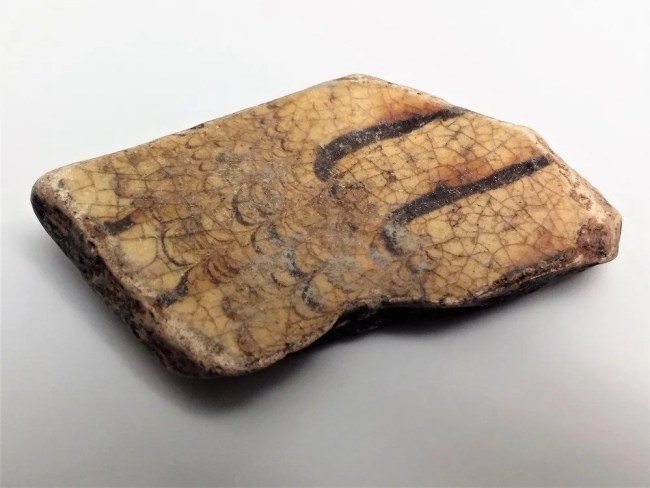
My first object is a fragment of brown slipware pottery, one of a handful I gathered last year while mud-larking on a pebble bank at the edge of the River Severn, downstream of Shrewsbury town centre.

Slipware pottery fragment from the River Severn
Photograph: Andrew Howe © 2020

An informed acquaintance suggested to me that the brown and amber pieces were most likely 17th or 18th Century combed slipware. I was intrigued by its unknowable journey from formation of the clay, very likely a result of glaciation, and extraction for making into a pot. It was then used in someone’s house in Shrewsbury, maybe even one of the Tudor timbered mansions that still stand in the town centre. At some point it was lost and broken and found its way into the river. Over the years, it has been washed downstream, gradually rounding off the edges until I picked it up. How will my intervention change its course of flow?

Ruptured nature in peatbog and bitumen

I encountered the second object whilst researching a project at the Fenn’s, Whixall & Bettisfield Mosses National Nature Reserve, the UK’s third-largest raised peatbog. Within the wetland nature reserve, there was a car breaker’s yard that operated for many years until the site was taken over by the Shropshire Wildlife Trust. The stark juxtaposition of the scrapyard against the remote wetland landscape had fascinated me for some time.

Artefacts 6×6
Photograph: Andrew Howe © 2020
Tyre mountain
Photograph: Andrew Howe © 2020
Artefact 26
Photograph: Andrew Howe © 2020

Shortly after many of the crushed cars had been removed from the site, I made a visit to observe the mountains of remaining tyres and thousands of mangled fragments of plastic and metal car parts. I collected these like archaeological finds. Then entering a thicket between the scrapyard and peatbog, I saw a large bitumen tanker part-suspended in amongst the trees, as if it had been driven in at speed and simply left.

Showing a bitumen tanker dumped in woods
Tanker in the wood
Photograph: Andrew Howe © 2020

When I returned a few months later, the tanker had been separated from its cab and moved, as part of the ongoing clean-up process, to a position on the concrete hardstanding in the main scrapyard, which was being cleared for restoration by covering with topsoil. In the warmer weather, the bitumen leaked from ruptures in the rusted steel carcass and spread out in mesmerising black pools, its ‘skin’ intricately marked and rippled.

Showing bitumen spill from a tanker
Tanker
Photograph: Andrew Howe © 2020
Showing a black pools of bitumen, its 'skin' intricately marked and rippled.
Bitumen
Photograph: Andrew Howe © 2020

Bitumen can be found naturally or produced via the fractional distillation of petroleum. This natural hydrocarbon seemed to be reaching out, as if trying to recombine with the peat below and complete a cycle interrupted by human processing. The sculptural tanker is a powerful artwork in itself, symbolic of the human exploitation of petroleum and car manufacture.

In my early discussions with the Shropshire Wildlife Trust, there was general agreement that we, as a society, should take responsibility and acknowledge the legacy of human impact on the environment, perhaps by leaving some of the dereliction in place. However, while bitumen is widely used as a construction material, it has some chronic toxicity, it is a potential carcinogen and the tanker was regarded as a hazardous waste. The metal structure was also regarded as unsafe, so the decision was regretfully made to retain the tanker on the concrete and cover it with soil as protection.

Acorn to oak, and uncertain futures

The final object is an acorn. This particular acorn came into my possession during a heritage project where I was trying to locate trees more than 200 years old in Telford; trees that could have been witness to the battle of Cinderloo, an industrial dispute in 1821. Around 3,000 miners marched in protest against savage wage cuts and they shut down ironworks before coming into conflict with the Shropshire Yeomanry, resulting in two fatalities and nine arrests, with one man hanged for felonious riot.

Acorn
Photograph: Andrew Howe © 2020

There are many woodlands in Telford, growing over the ruins of industries that date back to the start of the Industrial Revolution. Only a few of the trees are as old as 200 years though, so the acorn I collected from one old oak in Coalbrookdale provided me with the potential to create a special connection. By planting the acorn, it may grow and live on beyond a normal human lifetime to make a connection spanning between the origins of the Anthropocene and an uncertain future.

The centuries-old relationship between the English and oak woods is at the heart of national identity; once integral to peasant livelihoods, Royal hunting forests and naval shipbuilding. Oak has abundant uses as a strong and durable construction timber, as fuel, as animal fodder, for the tanning of leather and in production of ink, but its value is increasingly recognised for sequestering carbon and sustaining biodiverse flora and fauna in its branches and in its root systems. Humans will need to rebalance the values of oak between a commodity and as a living guardian, if we are to begin regaining some harmony with the more-than-human for our own survival.

Witness, Coalbrookdale Oak: oak gall ink on paper
Image: Andrew Howe © 2020

Find more

You can explore Fenn’s, Whixall & Bettisfield Mosses National Nature Reserve, and the Marches Mosses of which it is a part, at The Meres and Mosses site. And you can find out more about Andrew’s own work with the Mosses and Marshes project at Of the Mosses. including an introduction to the site: Tracing Human history across the Moss.

Bitumen, a sticky, black, highly viscous liquid or semi-solid form of petroleum, is also known as asphalt, and is mainly used in road and other construction, although its natural form was historically used for waterproofing and as an adhesive as far back as 5,000 BCE. Runoff from roads can cause water pollution from bitumen and, as this article from MedicineNet explains, Hot asphalt causes a lot of air pollution. “As it heats up, asphalt releases chemical compounds that contribute to air pollution … Sunlight plays a key role in these asphalt emissions, with even moderate levels of sunshine tripling the release of air pollutants.”

You can learn more about the history of the Cinderloo Uprising in Dawley, Telford and the heritage project led by community group Cinderloo 1821. 

Andrew Howe
Andrew Howe
An interdisciplinary artist and project manager using walking and mapping to explore how people interact with places, drawing attention to human entanglements within a multi-species environment.