
 Artist and writer Nicky Saunter shares her recent photographic exhibition and the artist-activist collaboration that brought the wild into our city streets, revealing humans as creatures in a world that allows less space than ever for the natural.
1,560 words: estimated reading time = 6 minutes
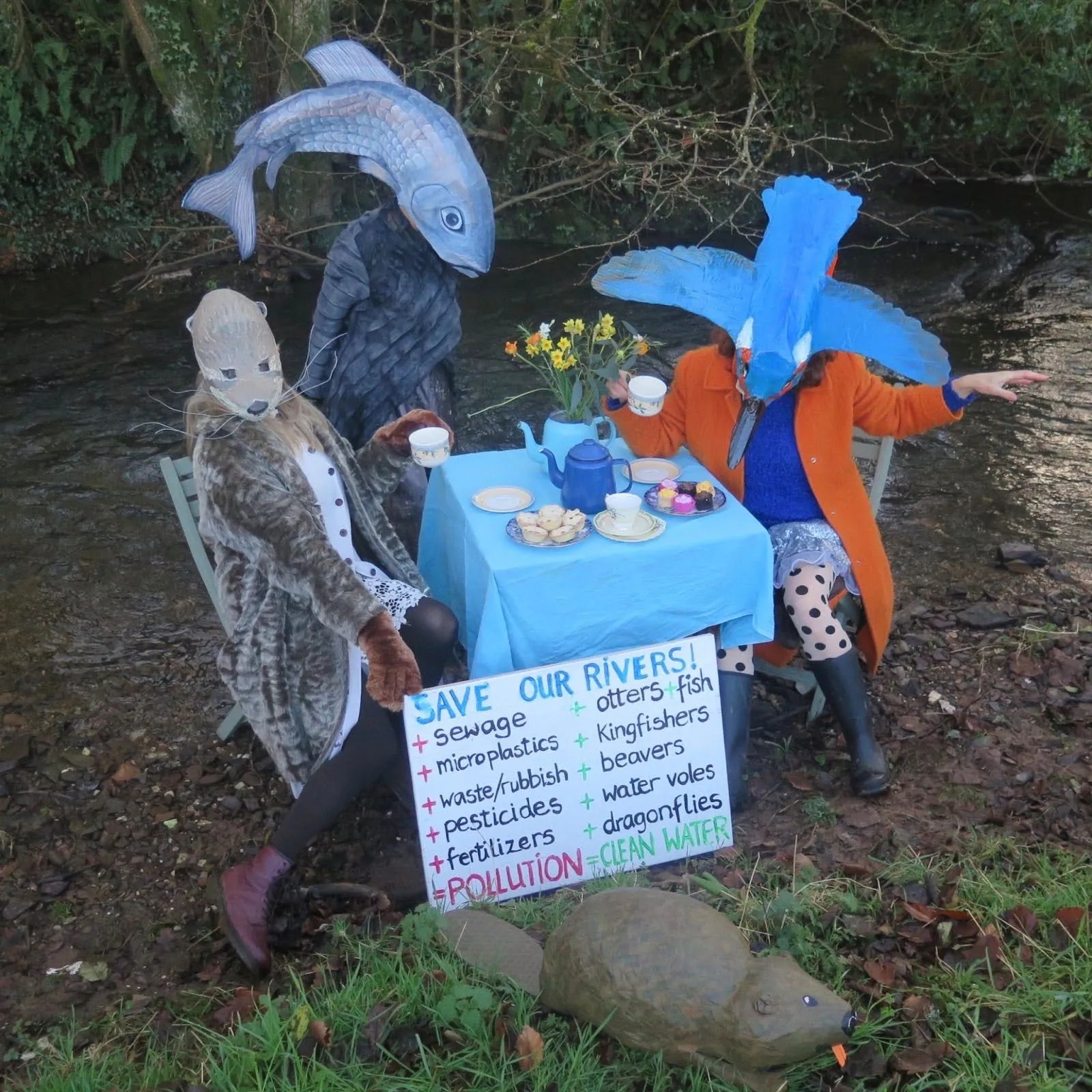
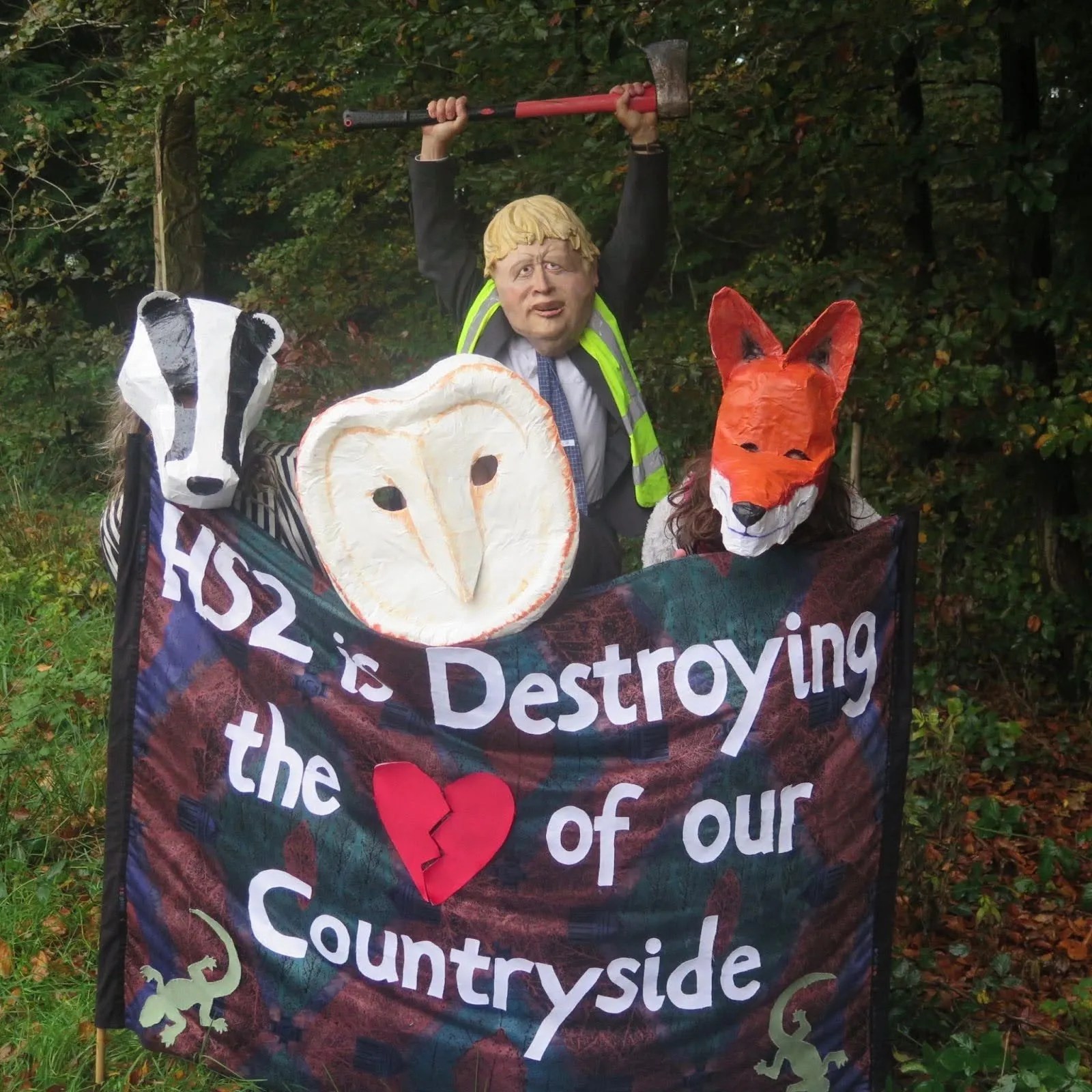
Back in the mists of time during the first pandemic lockdown, I became involved with a bunch of local creative people who were also into drumming and protesting about climate change with Extinction Rebellion. As a small group of enthusiastic activists based in a small west Somerset rural town, we were conscious that if we were to invest the time, energy and money in travelling to London to join other protesters, we should make it worthwhile by making as big an impact as possible. Hence the idea to make big animal masks that would transform us into creatures other than humans. We wanted to take nature into the protest and chose to become native animals that we saw in our countryside.
We are creatures: supported in a web of life
Sadly, today there is often more wildlife in cities and towns than in our increasingly sterile and denuded landscape. We rarely see large mammals such as foxes, insects are few around sprayed crop fields and amphibians are struggling with a lack of ponds. A study published by Buglife in 2020 showed that insects are in steep decline worldwide – with an average loss of over 8% per decade. Studies using other methods have produced even higher figures for insect population decline of over 2% per year. And we cannot survive without insects, for they form a critical part of the global food chain and maintain the soils we need to grow our food. There are some long words in the pyramid chart below, but you get the message: we need a lot of insect life at the bottom in order to support our food system at the top. For example, three-quarters of our food crops depend on insects for pollination. Without them we won’t survive for long.
“But man is a part of nature, and his war against nature is inevitably a war against himself.”
– Rachel Carson (Scientist and author of Silent Spring, the book that brought the dangers of pesticides to the general public in the 1960s.

Here is a BBC Ideas film that explains it really well too – and with beautiful animation and a voiceover by the brilliant bee man Dave Goulson: Why insects are so crucial to life on Earth | BBC Ideas.
With the help of a fellow local artist, Jenni Dutton, who is extremely skilled in both creating and teaching, we made a range of masks that went on parades, demonstrations and protests around the country. It is amazing what can be made from corrugated cardboard boxes, newspaper, glue and paint. From the fox to the frog, the owl to the dragonfly, these creatures came alive and danced and drummed alongside the humans. They brought a little of the wild into our city streets. It felt like a reminder of our ecological crisis, which was often forgotten in the headlines of carbon, energy and climate. After all, humans are just one of the many creatures affected by climate change, although we are the only ones to have caused it.
When people disappeared
There is less space than ever for wildlife in our world today. More concrete and less earth, more chemicals and fewer insects. In the pandemic, without the endless noise of machinery and traffic, many of us heard the birds again and some experienced the dawn chorus for the first time. People saw some strange and wonderful sights as animals wandered fearlessly into spaces usually occupied by humans, like car parks and city streets. Security cameras caught bemused-looking deer wondering where the humans had all gone. It was surprising how quickly the wildlife found its feet and began to use paths and places long abandoned to people.
We talk endlessly about our need for connection with nature, but it feels as if this is always on our own terms. The wild is fabulous in the right place at the right time, leaving no mess and creating no inconvenience for humans. Mud must stay in the field — although of course it runs down the road as the rate of rainfall increases and blocks our drains. Weeds must stay out of gardens so that plants we choose to call flowers can flourish, since they might be weak and easily overcome if left to fend for themselves. Animals that are potentially dangerous, from the snake to the wolf, are banished, hunted, slaughtered in a range of grisly ways and treated as unworthy of life in comparison with humans. Creatures that we find unappealing or are too good at surviving alongside us and our mess are designated as ‘vermin’. I wonder if — according to the data of who is a real danger to who and how much filth they each create — if we aren’t perhaps the ultimate vermin. Superrats even. After all, we are also creatures.
Wearing an animal mask for a street protest was an interesting experience, as from inside we could see the reactions of people around us. Some laughed, lots took photos, many smiled and children often waved or held out their hands. Recognition was immediate and response warm — something animals help us to do is to connect with each other, perhaps? I think of the ease with which dog walkers start conversations and even become friends with someone they would otherwise just pass in a park or street.
Black and white
There is something about monochrome photography that gets to the very essence of a thing. I don’t know why this is, but time and again, I see the impact of black and white images cut through the constant colour and clatter of today’s busy world and strike at the heart of the matter. This is particularly true of portraits, and therefore my choice to make a series of monochrome photographic prints of people wearing animal masks at night going about their business in our local small town.
The very first image was a take on the Beatles album cover on the zebra crossing at Abbey Road. It was a cold winter night and we had fun arranging ourselves artfully across the road, only to have to scuttle out of the way when cars came along — just like real animals. The final image was both funny and poignant too — people-creatures trying to claim back some space in our world.

I went on to take a series of ten images, imagining what might happen at night in a town as creatures show their faces in our human spaces. They are strong, confident and do not seem frightened of us. Have they come to take over? Or are they our almost forgotten selves walking the streets as we lie sleeping in our beds? Some are funny, and others are creepy or disturbing.
These images became part of an exhibition in a studio at East Quay in Watchet, an amazing art venue created by a local group of people called The Onion Collective. The main building houses national exhibitions, often with a local connection or collaboration, while several containers outside house artists’ studios. My exhibition was in one of these, loaned by the Somerset conceptual artist Jenni Dutton.


One of the things that visitors commented on most was how the combination of my statement and photos challenged their view of their own connection to nature. As we are in a rural area, many people recalled the pandemic quiet and how they took walks and saw wildlife differently — and how that had disappeared again so quickly once ‘normal’ life resumed. I had written about how my images intend to ask us to think differently about ourselves as animals and about the rest of the natural world that surrounds us and yet remains invisible in our daily lives. We see a beautiful vista, the blossom on a tree or enjoy the sound of birdsong, but rarely notice an ancient lichen, a pondskater on a forgotten pool or the perfection of a dandelion seed head. Our filters are set by our culture, which values some things randomly over others. Most of them need challenging.
Nicky Saunter is a writer and artist who uses mostly monochrome photography as part of her practice. She focuses on emotional connection to issues of the day, from women’s rights and colonialism to water pollution. She often features nature and in particular the wildlife of Somerset. More of her work — including the We Are Creatures series — can be seen at Through the Window.
You can read the Buglife report Nicky mentions in this April 2020 post at their site: We are losing 9% of insects per decade.
Nicky mentions multimedia artist Jenni Dutton and you can explore her work here. And you can find out more about the work of the Onion Collective, a place-based social enterprise in the small coastal town of Watchet in Somerset, “working to reconfigure economics from the perspective of our attachments to community, culture, nature and the future we hope for.”

Nicky Saunter